Do you have days when you feel like hitting the “reset” button?
It’s the first few days back after the Easter break, with school restarting in the UK.
Perhaps you have been away or have been working extra hard whilst others have been away.
Perhaps you’ve just had a stressful encounter, conversation, or email.
3-steps to Reset
Try this for a moment of pause and reset.
I called this a “reset” in this post, inspired by one of my participants in my Mindfulness research study, as he says this has been a powerful way for him to “reset” and change the tone of his day.
It’s a Mindfulness technique called the 3-Step Breathing Space, from the Mindfulness-Based Cognitive Therapy course.
3-step Breathing Space
 |
Set up: Posture change and three slow long exhales to settle into the posture
Make a deliberate change to your posture as you start, e.g. adjusting your chair, sitting upright.
Take 3 deep breaths, and an extra long and slow exhale for three cycles of breaths, as you prepare to start.
Step 1: Open awareness
Take a minute now, to notice what is here at this moment.
What do you observe in this moment with your emotions, the sensations of your body with these emotions, your thoughts patterns or concerns?
Step 2: Gathering and anchoring on your breath
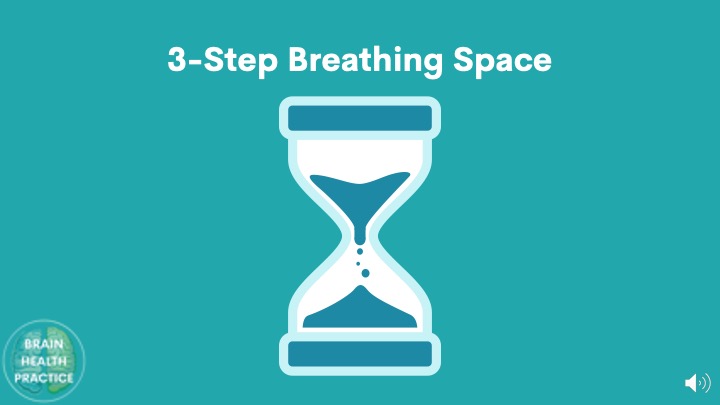
Like the hour-glass in the image above, direct your attention now to your breath.
SImply follow the natural flow of your breath, without changing it.
It can help to count as you follow your breath, e.g. inhale one (followed by noticing the pause), exhale one (then notice the pause), inhale two (then notice the pause), exhale two, and so and so forth.
Take about a minute here. Or, instead of looking at the clock, you can count for 10 cycles of breaths, for example.
Step 3: Expanding your awareness
Expand the spotlight of awareness, from your breath, to your whole body.
Notice the sensation of your body sitting. Your posture, your facial expression.
If you have a sense of tension in any part of your body, imagine your breath reaching that spot, with each exhale giving a sense of release.
You can drop in a question to consider now, “What would be helpful next?”
Bring with you, this sense of presence and awareness to the next moments of your day.
Our Response to Stress
Excessive stress, when persistent and unmanaged, can have a negative impact on your brain.
It can affect concentration, mood, and sleep.
Stabilising the fluctuations of day-to-day stresses is also beneficial for preventing migraines. The above 3-Step Breathing Space is therefore a technique that I teach in my Mastery over Migraines Mentorship.
You Stress(ed)? Or Eustress(ed)?
Eustress is defined as the type of stress that can be beneficial.
In other words, it’s not stress itself, but our response to stress.
Although we may not have control over the stressful stimulus at this moment, we can develop the skillset to change our response to the stressful stimulus.
Did the above 3-steps to reset help you today?
Did it help you in creating a space, in deciding how you respond to the stressful stimulus?
I hope this is helpful.
Wishing you a restful weekend ahead (almost there),
Dr Sui Wong MD FRCP bit.ly/DrWongBio
 Dr Sui Wong Empowering Your Brain Health