This week started with me excited about going to Sweden as an invited speaker.
And then I missed my flight.
Wait, what?
Yep. Couldn’t believe it.
My online check in wasn’t valid, and I got bumped off the flight – no discussion, just “computer says no” (I paraphrase!).
It was such an important flight that I even booked myself into an airport hotel, so I would not miss the early morning flight (and also minimise the impact on my REM sleep, of course).
Long story short, 12 hours later I reached my destination…
After that false start, it is turning out to be an exciting week in Sweden. I am here to review data and co-write a research paper on a clinical study (RCT) on Sleep and Physical Activity to treat fatigue in a neurological condition called Myasthenia Gravis.
I was equally excited to give two invited talks whilst here, and guess what? One was about lifestyle for brain health! I shared the BRA(i)NS ® framework, which was well received – hurray!
I opened with this question:
📍Q: What makes you, you?
.
.
.
.
.
A: Your brain, your best asset!
(I’m biassed of course. Other opinions are available 😄 )
When I started writing books for the public, offering my Thursday Tips [TT] newsletter, and sharing more widely about lifestyle for brain health, it was with the mission of empowering people with practical strategies to improve their brain health and wellbeing.
I have been so moved by the benefits my patients report in my patient-facing role as their neurologist and physician. So I felt it important to share these effective lifestyle and integrative approaches more widely to benefit more people.
The week kicked off to a great start with a podcast with Andrea Samadi, host of Neuroscience meets SEL, being published with positive feedback. I’ve put the link to the podcast above the footer of this newsletter.
I was also grateful to be invited by Dr Nur Ozyilmaz on the NUMA podcast – this was released yesterday, link at the end of the newsletter. We talked about migraines and how to manage this through the BRA(i)NS ® lens.
Okay 😊
That’s all for that little news diversion – now back to our weekly [TT] for bite-size brain health tips to thrive! 😊
I reflected on the stressful day of the missed flight and (badly) letting down my Swedish host. So I thought to share some tools you may consider in the midst of a stressful event.
This topic may be timely for most of you who are getting back to school/ work/ “the grind” after the Summer break. Yes, indeed, it can be an emotionally charged time!
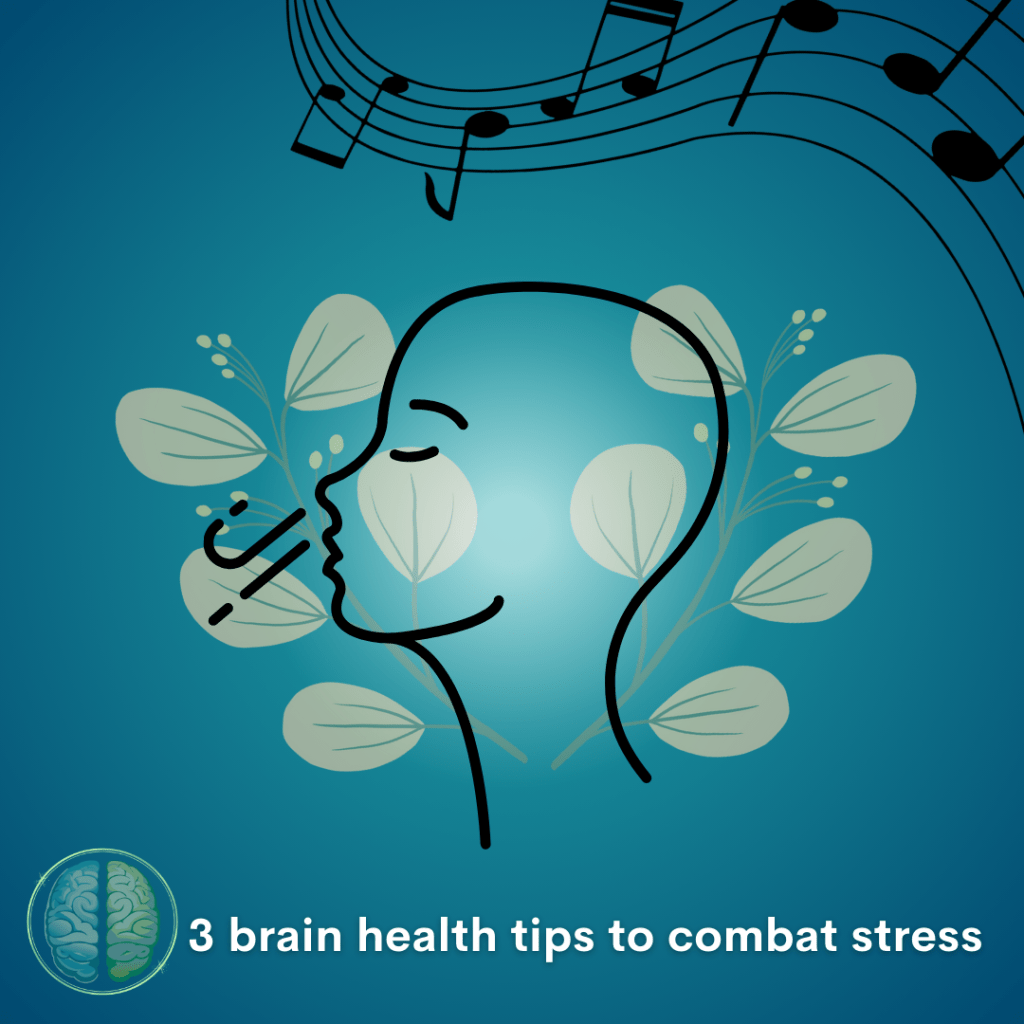
📍3 brain health tips to combat stress
🌟1️⃣ Deep exhale-focused breath
Try this: Breath in for 4 counts, hold it for 3-4 counts, breath out for 7-8 counts (i.e.the same amount of air but at a slower rate) , and hold again for 3-4 counts. Each count could be as slow or fast as you wish, i.e. it’s about the ratio of inhale to exhale. The cue to hold your breath between inhale and exhale is to avoid hyperventilation.
Repeat this for a few rounds (e.g. 10 consecutive cycles) to rapidly downregulate your “fight/flight” response.
🌟2️⃣ What do you habitually reach for?
Before I became conscious of this habit, I would grab something that gives me a sugar rush. Usually crisps (a.k.a. potato chips to my USA readers) or chocolate.
I soon realised this habit causes a blood sugar spike and crash, worsening my stress response. Now that I’m aware of this habit, I try to reach for something else (e.g. nuts) that doesn’t cause a big blood sugar swing. I try 🙂
What are you habitually reaching for at the moment of stress, and what would you now choose to do instead?
🌟3️⃣ Try humming or singing
Have you tried this? I think humming or singing can combat stress through a few ways. One may be the long notes in singing (which is like the exhale-focused breath, above), perhaps it’s the vibration of the chest resulting in vagus nerve stimulation, perhaps it’s the joy from the song! For people singing in a group there may be an added benefit of social bonding.
📍Question for you today:
What would you consider practising when you encounter your next stressful moment?
Remembering also, that it’s not as simple as “stress is bad”.
What matters is our response to stress.
Wishing you calm and clarity ❤️
Dr Sui Wong MD FRCP
 Dr Sui Wong Empowering Your Brain Health
Leave a comment