🌟[TT] why walk 🧠
Last week, I shared how you can create Mindful Moments without formal meditation. This week, let’s get even more practical.
I’ve been writing about physical activity as part of my upcoming book about the BRA(i)NS® Method.
Walking might seem too simple to be powerful.
And here’s what’s fascinating when it comes to your brain: walking engages multiple brain networks simultaneously – motor control, spatial navigation, and executive function.
So, like a gentle full-brain workout, with minimal effort!
Plus, it’s probably the most accessible form of movement for most people (though see my PS for alternatives if walking isn’t suitable for you).
📍3 Ways to Walk for Brain Health
🌟1️⃣ The Mindful Walk
Transform any walk into a brain-balancing practice.
Pick an anchor for your attention: the rhythm of your feet, the swing of your arms, or your breathing pattern.
When your mind wanders to your to-do list (which it will!), gently return to your chosen anchor.
This dual-tasking – walking while maintaining awareness – strengthens your prefrontal cortex and improves cognitive flexibility.
Try this: Count your steps up to 10, then start again. Simple, but surprisingly effective for focus training.
🌟2️⃣ The Morning Stroll
A gentle morning walk works magic on your circadian rhythm.
Even 10 minutes of natural light exposure helps set your body clock, improving both alertness during the day and sleep quality at night.
No need to power-walk – a relaxed pace while getting morning light is perfect.
Your brain’s suprachiasmatic nucleus (your master clock) responds powerfully to this combination of movement and light.
Try this: Make it automatic by linking it to something you already do. Perhaps walk to get your morning coffee, or do a lap around your home after breakfast.
🌟3️⃣ The Brisk Boost
Remember my “singing test” from a previous Thursday Tips?
That’s walking at a pace where you can speak in short phrases but can’t sing a song. It’s your brain’s sweet spot for cardiovascular benefits.
Just 15 minutes at this pace can improve memory, focus, and mood for hours afterward.
Try this: Find a slight incline or pick up your pace for 30-second intervals during your regular walk.
📍Why Walking Works for Your Brain
Walking increases blood flow to your brain, delivering oxygen and nutrients while clearing metabolic waste.
The bilateral rhythm of walking activates both brain hemispheres, promoting neural communication and creative thinking (I do this a lot when writing!).
Regular walking can increase hippocampal volume (your memory centre) and strengthen white matter connections between brain regions.
Studies show that people who do physical activity regularly have a lower risk of cognitive decline.
📍Try This Week
Pick ONE walking style that appeals to you. Commit to just 10 minutes, 3 times this week. Notice how your brain feels afterward.
📍Question for you today
When could you fit in a 10-minute walk today – and which type will you try first?
Wishing you joyful steps and clearer thinking,
Dr Sui Wong
PS – If walking isn’t accessible for you, these same principles apply to seated or lying movements. Mindful arm circles, gentle stretches, or even intentional breathing patterns can provide similar brain benefits. I’m committed to inclusive brain health – please reach out if you’d like adaptations for your specific needs, I’d be grateful to hear from you.
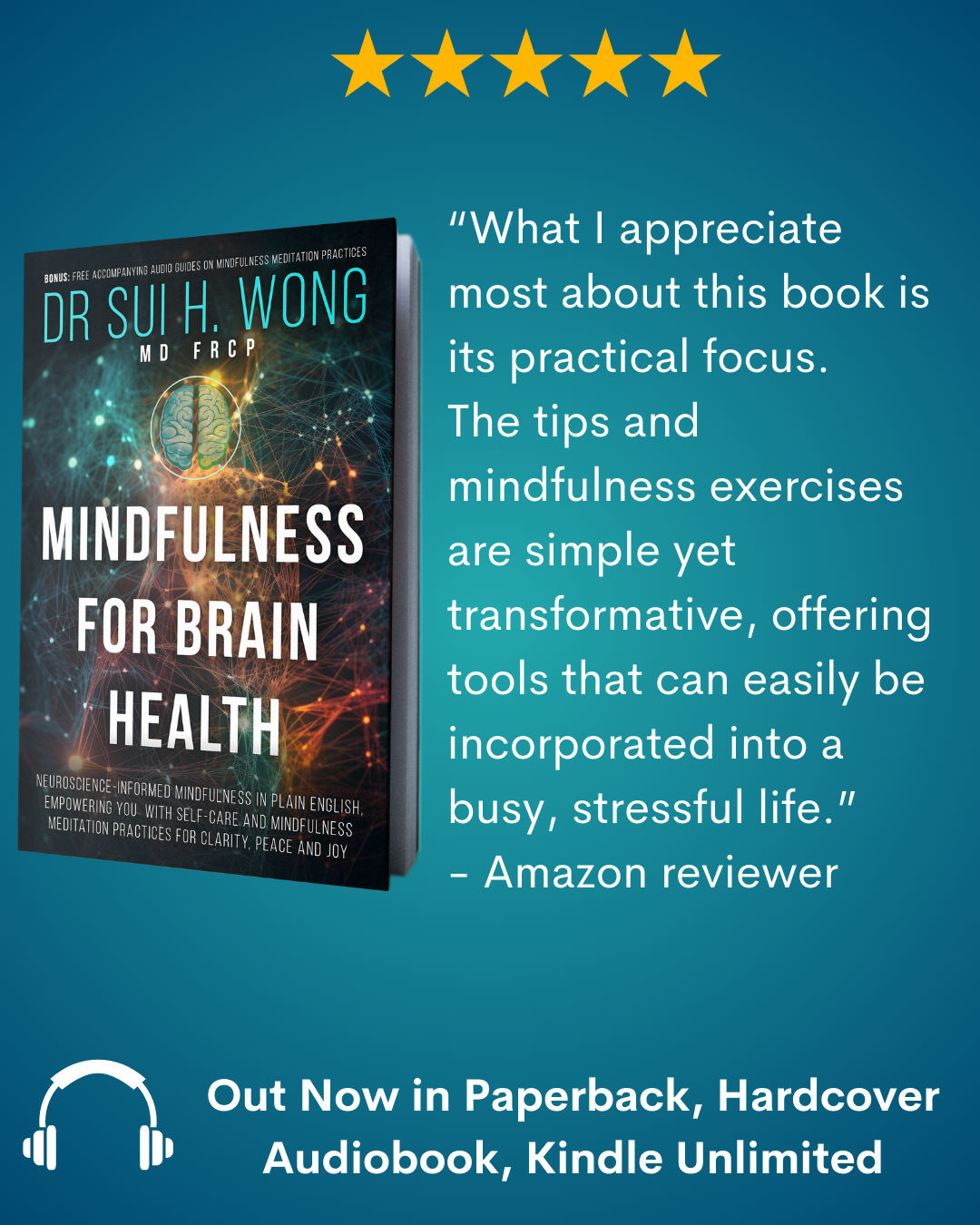
PPS –  In case you missed it last week, I have a “Black Friday” thank-you bonus for you as a subscriber to my Thursday Tips! Get an audiobook copy of Mindfulness for Brain Health using this this link: https://app.hiro.fm/channel/mindfulness-for-brain-health
use the code BF75 for 75% off, at $3 (RRP $11.99)
This book is also available in paperback/ hardcover formats, wherever good books are sold, click here to learn more. The audiobook is also available on other platforms eg Audible, and Spotify.
References:
Voss et al (2013) https://pubmed.ncbi.nlm.nih.gov/22674729/;
Erickson et al (2011) https://pubmed.ncbi.nlm.nih.gov/21282661/;
Morris & Hardman (1997) https://pubmed.ncbi.nlm.nih.gov/9181668/
FAQ
Q: How long should I walk for brain benefits?
Even 10 minutes can help. Short, regular walks support focus, mood, and mental clarity.
Q: When is the best time to walk?
Morning light is ideal for setting your body clock, but any time you can fit in a walk is useful.
Q: Does the pace matter?
It depends on your goal. Slow is great for mindfulness, steady-light for circadian support, and brisk for a focus boost.
Q: What if I can’t walk outdoors?
Indoor walking, gentle marching in place, or short movement breaks still activate similar brain pathways.
Q: How often should I walk for cognitive support?
Aim for a few short walks throughout the week. Consistency helps more than long sessions.
Books: available where all good books are sold, in print, eBook and audiobook formats. LEARN MORE: Mindfulness for Brain Health , Break Free From Migraines Naturally, Sleep Better to Thrive, Quit Ultra-Processed Foods Now, Sweet Spot for Brain Health, Magnesium: Restore & Revitalize Your Brain & Body
Spread the love! Share this post with someone who will enjoy my Thursday Tips [TT] newsletter.
If you received this as a forwarded link, please sign up to the [TT] newsletter via bit.ly/drwongbrainhealth
INSTAGRAM: drsuiwong.neurologist | LINKED IN: linkedin.com/in/dr-sui-wong-neurologist
My mission here is to share good quality, actionable information that empowers people to improve their brain health and wellbeing.
Thank you for your support!
 Dr Sui Wong Empowering Your Brain Health
Leave a comment