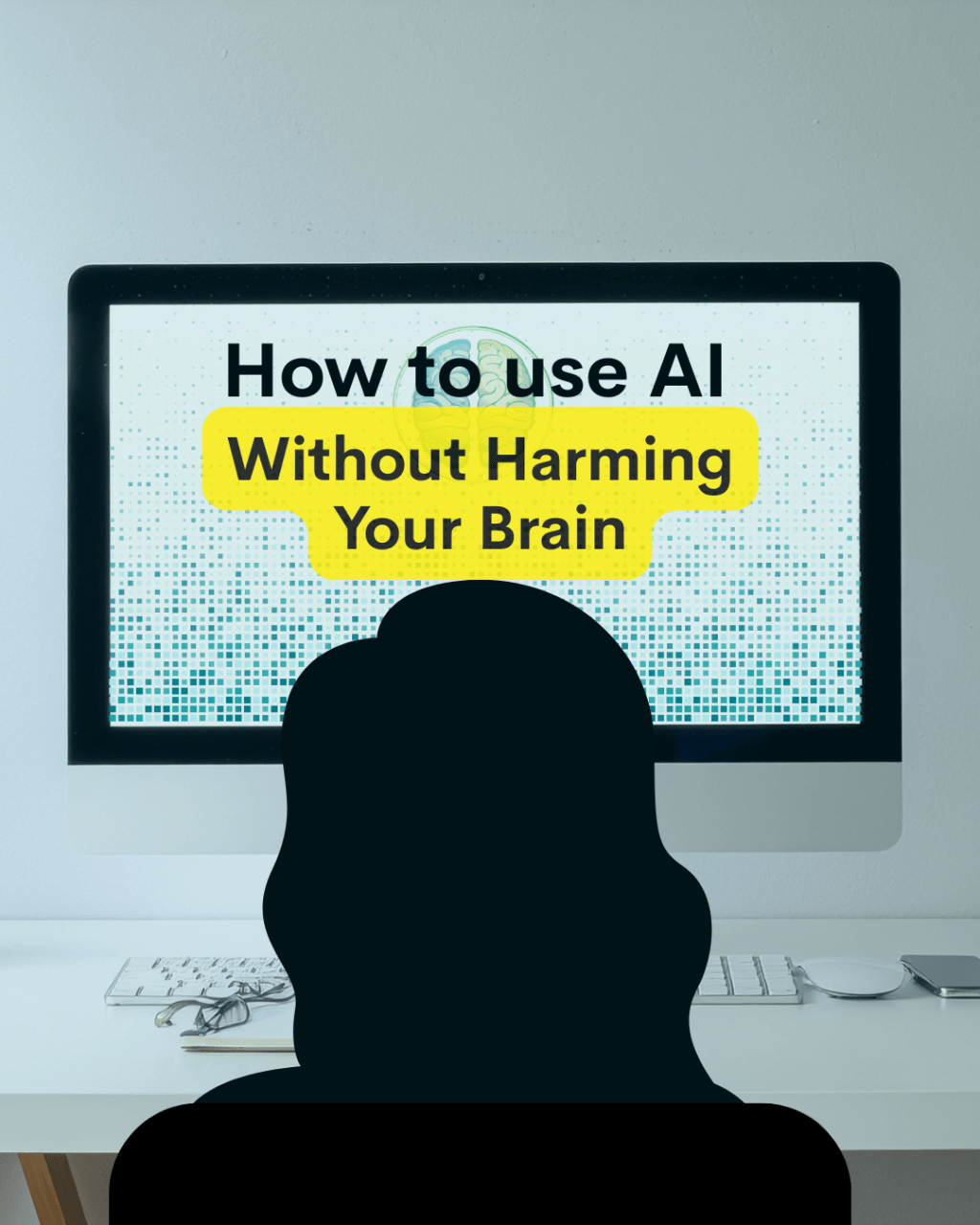
🌟[TT] Artificial 🧠
This topic about AI has come up a few times in recent weeks.
Questions to me as a neurologist include: “Is AI making my brain lazy?”
Or even worse: is AI damaging my brain?
Here’s my view on this, with three practical tips to keep your brain sharp in the age of AI!
📍Three Tips for Using AI Without Harming Your Brain
[1] Treat AI as a tool, not a crutch
Remember the phrase “use it or lose it?” Maybe you’ve experienced that with the ability to do mental maths well in school but less so as adults (hands up, that’s me!).
AI works the same way. The more you rely on it to do your thinking, the less you exercise those cognitive skills.
Try this: Ask yourself before reaching for AI: “Will this help me think better, or will it think for me?”
[2] Protect your “struggle time”
Guess what? All that struggle bus in school was worth it after all!
Because the struggle IS the learning.
How “meta”: learning to learn!
When your brain wrestles with a problem, that’s when neural connections form and strengthen.
And what we don’t want is to lose the skill of learning and thinking with overreliance on AI
If AI removes that productive struggle too early, you might get quick answers but miss the deep understanding that comes from working things through yourself.
(Something to consider for how kids use AI, maybe…)
Try this: Give yourself time to think through problems before turning to AI. When learning something new, do the hard work first, then use AI to fill gaps or verify understanding
[3] Use it to enhance learning
I’ve heard this from a few medical students (how clever are they!) who put in lectures into AI and ask for multiple choice questions or scenarios to test their knowledge.
The key difference from point 2 above is that you’re using AI to test and strengthen your learning, not to do the learning for you.
So how can we follow the examples of these clever students to our benefit in adulthood?
Try this: When learning something new, write down what you understood first, then use AI for brainstorming and fact checking (but remember to fact check the fact checker! 🤣)
📍The Brain Science Behind It All
Your brain is remarkably adaptable. It is continuously reorganising itself based on what you use most often.
When you repeatedly practise a skill, neural pathways strengthen. When you stop using a skill, those pathways weaken and eventually fade.
Here’s an example from a research study.
Researchers from University College London found that London taxi drivers who navigate without GPS have significantly larger hippocampi (the brain region for spatial memory and navigation) compared to bus drivers who follow fixed routes. And this volume correlated with the amount of time spent as a taxi driver.*
This may be happening to us GPS users, too!
A 2020 study found that people with greater lifetime GPS experience have worse spatial memory during self-guided navigation. Greater GPS use was associated with steeper decline in hippocampal-dependent spatial memory*.
The same principle applies when we over-rely on AI for thinking tasks. The neural circuits involved in problem-solving, critical thinking and memory formation need regular activation to stay strong.
And the Struggle Bus story?
Cognitive scientists call this “desirable difficulty.” When your brain has to work hard to retrieve information or solve problems, it creates stronger, more lasting neural connections.*
When AI removes that struggle too early, you might get the answer, but your brain hasn’t done the work that creates lasting understanding and memory.
AI isn’t inherently harmful to your brain. But how you use it matters enormously.
Think of the word: INTENTION. Use it intentionally.
Use it to free up mental energy for deeper thinking. Use it to test and strengthen your learning. But don’t let it replace the cognitive work that keeps your brain sharp.
📍Question for you today
How do you use AI with intention, so as to protect (and enhance!) your brain?
Wishing you sharp thinking in the modern AI age!
Dr Sui Wong
PS – I use AI to check my [TT] post for silly grammatical errors and typos, with all the rewriting of sentences/ talking points (writing a weekly [TT] can be a Struggle Bus sometimes!🤣) – and then I look at the correction and make a mental note to do better next time 🙂 So using it to enhance learning, how meta!
PPS – I am working on a AI-tool to help you kickstart your Brain Health Habits!
Want early access to this? I will be gifting this to current members of my free BRA(i)NS® Clarity Community at the time of launch as my way of saying thank you 🙂
The reason for building a community is because I have found this an incredible way to support people and build momentum.
Join now to get early access to my new cool AI tool!
Link to join:
https://www.skool.com/dr-sui-wong-brains-group-3768/about?ref=0a524f8ef4a9467792af9f4fe43a7d8c
*References:
- Maguire 2006 https://pubmed.ncbi.nlm.nih.gov/17024677/
- Maguire 2000 https://pubmed.ncbi.nlm.nih.gov/10716738/
- Dahmani https://pubmed.ncbi.nlm.nih.gov/32286340/
- Bjork: https://psycnet.apa.org/record/2011-19926-008
FAQ
Q1: Does using AI make the brain lazy?
AI itself does not harm the brain, but over-reliance can reduce how often you practise problem-solving and memory skills.
Q2: What is ‘desirable difficulty’?
Desirable difficulty refers to the effortful process of learning where struggle strengthens memory and understanding.
Q3: How can I use AI in a brain-healthy way?
Use AI to test knowledge, check understanding, and support learning rather than replacing the thinking process.
Summary
Artificial intelligence is not inherently harmful to brain health. The brain adapts based on how it is used, strengthening pathways that are regularly engaged and weakening those that are not. When AI replaces thinking too early, skills such as problem-solving, memory, and critical reasoning may be used less often. Using AI with intention, allowing time for mental effort, and treating it as a support rather than a replacement helps protect learning and cognitive resilience.
Spread the love! Share this post with someone who will enjoy my Thursday Tips [TT] newsletter.
If you received this as a forwarded link, please sign up to the [TT] newsletter via bit.ly/drwongbrainhealth
INSTAGRAM: drsuiwong.neurologist | LINKED IN: linkedin.com/in/dr-sui-wong-neurologist
My mission here is to share good quality, actionable information that empowers people to improve their brain health and wellbeing.
Thank you for your support!
 Dr Sui Wong Empowering Your Brain Health
Leave a comment