🌟[TT] Levers 🧠
If you caught my PS in the last [TT] you’ll already know something exciting is coming. More in this week’s PS too!
But first, this week’s topic came to me as I was preparing content for my upcoming Peak Performance Brain Lab.*
I kept coming back to one question.
Which lever creates the biggest impact on your brain health?
I’ve thought about this a lot. Not just from the neuroscience, but from 26 years of clinical practice, watching patients struggle and succeed. And honestly, from my own stop-start attempts at building sustainable habits too.
Because I’ve had plenty of those.
And what I’ve noticed, both in myself and in the people I’ve worked with, is that the “right” lever isn’t the same for everyone. It’s personal.
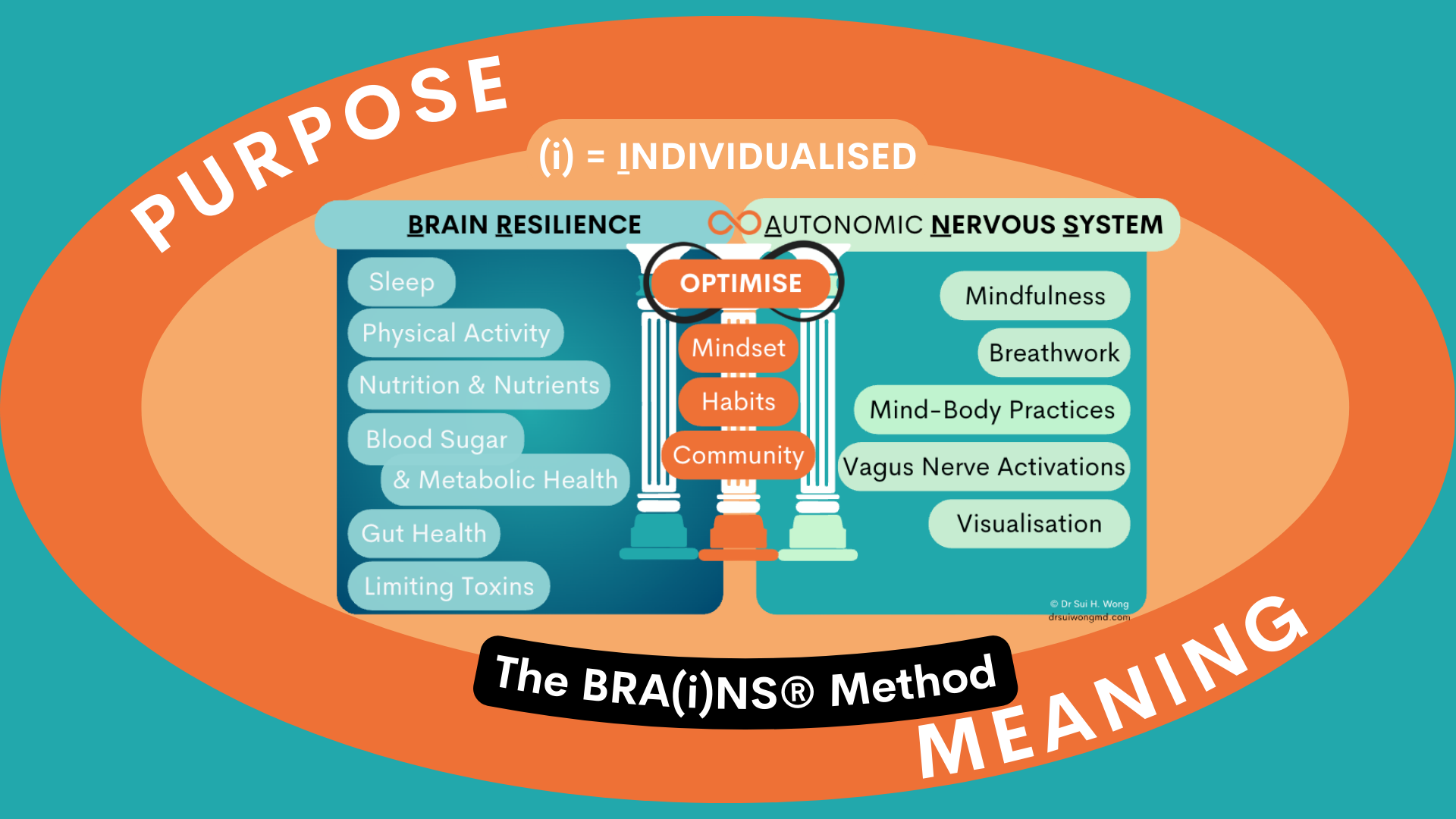
This is why individualisation sits at the heart of the BRA(i)NS® Method. The (i) isn’t decorative. It’s the whole point ☺️
📍 3 Levers to Pull for Lasting Brain Health
[1] Address Your Biggest Deficit
Look across the principles of the BRA(i)NS® Method and ask yourself: where is the gap?
For many people, the answer is sleep. They underestimate how profoundly poor sleep erodes focus, memory, mood regulation, and metabolic health. When sleep is the weak link, everything else is harder.
For others, the deficit is nutrition, or blood sugar stability, or chronic stress with no recovery built in.
This lever works well for people who are motivated by understanding the “why.” Once they see the gap clearly, they want to close it.
Try this: Look at the BRA(i)NS® principles (image below as reminder). Which one, if you improved it by 20%, would lift everything else?
[2] Start With the Easy Entry
Sometimes the most powerful move is building momentum first.
I have seen this again and again in clinic. The patients who made the most lasting changes weren’t always those who tackled the hardest thing. They were the ones who found something they could sustain, and kept going.
One patient loved walking. Already did it. We simply added intention to it: a specific duration, a particular time of day, some social connection. That one habit anchored the rest.
This lever works well when motivation is fragile or life is already demanding. Start where there is already some traction.
Try this: Which BRA(i)NS® principle do you already partially do? How could you strengthen it just a little, consistently?
[3] Pick and Mix Your Way In
Some people freeze when they think “healthy lifestyle,” because they imagine a rigid plan they’ll inevitably fail.
Think of it like a pick and mix. You choose what appeals, leave what doesn’t, and nothing goes in the bag by force.
A bit of breathwork here. A better breakfast there. A walk with a friend.
None of it feels like sacrifice. And that matters, because what feels sustainable usually is.
Try this: From the BRA(i)NS® Method, pick one thing from building brain resilience and one from balancing the autonomic nervous system. Do those two things consistently this week.
📍 The Brain Science: Why Consistency Is the Lever of Levers!
Whichever entry point you choose, one principle holds across all three.
Consistency.
Not perfection. Not intensity. Consistency.
Your brain builds through repetition. Each time you repeat a behaviour, the neural pathway supporting it becomes a little more efficient, a little more automatic. What starts as effortful becomes habitual. This is the principle of activity-dependent plasticity.
I like to think of it as 1% at a time.
Each small, repeated action is like a piece of wool that builds the thread. One thread is fragile. But thread after thread, twisted together, forms something you can’t easily break.
And here is where the BRA(i)NS® Method has a particular advantage. The principles aren’t isolated. They support and reinforce each other. Better sleep improves your willpower to eat well. Movement reduces cortisol and improves sleep. Breathwork steadies the nervous system and sharpens focus.
Pull one lever consistently, and the others start to move too.
Research on neuroplasticity and habit formation supports this: repeated behaviours strengthen synaptic connections over time, a process sometimes described as Hebbian learning (“neurons that fire together, wire together”).
📍 Question for You Today
Which of the 3 levers resonates most with you right now: biggest deficit, easy entry, or pick and mix?
And which BRA(i)NS® principle will you commit to this week?
I’d love to hear from you. Just hit reply.
Wishing you a week of small, powerful actions,
Dr Sui Wong
*PS The Peak Performance Brain Lab is launching shortly! This will be limited to 15 people. You will have the opportunity to work with me in a small-group setting to curate your brain health ecosystem, with everything tailored to your individual BRA(i)NS® profile.
If you’d like first dibs to sign up, just reply to get on the priority list. I’m opening 5 spaces for pre-launch now! 🥳
References:
- Lally et al 2010 – https://onlinelibrary.wiley.com/doi/abs/10.1002/ejsp.674
- Citri & Malenka 2008 – https://www.nature.com/articles/1301559
Summary
Brain health is improved through personalised lifestyle changes, not a one size fits all approach. Whether addressing your biggest deficit, starting with an easy habit, or mixing small actions, consistency is key. Repeated behaviours strengthen neural pathways over time, making habits more automatic and sustainable.
FAQ
What is the best way to improve brain health?
There is no single best way. The most effective approach is personalised, focusing on habits that are sustainable for you.
Why is consistency important for brain health?
Repeated behaviours strengthen neural pathways, making habits easier and more automatic over time.
Can small habits really make a difference?
Yes. Even small, consistent actions can lead to meaningful improvements in brain function and overall wellbeing.
Books: available where all good books are sold, in print, eBook and audiobook formats. LEARN MORE: Mindfulness for Brain Health , Break Free From Migraines Naturally, Sleep Better to Thrive, Quit Ultra-Processed Foods Now, Sweet Spot for Brain Health, Magnesium: Restore & Revitalize Your Brain & Body
My mission:
To inspire a movement for better brain health.
Because better brain health supports better wellbeing. And better wellbeing creates a ripple effect that benefits individuals, families, communities, and beyond.
Making the world a better place for all.
I am a practising medical doctor (MBBS MD FRCP MA FHEA DipIBLM) working as a Neurologist and Neuro-Ophthalmologist, and am an active neuroscience researcher. My research is inspired by questions arising from my busy clinical practice, and I am grateful that both have been recognised with awards.
I am also an Author and Speaker, creating public-facing health content in my spare time.
Learn more:
drsuiwongmd.com
Join me on my mission?
>> Spread the love! ❤️ Share this email with someone who will enjoy my Thursday Tips [TT] newsletter.
>> Follow me on:
INSTAGRAM: drsuiwong.neurologist | LINKED IN: linkedin.com/in/dr-sui-wong-neurologist | YouTube: http://www.YouTube.com/@DrSuiWong
If you received this as a forwarded link, please sign up to the [TT] newsletter via bit.ly/drwongbrainhealth
Thank you for your support!
(C) 2024-2026 Dr Sui H. Wong MD FRCP


Leave a Reply