🌟[TT] I/O 🧠
I/O. Input, output.
In computing, it’s how information flows in and out of a system.
I was also thinking about this in terms of research and brain health.
As you know, in addition to my clinical duties, I am also an active neuroscience researcher.
In research, we’re trained to evaluate a study by the quality of its inputs. Poor data going in means unreliable conclusions coming out, no matter how sophisticated the analysis.
The same principle applies to your brain health.
What you absorb shapes what comes out: your energy, your focus, your mood, how you show up in your day.
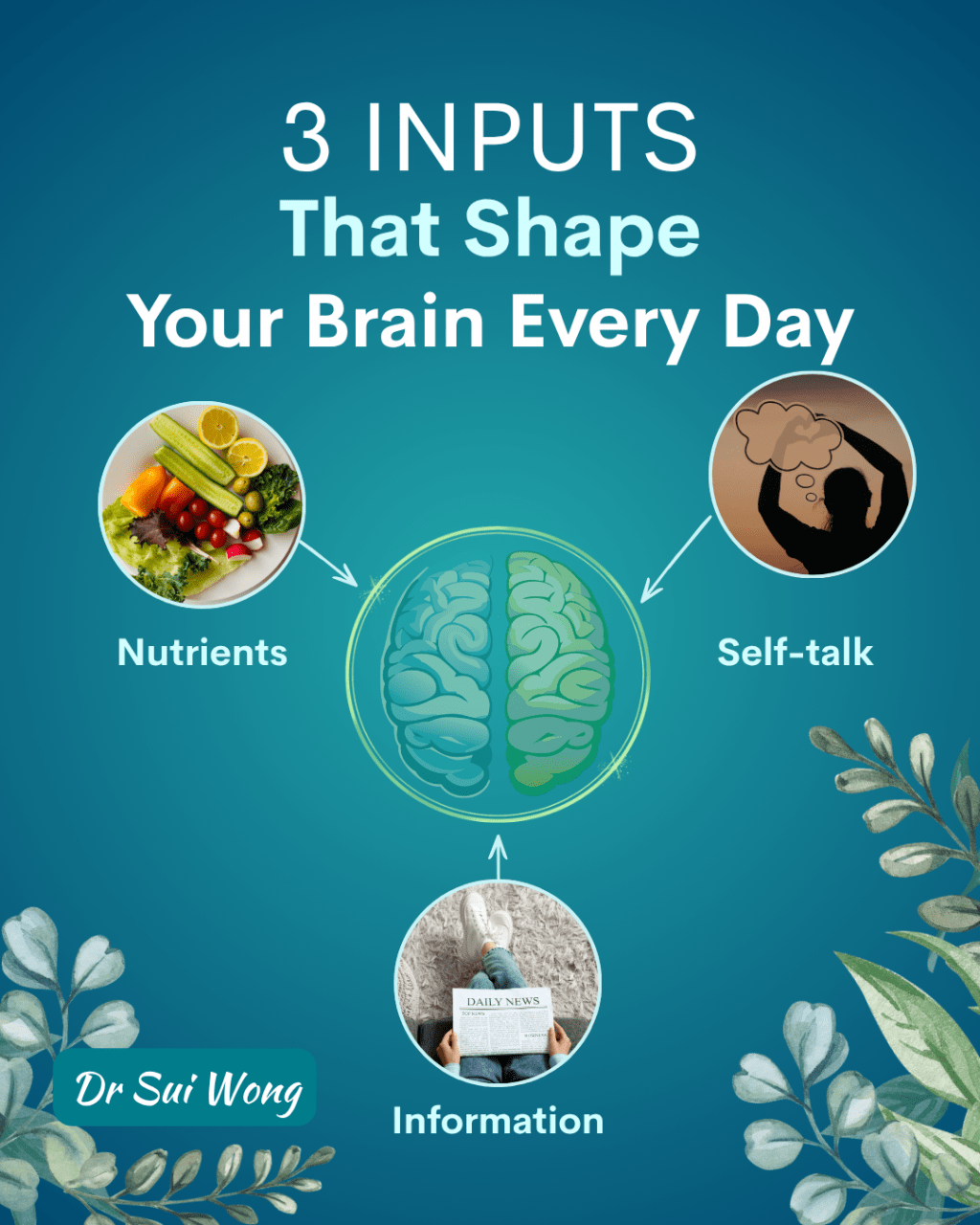
Here are three types of input that reach your brain every single day.
📍3 IOs for Your Brain Health
[1] Nutrients on Your Plate
Your brain uses about 20% of your body’s energy, despite being just 2% of its weight.
The raw materials? Food.
Fatty acids build cell membranes. Amino acids become neurotransmitters. Polyphenols and fibre feed the gut-brain axis.
The landmark MIND diet study found that older adults who followed this brain-focused eating pattern (rich in leafy greens, berries, nuts, whole grains, fish, olive oil, and legumes) had a 53% lower risk of Alzheimer’s disease.*
>> Try this: Add one brain-supportive food today. A handful of walnuts with breakfast. Spinach in your lunch. A small bowl of berries with your afternoon cuppa.
[2] The Voice in Your Head
Your brain listens to everything you say to it. It doesn’t distinguish between external criticism and self-criticism.
“I’m so hopeless.” “I always mess up.” “I’ll never get there.” Each phrase lands like a stress signal, activating the same physiological response as if someone else were attacking you.
Whatever you habitually say to yourself is input that shapes your cortisol release, your motivation, and your next move. (If you missed it, my TT on Self-Talk from 22/1/26 goes deeper into this.)
>> Try this: Catch one harsh phrase you use with yourself today. Reword it the way you’d speak to a good friend. “I’m still figuring this out” lands very differently to “I’m useless.”
[3] Information You Take In
News, social media, podcasts, conversations. Everything you consume is input your brain has to process.
Your attention, mood, and stress response shift according to the quality and volume of what you let in.
A doomscroll over breakfast primes your day differently than ten minutes with a book or a walk outside.
>> Try this: Notice how you feel after 10 minutes with one of your regular information sources. Energised? Anxious? Flat? Curious? Use your body’s feedback as data for curating your brain’s information diet.
📍The Brain Science of IO
Your brain is a prediction-making organ.
It uses inputs to build its model of the world, adjust your stress response, and decide where to focus attention.
Nutrition input affects brain energy, inflammation, and the gut-brain axis. Self-talk input activates threat or safety pathways. Information input shapes what your brain expects and prepares for.
This is where the BRA(i)NS® Method pieces fit together. Building Brain Resilience (BR) through principles such as nutrition and sleep. Balancing your Autonomic Nervous System (ANS) through principles like mindfulness of your automatic reactions. Optimising through principles of mindset and habitual patterns of what you pay attention to.
All this through the lens of (i), individualised to you and your needs.
Paying attention to these inputs, however big or small, compounds over time.
📍Question for you today
Of the three IOs (nutrients, mindset, information), which one feels most in need of attention from you right now?
I’d love to hear from you, just leave a comment 🙂
Wishing you quality inputs and clearer outputs,
Dr Sui Wong
PS Want some guidance on the implementation of improving your inputs using the BRA(i)NS ® Method? Good news! I’ve opened 5 pre-launch seats for my upcoming Peak Performance Brain Lab. It’s a small group that I’m taking through to help you curate your brain health ecosystem for powerful and sustainable brain benefits, including energy, focus, and performance.
Reply if you’d like first dibs for the 5 pre-launch places at a special offer.
Reference:
- Morris et al 2015 –
https://pubmed.ncbi.nlm.nih.gov/25681666/
Summary
Your brain is constantly shaped by three main inputs every day: what you eat, what you tell yourself, and what you consume through information. These inputs influence your energy, focus, mood, and long-term brain health. By making small, consistent changes in each area, you can support clearer thinking, better emotional balance, and improved overall wellbeing. Understanding this IO concept helps you become more intentional about what you allow into your daily life.
FAQ
What does IO mean in brain health?
IO stands for input and output. In brain health, it refers to how what you take in each day influences how your brain functions and what it produces in terms of thoughts, mood, and behaviour.
How does food affect brain function?
The brain relies on nutrients like healthy fats, amino acids, and plant compounds to produce energy and support communication between brain cells. Poor diet can affect focus, mood, and long-term cognitive health.
Can self-talk really affect the brain?
Yes. Your brain responds to self-talk as a real input. Harsh internal language can activate stress responses, while supportive self-talk helps create a calmer and more balanced mental state.
Books: available where all good books are sold, in print, eBook and audiobook formats. LEARN MORE: Mindfulness for Brain Health , Break Free From Migraines Naturally, Sleep Better to Thrive, Quit Ultra-Processed Foods Now, Sweet Spot for Brain Health, Magnesium: Restore & Revitalize Your Brain & Body
My mission:
To inspire a movement for better brain health.
Because better brain health supports better wellbeing. And better wellbeing creates a ripple effect that benefits individuals, families, communities, and beyond.
Making the world a better place for all.
I am a practising medical doctor (MBBS MD FRCP MA FHEA DipIBLM) working as a Neurologist and Neuro-Ophthalmologist, and am an active neuroscience researcher. My research is inspired by questions arising from my busy clinical practice, and I am grateful that both have been recognised with awards.
I am also an Author and Speaker, creating public-facing health content in my spare time.
Learn more:
drsuiwongmd.com
Join me on my mission?
>> Spread the love! ❤️ Share this email with someone who will enjoy my Thursday Tips [TT] newsletter.
>> Follow me on:
INSTAGRAM: drsuiwong.neurologist | LINKED IN: linkedin.com/in/dr-sui-wong-neurologist | YouTube: http://www.YouTube.com/@DrSuiWong
If you received this as a forwarded link, please sign up to the [TT] newsletter via bit.ly/drwongbrainhealth
Thank you for your support!
(C) 2024-2026 Dr Sui H. Wong MD FRCP
 Dr Sui Wong Empowering Your Brain Health
Leave a comment