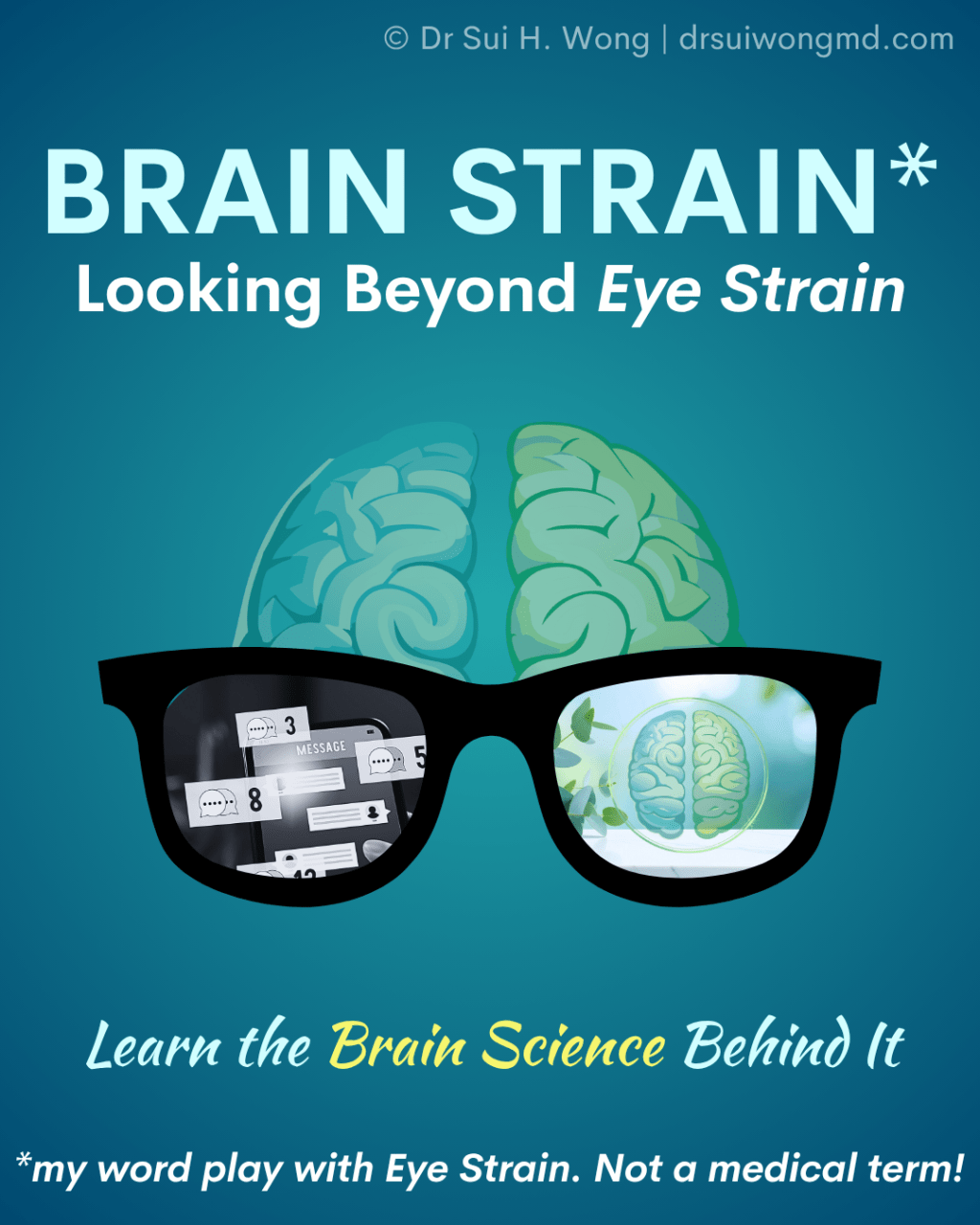
🌟[TT] Strain 🧠
Hello from the Association of British Neurologists conference! I’m geeking out on all the Neurology discussions. As you might have guessed, I love working in this speciality!
Now back to our regular Thursday Tips content 😊
Over the weekend, I was reflecting on a pattern I notice in clinic.
People are often sent to me for persistent eye strain. The standard advice has been given. Take screen breaks. Adjust your posture. Wear the correct prescription. Treat dry eyes. And yet they still feel that fatigue, that fog, that “I can’t focus and my eyes are tired” feeling.
In some of these cases, when I look more carefully, the issue isn’t actually the eyes.
It’s the brain.
And just this weekend, a phrase popped up when I was thinking about the topic for this week’s Thursday Tips: Brain Strain!
Yes, I just made up that phrase… But it’s helpful to illustrate a point I think 🙂
Eye strain has a proper medical term, asthenopia, which describes stress on the visual system.
Brain strain is my way of describing something similar, one step further back, in the brain itself.
Think of it like a balance: load on one side, capacity on the other.
When load exceeds capacity, you feel it. Foggy. Tired. Slow.
The eyes may be the messenger, but the brain is often where the imbalance sits.
So you have two ways to help this: lighten the load, or build the capacity.
📍3 Tips for “Brain Strain”
[1] A 30 second eye reset
This can be a nice way to bridge your eyes and brain, both getting a little breather.
>>Try this: soften your gaze and look towards the furthest point you can see (out of a window if possible). Close your eyes for a few seconds. Open them and slowly look up, down, left, right, then corner to corner. Finish with three slow blinks, fully closing the upper and lower lid. I jokingly call this eye yoga. 🤣
This relaxes the muscles around your eyes and gives your visual system a micro break.
[2] From Multitasking to just one…
Your brain pays a cost every time it switches tasks.
Notifications, open browser tabs, half written emails, the phone face up on your desk.
>>Try this: For the next hour, silence your phone notifications, or close every tab that isn’t needed for the task in front of you. Notice the difference in how your brain feels.
[3] Purposeful Rest
When did you last take a purposeful rest?
By that I mean a real rest break. Not a phone scroll… Remember, capacity is built, not given.
>>Try this: How about an IRL (in real life!) stroll instead? A few minutes of mindful walking in the park? A cup of tea away from your screen? Find something that gives you space to breathe and rest.
📍The Brain Science Behind It
Eye strain is a recognised medical concept. Asthenopia describes the stress that builds across the muscles that move the eyes, the muscles that change pupil size and focus, and the eye surface itself.
Brain strain isn’t a formal diagnosis. It’s a useful frame for what happens when cognitive load outstrips cognitive capacity.
One contributor is the cost of switching. Research shows that when people alternate between tasks, they incur a switching time cost, and that cost grows with the complexity of the task.*
Each switch costs you something. Multiply that across a day full of pings, tabs, and interruptions, and the toll adds up quickly. Multitasking, for work that needs your full focus, is really task switching in disguise.
The other side of the equation is capacity.
This is where the BRA(i)NS® Method comes in. An approach that is easy and sustainable, as it helps you create your own brain health ecosystem, for sustained energy, focus and performance.
And guess what? The (i) in BRA(i)NS® stands for individualisation. The lens through which this is applied: to your life, your stage, your starting point. Not generic, but personalised to you.
📍Question for you today
What’s one thing you could lighten this week, and one tiny action that could build your capacity?
Comment on this post, and I’d love to hear it.
Wishing you a lighter load and larger capacity,
Dr Sui Wong
PS: Want to learn the BRA(i)NS® Method to build your brain’s capacity? Come join me in my upcoming Your Peak Performance Brain Masterclass, live and free. Sign up at drwongmasterclass.com
PPS – Can you help? Please share news about Your Peak Performance Masterclass with your circle of friends and loved ones by forwarding this newsletter, thank you! 🙂
*Reference:
Rubinstein JS, Meyer DE, Evans JE. (2001) – https://pubmed.ncbi.nlm.nih.gov/11518143/
Summary
Persistent eye strain is not always driven by the eyes alone. When cognitive load exceeds the brain’s capacity, it can lead to fatigue, fog, and difficulty focusing. Reducing mental load and building brain capacity through simple daily habits can ease this strain and improve clarity.
FAQ
What is brain strain?
It is a simple way to describe mental fatigue that happens when cognitive load is higher than your brain’s capacity.
Why do my eyes feel tired even after doing the right things?
Because the issue may not be the eyes themselves, but the brain processing too much information.
Does multitasking really affect focus?
Yes. What feels like multitasking is often task switching, and each switch uses mental energy.
What is one simple way to reduce brain strain?
Focus on one task at a time and take short, real breaks away from screens.
Books: available where all good books are sold, in print, eBook and audiobook formats. LEARN MORE: Mindfulness for Brain Health , Break Free From Migraines Naturally, Sleep Better to Thrive, Quit Ultra-Processed Foods Now, Sweet Spot for Brain Health, Magnesium: Restore & Revitalize Your Brain & Body
My mission:
To inspire a movement for better brain health.
Because better brain health supports better wellbeing. And better wellbeing creates a ripple effect that benefits individuals, families, communities, and beyond.
Making the world a better place for all.
I am a practising medical doctor (MBBS MD FRCP MA FHEA DipIBLM) working as a Neurologist and Neuro-Ophthalmologist, and am an active neuroscience researcher. My research is inspired by questions arising from my busy clinical practice, and I am grateful that both have been recognised with awards.
I am also an Author and Speaker, creating public-facing health content in my spare time.
Learn more:
drsuiwongmd.com
Join me on my mission?
>> Spread the love! ❤️ Share this email with someone who will enjoy my Thursday Tips [TT] newsletter.
>> Follow me on:
INSTAGRAM: drsuiwong.neurologist | LINKED IN: linkedin.com/in/dr-sui-wong-neurologist | YouTube: http://www.YouTube.com/@DrSuiWong
If you received this as a forwarded link, please sign up to the [TT] newsletter via bit.ly/drwongbrainhealth
Thank you for your support!
(C) 2024-2026 Dr Sui H. Wong MD FRCP


Leave a Reply