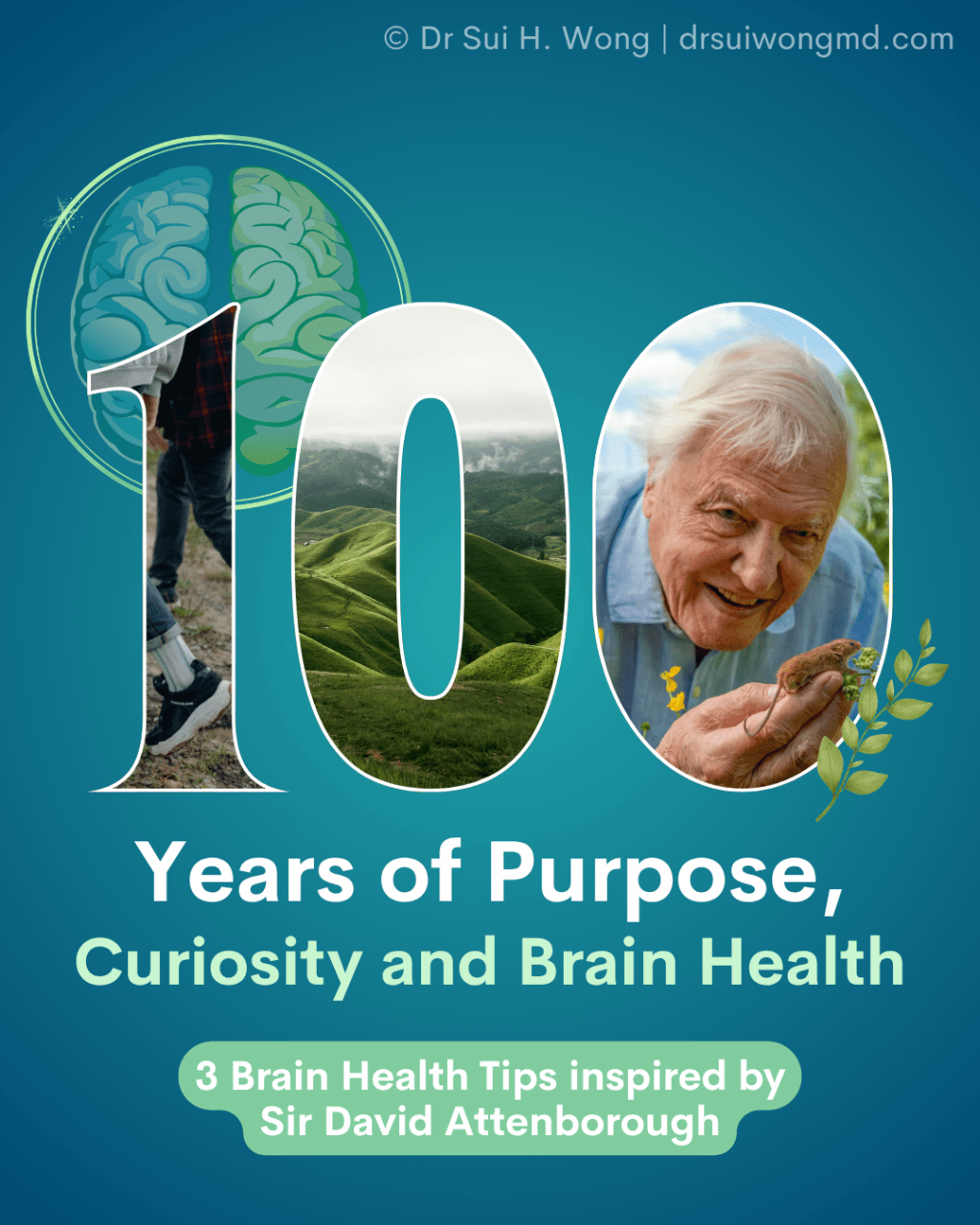
🌟[TT] 100 🧠
Sir David Attenborough turned 100 last week!
What got me was hearing him on the BBC interview.
His voice, his spark, how sharp he is. Full of warmth and curiosity.
Here’s the link, if you want to read the article with a clip of his interview, it’s a good one: https://www.bbc.co.uk/news/resources/idt-715ff936-f52a-429d-bb35-d1940d7f6111
It brought me back to the Your Peak Performance Brain Masterclass I delivered yesterday (with an encore on Tuesday 19 May if you missed it!).
I shared about the BRA(i)NS® Method, a science backed way to keep your brain in peak condition. So that you live well in your final decade.
The container that holds the BRA(i)NS® Method is Purpose and Meaning.
Attenborough is what that looks like, over a century.
His purpose was the natural world. And he lived inside it. He described his encounter with the gorillas in Rwanda back in 1978 as “one of the most privileged moments of my life.”
Thank you, Sir David Attenborough, for inspiring people with what 100 years old can look like (breaking all the preconceptions of “old!”) and for championing and protecting nature.
And now for Thursday Tip’s usual format of 3 tips, this time inspired by Sir David Attenborough 🙂
📍 3 Brain Health Tips inspired by Sir David Attenborough
[1] Name your “Attenborough thing”
What’s the one subject, person, place or question you’d still want to be working with at 90 (or the final decade of your life, whatever age that is)?
It doesn’t have to be world changing. Could be your garden. Your grandchildren. A skill. A question that pulls you back to it.
[2] Take it outside this week
Attenborough’s purpose was nature itself. Walking in a forest supports the immune system and settles the mind.*
Find 20 minutes in green space this week. Phone away. Just looking.
[3] Start where Attenborough started
He was collecting fossils as a child. Long before the cameras. Long before Life on Earth.
Big purpose often begins with a small, quiet action. What’s yours this week? One call. One walk. One question asked. One page written.
📍 The Brain Science Behind It
Purpose. A long running study at the Rush Alzheimer’s Disease Center followed over 900 older adults across seven years. Those with a stronger sense of purpose in life had around 2.4 times lower risk of developing Alzheimer’s disease, compared with those scoring lower on purpose.*
Nature. A Stanford study scanned the brains of participants before and after a 90 minute walk. Those who walked in a natural setting showed reduced activity in the subgenual prefrontal cortex, a region linked to rumination and depression. Those who walked the same length of time in an urban setting did not.*
Attenborough lived at the meeting point of these two. A life of purpose, in nature.
📍 Question for you today
In your final decade, who is around you, how is your physical and brain health? And what can you do today to take the steps towards how you wish it to be?
Wishing you purpose, and time with nature,
Dr Sui Wong
PS: If you want to catch the encore Your Peak Performance Brain Masterclass on Tuesday 19th May, just go to drwongmasterclass.com, or email me for a time-limited copy of the recording.
PPS: Fun fact (or should I say sobering fact)… Planetary health impacts human health, which is why medical organisations including the Association of British Neurologists are part of the UK Health Alliance on Climate Change, and I am so grateful that a group of us at the ABN set up the Sustainability Special Interest Group and got it up and running
*References:
- Boyle PA et al 2009 – https://pubmed.ncbi.nlm.nih.gov/20194831/
- Bratman et al (2015) – https://pubmed.ncbi.nlm.nih.gov/26124129/
- Li 2022 – https://pubmed.ncbi.nlm.nih.gov/36328581/
Summary
David Attenborough turning 100 offers a powerful reflection on purpose, curiosity, and brain health. His lifelong connection to nature highlights how meaning, movement, and engagement with the world around us may support cognitive health and wellbeing into later life.
FAQ
Why does purpose matter for brain health?
Studies suggest that a stronger sense of purpose may support healthier cognitive aging and lower dementia risk.
How does spending time in nature help the brain?
Research shows that natural environments may reduce stress, calm the mind, and support emotional wellbeing.
Does purpose have to be something big?
No. Purpose can come from small, meaningful parts of life such as family, hobbies, learning, or community.
What is one simple step I can take this week?
Spend time outdoors or reconnect with something that sparks your curiosity and attention.
Books: available where all good books are sold, in print, eBook and audiobook formats. LEARN MORE: Mindfulness for Brain Health , Break Free From Migraines Naturally, Sleep Better to Thrive, Quit Ultra-Processed Foods Now, Sweet Spot for Brain Health, Magnesium: Restore & Revitalize Your Brain & Body
My mission:
To inspire a movement for better brain health.
Because better brain health supports better wellbeing. And better wellbeing creates a ripple effect that benefits individuals, families, communities, and beyond.
Making the world a better place for all.
I am a practising medical doctor (MBBS MD FRCP MA FHEA DipIBLM) working as a Neurologist and Neuro-Ophthalmologist, and am an active neuroscience researcher. My research is inspired by questions arising from my busy clinical practice, and I am grateful that both have been recognised with awards.
I am also an Author and Speaker, creating public-facing health content in my spare time.
Learn more:
drsuiwongmd.com
Join me on my mission?
>> Spread the love! ❤️ Share this email with someone who will enjoy my Thursday Tips [TT] newsletter.
>> Follow me on:
INSTAGRAM: drsuiwong.neurologist | LINKED IN: linkedin.com/in/dr-sui-wong-neurologist | YouTube: http://www.YouTube.com/@DrSuiWong
If you received this as a forwarded link, please sign up to the [TT] newsletter via bit.ly/drwongbrainhealth
Thank you for your support!
(C) 2024-2026 Dr Sui H. Wong MD FRCP


Leave a Reply