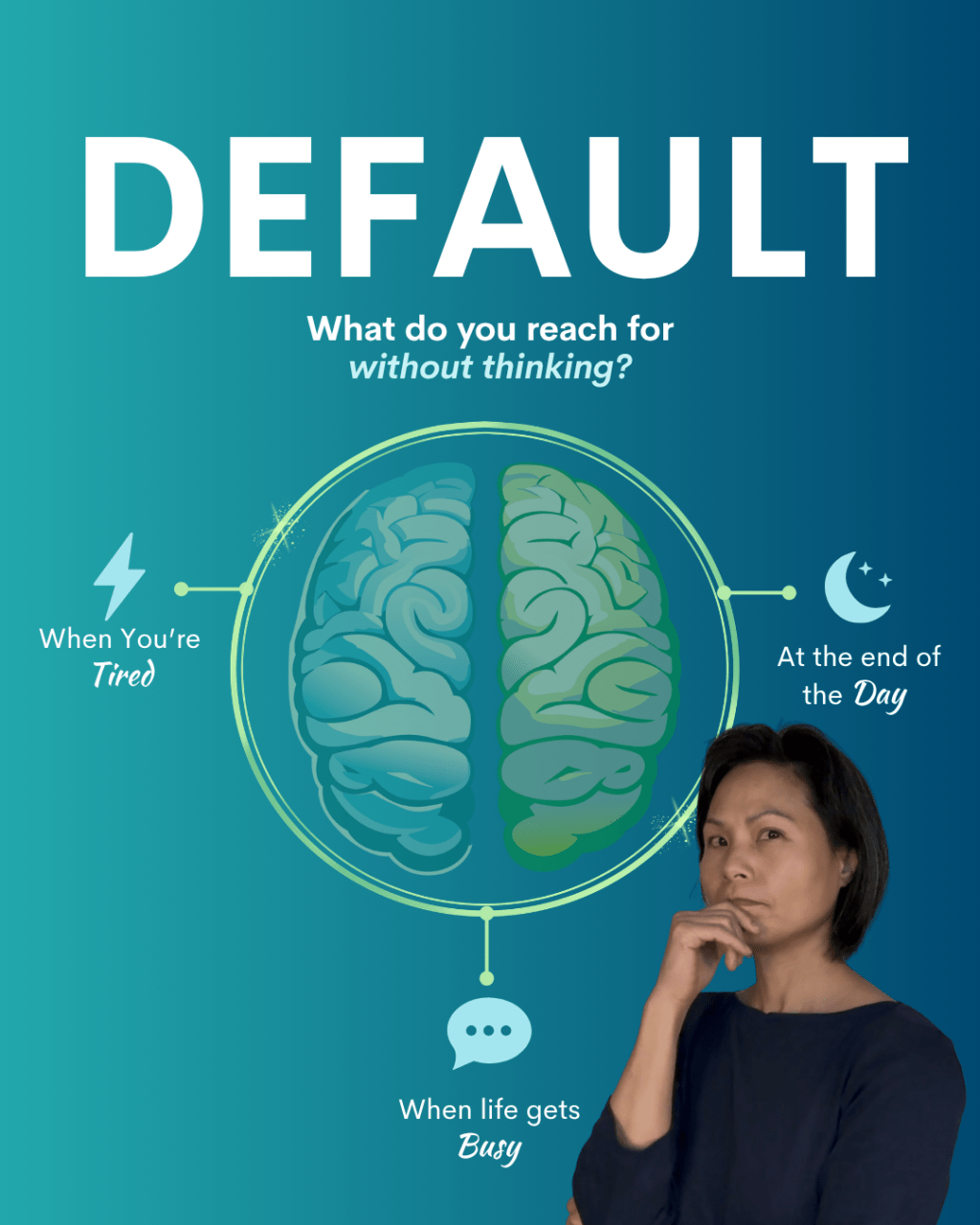
🌟[TT] Default 🧠
So many levels to this one.
What is your default behaviour? Your default choice, when you are tired, busy, or stretched thin?
A while back in [TT] I wrote about your brain’s “default mode”, the screensaver running in the background when you are not on a specific task (e.g. daydreaming), and my mindfulness research showing how we can change that.*
Today I mean default in another sense. The thing you reach for without thinking.
Here is what prompted it. I got home recently to an empty fridge, on a Sunday, when the UK shops shut at 4pm and I had a video call to make. So I opened the food delivery app.
Option 1: comfort food. I have done that, and last time it left me uncomfortable and low on energy.
Option 2: a few simple ingredients to cook fast. Spinach, tofu, basmati rice with a handful of store cupboard bits. Enough for a couple of days, since I can cool the rice dish and reheat it.
I went for Option 2. Not because I am disciplined, but because I remembered how Option 1 left me feeling.
That small moment inspired today’s Thursday Tips!
📍3 Default Questions for Your Brain Health
[1] When your energy dips
(BRA(i)NS® Method Pillar: Building Brain Resilience, under Physical Activity and Movement)
What do you reach for?
Common defaults: caffeine, a cigarette, something sugary.
Try a brisk walk around the block instead (this works a treat on a lunch hour in the hospital), or a glass of cool water. See last week’s [TT] on hydration for why 🙂
[2] When you unwind after a long day
(BRA(i)NS® Method Pillar: Balancing the Autonomic Nervous System)
The usual defaults: a glass of wine, Netflix, mindless scrolling.
Try a gentle stroll after your evening meal, or call a friend or family member for a catch up. Or even a game of FIFA with a teenager!
[3] When you notice your thought pattern
(BRA(i)NS® Method Pillar: Optimisation, under Mindset)
If you did go for the less helpful default, what would you say to yourself?
“I failed.” Or: “That is interesting data to learn from.”
Try the second one. Same event, very different effect on what you do next.
📍The Brain Science Behind It
Today’s “default” is a bit different from the “default mode” that I’ve written about in past Thursday Tips (like the brain’s screensaver). Today, it is about your habits.
The automatic thing you reach for, the habitual things you do whether you immediately realise it or not.
Here is why it matters for the empty-fridge moment. The brain runs two systems for action. One is deliberate and goal-directed (“what do I actually want here?”). The other is habitual and automatic (“the usual”).
The deliberate one costs energy. So when you are tired, busy, or under pressure, the brain leans on the cheaper option, and the old habit tends to win.
In one study, people put under acute stress shifted away from goal-directed choices toward habit.* So, “slipping” into a less optimal habit is not a character flaw at all. It is your brain being efficient. Now, isn’t our brain clever!
And guess what? Habits can be built through repetition*. Think of each repetition like laying down a little more track for your brain pathways.
I think most importantly of all, though, is what we say to ourselves. When you slip back to the old default, what you say to yourself shapes what you do next. People who met their own mistakes with self-compassion were more motivated to improve afterwards, not less.*
So the aim is not to never default. It is to make the better option the easier one to reach for, and to be kind to yourself on the days the old one wins.
📍Where this sits in the BRA(i)NS® Method
This approach sits inside the Optimisation pillar of the BRA(i)NS® Method, the one that holds mindset and habits.
Optimisation is how we apply the principles inside Building Brain Resilience and Balancing the Autonomic Nervous System.
A quick summary for those new to the Thursday Tips Tribe (welcome!): the BRA(i)NS® Method has Purpose and Meaning as its container, with three pillars inside:
Building Brain Resilience covers your physical foundations.
Balancing the Autonomic Nervous System covers your stress and relaxation responses.
Optimisation pulls these together through mindset, habits and community.
All this is individualised to you, giving the (i) in BRA(i)NS®.
So the approach shared in today’s Thursday Tips lives in Optimisation, because it is about how you apply the rest.
Your energy default (tip 1) is how you act on Building Brain Resilience, your physical foundations.
Your unwinding default (tip 2) is how you act on Balancing the Autonomic Nervous System, your stress and relaxation.
The thought-pattern default (tip 3) is Optimisation at its core, the mindset that sets up the next choice.
The (i) runs through it all, since your best default depends on your body, your life, and the day you have had.
📍Question for you today
Pick one default this week. Energy, unwinding, or the voice in your head when you slip. What is the small swap you will try?
Do let me know, I love hearing from you, and your message comes straight to my inbox.
Wishing you kinder defaults,
Dr Sui Wong
PS. An Invitation! 🙂 Would one of you like to come on my podcast to talk about your defaults and have me coach you through a change, as part of a 30-min coaching episode? The intention is to help both you, and the listener, to get inspired and learn from what we share. Reply to let me know if you’d be interested, thank you!
References:
- Wong et al (2024) https://pubmed.ncbi.nlm.nih.gov/37967050/
- Schwabe & Wolf (2009) https://www.jneurosci.org/content/29/22/7191
- Lally et al (2010) https://onlinelibrary.wiley.com/doi/10.1002/ejsp.674
- Breines and Chen (2012) https://journals.sagepub.com/doi/10.1177/0146167212445599
📌 Summary
When we are tired, stressed, or stretched thin, the brain often falls back on default behaviours. These automatic habits are not a sign of weakness but a reflection of how the brain conserves energy. By becoming aware of our defaults and making small intentional changes, we can create habits that better support our physical health, emotional wellbeing, and brain health over time.
❓ FAQ
What are default behaviours?
Default behaviours are the automatic actions, habits, or thought patterns we fall back on when we’re tired, stressed, or distracted.
Why does the brain rely on defaults?
Deliberate decision-making requires more energy. When resources are low, the brain often chooses familiar habits because they require less effort.
Can default habits be changed?
Yes. Repetition helps build new habits, making healthier choices easier and more automatic over time.
Why is self-compassion important when changing habits?
Research suggests that responding to setbacks with self-compassion can increase motivation and support future behaviour change.
Books: available where all good books are sold, in print, eBook and audiobook formats. LEARN MORE: Mindfulness for Brain Health , Break Free From Migraines Naturally, Sleep Better to Thrive, Quit Ultra-Processed Foods Now, Sweet Spot for Brain Health, Magnesium: Restore & Revitalize Your Brain & Body
My mission:
To inspire a movement for better brain health.
Because better brain health supports better wellbeing. And better wellbeing creates a ripple effect that benefits individuals, families, communities, and beyond.
Making the world a better place for all.
I am a practising medical doctor (MBBS MD FRCP MA FHEA DipIBLM) working as a Neurologist and Neuro-Ophthalmologist, and am an active neuroscience researcher. My research is inspired by questions arising from my busy clinical practice, and I am grateful that both have been recognised with awards.
I am also an Author and Speaker, creating public-facing health content in my spare time.
Learn more:
drsuiwongmd.com
Join me on my mission?
>> Spread the love! ❤️ Share this email with someone who will enjoy my Thursday Tips [TT] newsletter.
>> Follow me on:
INSTAGRAM: drsuiwong.neurologist | LINKED IN: linkedin.com/in/dr-sui-wong-neurologist | YouTube: http://www.YouTube.com/@DrSuiWong
If you received this as a forwarded link, please sign up to the [TT] newsletter via bit.ly/drwongbrainhealth
Thank you for your support!
(C) 2024-2026 Dr Sui H. Wong MD FRCP
 Dr Sui Wong Empowering Your Brain Health
Leave a comment