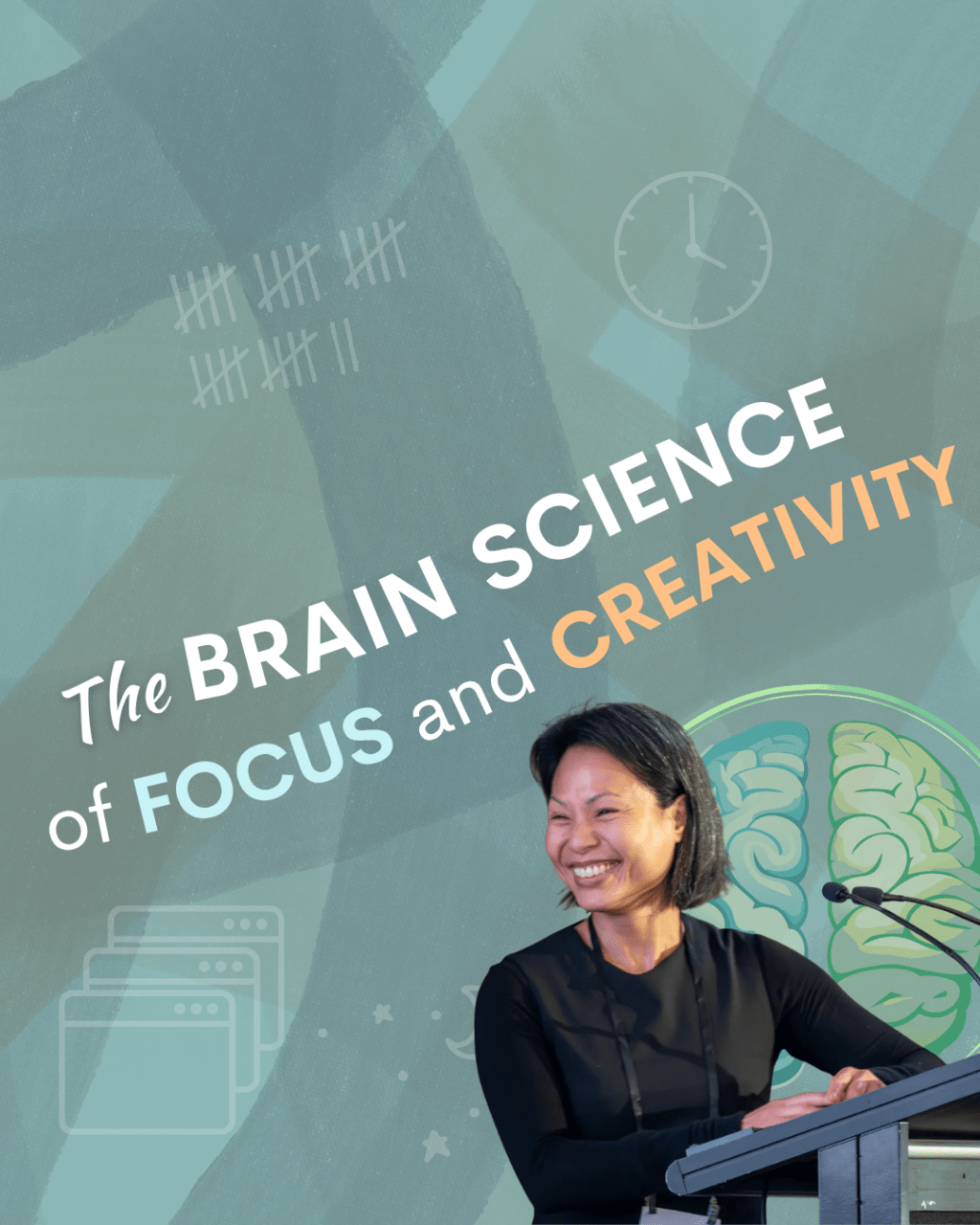
🌟[TT] Dinner 🧠
In last week’s Thursday Tips, we slowed down for a few mindful moments, attention resting on one thing at a time. A warm cup, a flower, a single breath.
This week stays with attention, but from the other side. How do you hold your focus when there is real work to get through?
Fun fact: this evening is a first for me… I am speaking as a dinner speaker, to a room of neurologists!
I have given plenty of talks. But never one where the brief was, more or less, “entertain us.” I am not a comedian, so the “entertain us” part has me smiling nervously.
And the extra challenge: “can you speak without slides?”. Ummm… wish me luck!
The odd thing is, I am looking forward to it. That little challenge is what inspired today’s Thursday Tips.
📍3 tips to stay focused and creative
[1] Start with “only twenty minutes”
Big tasks feel heavy before you begin.
Preparing this talk did. So does writing my book on the BRA(i)NS® Method.
My way in that might help you with your own big tasks: 20minutes.
I tell myself “only twenty minutes.” and set a timer. When the twenty minutes are up, I mark it as completed in my notebook (think: match-stick style check marks).
The marks add up across the day, and seeing them gives me a sense of achievement!
So when starting or staying on task is the hard part, I use this 20min method + cumulation method.
[2] Close the tabs
When I go deep on a topic, one search leads to another and the tabs pile up.
Each open tab is a small pull on my attention.
Try this tip I picked up from my nephew: on Chrome you can group tabs, then collapse the group. It’s fantastic, give it a try! That way, nothing gets lost, but the tabs stay out of sight. Which also means less distraction, and staying on task.
[3] Sleep on it
Each evening as I prepare my talk, I protect my sleep.
I expect that sleep will continue with its magic, helping me remember my talk, so I can deliver it more smoothly on the day!
📍The brain science
Tips one and two are really one idea: keep your attention in one place.
When you switch tasks, part of your attention stays stuck on the last one.
In two experiments, people who moved to a new task before fully letting go of the previous one performed worse on the new task, an effect named attention residue.*
Every open tab is a quiet invitation to switch. A protected block, even a short one, holds your attention where you want it. “Only twenty minutes” simply lowers the bar to begin.
Then there is sleep. Sleep is when the brain consolidates what you have learned, moving and stabilising memories across the night through slow-wave and REM sleep.* So a good night after rehearsal helps the lines stick.
Sleep does something more interesting, too. In one study, people learned a task with a hidden shortcut rule they had not spotted. After a night’s sleep, more than twice as many saw the rule, compared with those who stayed awake, and the time of day did not matter. The catch: this only happened for those who had trained first.* Sleep did not invent the idea. It reorganised what they had already practised, and the insight surfaced the next morning.
So if you are learning lines, a talk, or anything that matters: do the work, then sleep on it. The settling is part of the process.
📍Where this sits in the BRA(i)NS® Method
For those new to the Thursday Tips Tribe, welcome! Please see appended below a brief summary of The BRA(i)NS® Method**
Focus and creativity sit within the BRA(i)NS® pillar of Optimisation, under the principle of habits and mindset. These are the small moves that protect your attention so your foundations can do their work.
So protecting deep blocks and closing tabs are Optimisation moves, habits made easy. Sleep reaches into Building Brain Resilience, your physical foundation. And the (i) – for individualisation – fits too. How long you can focus, what pulls at your attention, and how much sleep you need all shift from person to person.
📍A question for you
Which task you have been circling would benefit from one of the 3 tips: 20min, close your tabs, or sleep?
I wonder how the seasoned actors learn and deliver their lines so well. I’m curious to learn from people outside my own field. If you have tips please share them (and send me some luck! 😊)
Wishing you focus and creativity,
Dr Sui Wong
PS – tune in next week to see if I fell flat on my face! 🤣
**What is the BRA(i)NS® Method?
It is my framework on helping you build your brain health ecosystem for consistent energy, focus and performance. It has Purpose and Meaning as its container, with three pillars inside:
> Building Brain Resilience covers your physical foundations.
Balancing the Autonomic Nervous System covers your stress and relaxation responses.
Optimisation pulls these together through mindset, habits and community.
All this is individualised to you, giving the (i) in BRA(i)NS®.
*References:
- Leroy (2009); https://www.sciencedirect.com/science/article/abs/pii/S0749597809000399
- Diekelmann & Born (2010); https://pubmed.ncbi.nlm.nih.gov/20046194/
- Wagner et al (2004) https://www.nature.com/articles/nature02223
📌 Summary
Staying focused and creative often comes down to protecting your attention. In this Thursday Tip, Dr Sui Wong shares three practical strategies: using a 20-minute focus block to get started, reducing distractions by closing tabs, and prioritising sleep to support learning and insight. Research shows that attention residue from task switching can impair performance, while sleep helps consolidate memories and can even improve problem-solving and creative thinking. Small habits that protect attention can make a meaningful difference to focus, productivity, and brain health.
❓ FAQ
Why is it harder to focus when multitasking?
Research suggests that when we switch between tasks, part of our attention remains attached to the previous activity. This phenomenon, known as attention residue, can reduce performance and concentration.
Does sleep improve creativity?
Yes. Sleep helps consolidate learning and memory, and studies suggest it may also support insight and creative problem-solving by reorganising information learned during the day.
What is the 20-minute method?
The 20-minute method involves committing to just twenty minutes of focused work. By lowering the barrier to getting started, it can help build momentum and make larger tasks feel more manageable.
Books: available where all good books are sold, in print, eBook and audiobook formats. LEARN MORE: Mindfulness for Brain Health , Break Free From Migraines Naturally, Sleep Better to Thrive, Quit Ultra-Processed Foods Now, Sweet Spot for Brain Health, Magnesium: Restore & Revitalize Your Brain & Body
My mission:
To inspire a movement for better brain health.
Because better brain health supports better wellbeing. And better wellbeing creates a ripple effect that benefits individuals, families, communities, and beyond.
Making the world a better place for all.
I am a practising medical doctor (MBBS MD FRCP MA FHEA DipIBLM) working as a Neurologist and Neuro-Ophthalmologist, and am an active neuroscience researcher. My research is inspired by questions arising from my busy clinical practice, and I am grateful that both have been recognised with awards.
I am also an Author and Speaker, creating public-facing health content in my spare time.
Learn more:
drsuiwongmd.com
>> Follow me on:
INSTAGRAM: drsuiwong.neurologist | LINKED IN: linkedin.com/in/dr-sui-wong-neurologist | YouTube: http://www.YouTube.com/@DrSuiWong
If you received this as a forwarded link, please sign up to the [TT] newsletter via bit.ly/drwongbrainhealth
Thank you for your support!
(C) 2024-2026 Dr Sui H. Wong MD FRCP


Leave a Reply