🌟[TT] shop 🧠
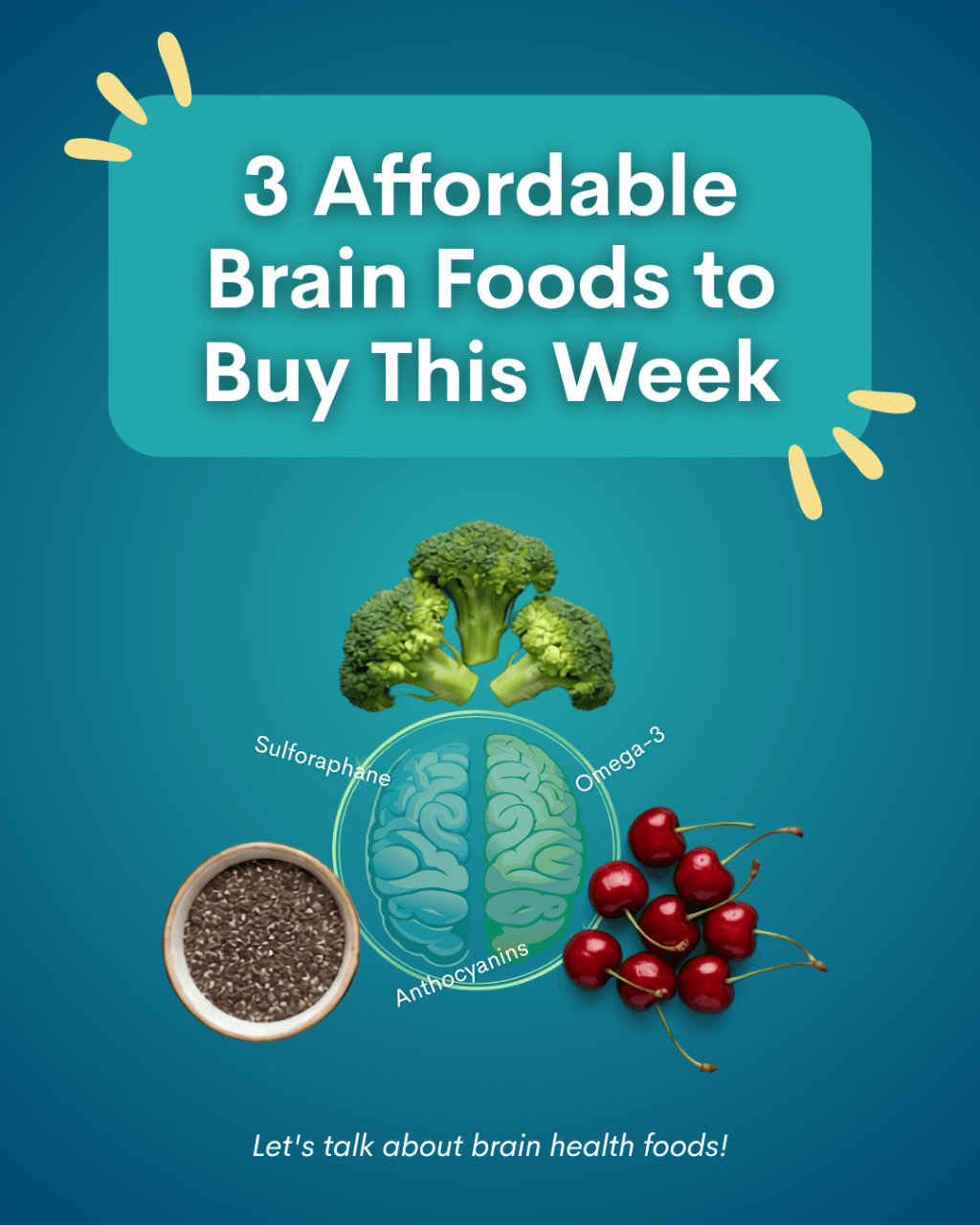
After a few weeks of Thursday Tips [TT] on mindset and habits, today we’re getting back to more “practical tacticals”. Let’s talk about brain health foods!
Do you find that brain health foods get marketed as expensive and can be hard to find?
But guess what? They don’t have to be! Here are three that are probably already on your regular shop, and widely available without breaking the bank. Let me know what you think?
📍3 Brain Foods for This Week’s Shop
(BRA(i)NS® Method: Building Brain Resilience via Nutrition and Nutrients)
[1] Broccoli
Broccoli’s brain benefit comes from sulforaphane, a compound formed when you chop or chew it. Sulforaphane is great for detoxification pathways and for antioxidants.
To enhance its effect, let it sit for 30 to 40 minutes after chopping it up, before cooking. This gives the reaction time to happen and maximise the sulforaphane content.
If you don’t have time to wait? Then add a pinch of mustard seed powder when cooking, as that also activates sulforaphane formation.
Try this: a quick blanch to keep the colour and the bite, lovely when tossed into a summer salad or grain bowl.
[2] Chia seeds
A recent “chia pitta” trend got me thinking about what these little seeds actually do for your brain (see link in PS if interested!)
Chia seeds are one of the richest plant sources of omega-3 (as ALA), and their fibre forms a gel in the gut that slows how fast sugar reaches your bloodstream after a meal.
That same fibre feeds your gut bacteria, which produce short-chain fatty acids. These can support your brain and help calm inflammation in the body.
Try this: stir a tablespoon into porridge or yoghurt and let it sit for 10 minutes to gel, rather than eating it dry. Or make it overnight in the fridge for a ready breakfast the next day.
[3] Cherries
Cherries are in season now in the Northern Hemisphere. I love cherries and guess what? They are great for your brain too!
Their deep red colour comes from anthocyanins, plant pigments with some of the better-studied antioxidant and anti-inflammatory effects among fruits.
Try this: Pick them up fresh at a farmer’s market when in season. Or buy them frozen – that still keeps the nutrients and costs less.
📍The Brain Science Behind It*
Sulforaphane switches on Nrf2, a pathway that activates your body’s own antioxidant defences. Getting it from the vegetable, not a supplement, also brings fibre and other polyphenols along for the ride.
Chia’s fibre effect on blood sugar has more direct food-based evidence. In a randomised trial, adding whole or ground chia seeds to white bread reduced the post-meal blood sugar rise by 20 to 35%, depending on the dose. Stable blood sugar matters for the brain because glucose is its main fuel; steadier levels mean steadier delivery.
Short-chain fatty acids (SCFAs) produced by the gut microbiome reach the brain, in part, by signalling through the vagus nerve. Animal studies show they can help calm brain inflammation by supporting healthy immune cell (microglia) behaviour, again mainly shown in animal studies so far. Note that this is from animal studies, hence best to take the approach of using this as motivation to support gut health generally, rather than taking SCFA supplements.
Cherries and their anthocyanins have been studied across dozens of human trials for oxidative stress and inflammation, both processes linked to brain ageing. A review pooling this research found cherries reduced markers of oxidative stress in most studies, and inflammation in around two thirds.
📍Try this week
Pick one of the three, whichever is already easiest to get into your basket, and build one small habit around it. Small and repeatable beats ambitious and abandoned.
📍Question for you this week
Which of the above 3 will you consume this week?
Wishing you a brain-healthy food shop,
Dr Sui Wong
PS – Here’s the Chia Pita trend video commentary I mentioned above:
on IG: http://instagram.com/reels/DadATcso_TK/
on YouTube: https://www.youtube.com/watch?v=jE15Bzk33mg
References:
- Ho et al (2013), https://pubmed.ncbi.nlm.nih.gov/23778782/
- Dalile et al (2019), https://pubmed.ncbi.nlm.nih.gov/31123355/
- Silva et al (2020), https://pmc.ncbi.nlm.nih.gov/articles/PMC7005631/
- Kelley et al (2018) https://pmc.ncbi.nlm.nih.gov/articles/PMC5872786/
📌 Summary
Supporting your brain health doesn’t have to mean buying expensive supplements or specialty foods. In this Thursday Tip, Dr Sui Wong highlights three affordable foods you may already have on your shopping list: broccoli, chia seeds, and cherries. Each offers unique nutrients that support brain resilience, from sulforaphane and omega-3 fatty acids to anthocyanins and gut-friendly fibre. Backed by scientific research, these everyday foods make it easier to build simple, sustainable nutrition habits for long-term brain health.
❓ FAQ
Why is broccoli considered a brain food?
Broccoli contains sulforaphane, a natural compound that activates the body’s antioxidant defence systems and supports healthy cellular function.
How do chia seeds support brain health?
Chia seeds provide plant-based omega-3 fatty acids and fibre that help support gut health, stable blood sugar, and the gut-brain connection.
Are frozen cherries as nutritious as fresh cherries?
Yes. Frozen cherries retain most of their nutrients and are an affordable way to enjoy the antioxidant benefits of anthocyanins year-round.
My mission:
To inspire a movement for better brain health.
Because better brain health supports better wellbeing. And better wellbeing creates a ripple effect that benefits individuals, families, communities, and beyond. Making the world a better place for all. And it all starts with you as the individual.
I am a practising medical doctor (MBBS MD FRCP MA FHEA DipIBLM) working as a Neurologist and Neuro-Ophthalmologist, and am an active neuroscience researcher. My research is inspired by questions arising from my busy clinical practice, and I am grateful that both have been recognised with awards.
I am also an Author and Speaker, creating public-facing health content in my spare time.
Learn more:
drsuiwongmd.com
>> Join the Brain Health Movement: Share this email with someone who will enjoy my content. See link to socials below
>> Follow me on:
INSTAGRAM: drsuiwong.neurologist | LINKED IN: linkedin.com/in/dr-sui-wong-neurologist | YouTube: http://www.YouTube.com/@DrSuiWong
If you received this as a forwarded link, please sign up to the [TT] newsletter via bit.ly/drwongbrainhealth
Thank you for your support!
Books: available where all good books are sold, in print, eBook and audiobook formats. LEARN MORE: Mindfulness for Brain Health , Break Free From Migraines Naturally, Sleep Better to Thrive, Quit Ultra-Processed Foods Now, Sweet Spot for Brain Health, Magnesium: Restore & Revitalize Your Brain & Body
NEW BOOK COMING SOON!
To be on the priority notification list and receive bonuses during the promotional period, sign up here: brainsbooklaunch.com
Other Resources:
Brain Health Podcast with Dr Sui Wong, link: brainhealth.fm
The BRA(i)NS® Clarity Community, [click here for free access]
Read my past Thursday Tips posts on drsuiwongmd.blog
If you received this as a forwarded email, please sign up for the [TT] newsletter via drwongbrainhealth.com
Apply for my next intake of the Peak Performance Brain Lab (PPBL) Mentorship: request by email
(C) 2024-2026 Dr Sui H. Wong MD FRCP
 Dr Sui Wong Empowering Your Brain Health
Leave a comment