🌟[TT] Cool 🧠
Last week’s [TT] on cherries, broccoli and chia seemed to be a hit. Thank you for your lovely replies. They come straight into my inbox, and they are how I keep these newsletters useful to you. Which is the whole reason I am here.
As I write this, much of the northern hemisphere is sitting under a persistent heatwave.
There is a serious side to this. Heatstroke is a medical emergency: the core body temperature climbs to around 40°C or above and the brain stops working properly. Confusion, agitation, slurred speech, collapse. If you ever see that, call your local emergency services.*
Thankfully, most of us will not meet that end of the spectrum. But what we encounter matters too: three broken nights in a row, a foggy afternoon, and a shorter fuse than usual.
Here are 3 things you can do to ride out this heatwave.
📍3 ways to stay cool in the heat
[1] Cool your palms, not your whole house
Growing up in Malaysia, I used to freeze a water bottle overnight and carry it around all day. I always assumed the point was the cold drink.
Turns out I was holding the useful bit!
Your palms, the soles of your feet and your face have hairless skin.
Underneath sits a dense network of specialised blood vessels that act as the body’s radiators, shifting heat out of you quickly. Cooling those surfaces moves more heat than cooling almost anywhere else on you.
A nuance here is to hold something cool rather than frozen. If the skin gets too cold, those vessels clamp shut so the transfer of heat out is less efficient.
So try holding a cool bottle in your palms for a few minutes, and even roll it across your wrists.
[2] Make the bedroom colder than you think it needs to be
Your body has to cool down to fall asleep. In a hot room it is harder to lose that heat, so you lie there awake.
Keep your bedroom cool by closing the blinds during the day, before the sun gets into the room, and opening two windows in the evening for cross airflow, once the air outside is cooler than the air inside.
[3] Give yourself grace, and give it to others
Patience can fray in the heat, both yours and people around you.
And guess what? That is not a character failure. Heat can affect mood and impulse control, in you and in others. So notice it, and give yourself and others some grace. It makes the week easier for everyone.
📍The brain science
Heat and your palms. Hairless skin, on the palms, soles and face, carries specialised blood vessels (called arteriovenous anastomoses). They behave like radiators, really, because they get blood close to the skin surface which lets heat leave fast. Fascinating research result by Stanford researchers: if the skin gets too cold, blood flow through those vessels drops and the heat exchange is compromised.* In other words, a cool surface (rather than super cold one, like an ice block) maybe work better for cooling yourself down.
Heat and sleep. A study of 765,000 people in the United States found that warmer nights were linked with self-report of worse sleep, particularly in older adults.* This makes sence because your body temperature has to fall for sleep to begin, and sleep onset is most likely at the steepest point of that fall.* So a cool room, around 19 to 21°C, is the range usually cited as optimal to assist with the body temperature drop.
Heat and patience. A 2024 systematic review pooled 83 studies and found a 10°C rise in short term temperature was linked with roughly a 9% higher risk of violent crime.* This only seemed to be linked with acts of impulse or aggression. I suspect it’s a combination of stress, poor sleep affecting emotional regulation. So take a breather (perhaps a sip of cold water?) and notice how you interact with others, when you’re feeling “hot and bothered”!
📍Where this sits in the BRA(i)NS® Method
Everything in today’s newsletter is your autonomic nervous system at work. The sweating, the vessels in your palms opening and closing, the temperature drop that lets you fall asleep. None of it is under your conscious control. That is Balancing the Autonomic Nervous System, one of the three pillars of my BRA(i)NS® Method, and this week it is working hard on your behalf.
For those new to the Thursday Tips Tribe, welcome. The BRA(i)NS® Method is my framework for building your brain health ecosystem for consistent energy, focus and performance. It has Purpose and Meaning as its container, with three pillars inside: Building Brain Resilience covers your physical foundations. Balancing the Autonomic Nervous System covers your stress and relaxation responses. Optimisation pulls these together through mindset, habits and community. All this is individualised to you, giving the (i) in BRA(i)NS®.
And the (i) here? Heat tolerance varies enormously between people. Age, medication, and how well you sleep in the first place all shift where your line sits.
📍Question for you today
Which of these cooling strategies will you try this week?
Hit reply, it comes straight to my inbox.
Keeping cool with you,
Dr Sui Wong
PS: Heat and health is not just a personal matter. There is a bigger question about our planet and its impact on human health. The Lancet Countdown, which tracks climate and health each year, now puts heat related deaths at around 546,000 a year.* UK health professionals are pushing on this through the UK Health Alliance on Climate Change, which represents about a million of us, my own Association of British Neurologists among them. Planetary health is human health.
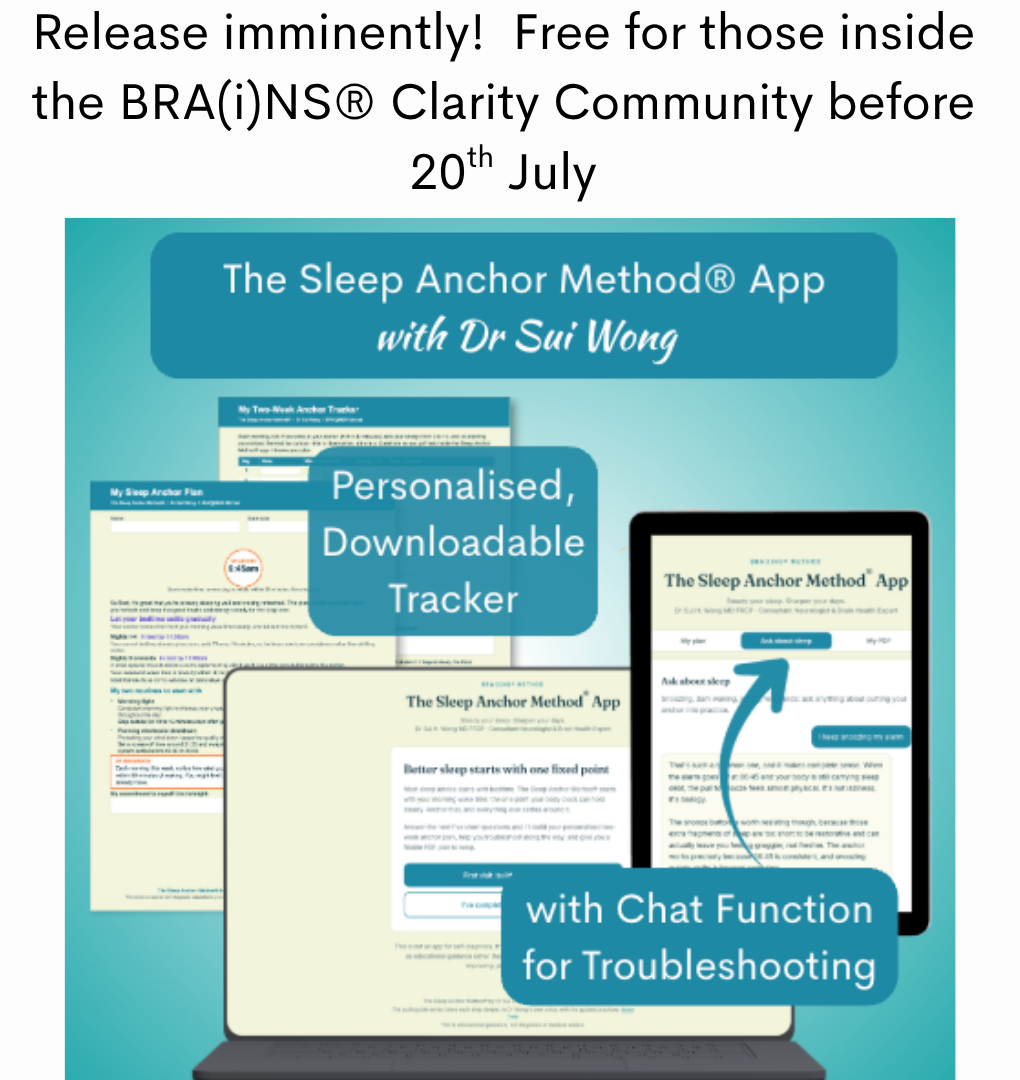
PPS: I’m excited to announce that (finally!) I’ve built an AI tool based on my Sleep Anchor Method®! It’s an app to create a personalised tracker, with a companion chat for troubleshooting and questions. I’m giving it away for free to people in my BRA(i)NS® Clarity Community. If you’re not there yet, I invite you to join us before the end of this week to get this free gift! LINK:https://www.skool.com/dr-sui-wong-brains-group-3768/about
I set up the free BRA(i)NS® Clarity Community, as part of my mission of creating a brain health movement (see below). I hope that this space for like-minded and positive people wanting to chat about brain health and wellbeing can be helpful and supportive. I hope you can join us!
*References
Heat exhaustion and heatstroke. NHS, 2025.
https://www.nhs.uk/conditions/heat-exhaustion-heatstroke/
NHS 2025; https://www.nhs.uk/conditions/heat-exhaustion-heatstroke/
Grahn et al 2009; https://asmedigitalcollection.asme.org/crawlprevention/governor?content=%2fbiomechanical%2farticle-abstract%2f131%2f7%2f071005%2f400891
Obradovich et al 2017; https://pubmed.ncbi.nlm.nih.gov/28560320/
Harding et al 2019; https://pubmed.ncbi.nlm.nih.gov/31105512/
Choi et al 2024; https://pubmed.ncbi.nlm.nih.gov/39404825/
Romanello et al 2025 https://www.thelancet.com/journals/lancet/article/PIIS0140-6736(25)01919-1/abstract
https://www.nhs.uk/conditions/heat-exhaustion-heatstroke
Summary
Hot weather doesn’t just leave you feeling uncomfortable. It can affect your concentration, sleep quality, mood, and overall brain function. In this Thursday Tip, Dr Sui Wong explains the science behind staying cool, from cooling your palms and improving airflow in your bedroom to understanding why heat can make us feel more irritable. Supported by neuroscience and physiology, these simple strategies can help you stay comfortable while protecting your brain during periods of extreme heat.
FAQ
Why does hot weather make it harder to sleep?
Your body needs to lower its core temperature before you can fall asleep. A hot bedroom makes this cooling process more difficult, which can delay sleep and reduce sleep quality.
Why does cooling your palms help?
The palms contain specialised blood vessels that help transfer heat away from the body. Holding something cool, rather than ice cold, can support natural heat loss more effectively.
Can heat affect mood and concentration?
Yes. Research suggests higher temperatures can increase mental fatigue, reduce concentration, and affect emotional regulation, making people feel more irritable or impulsive.
My mission:
To inspire a movement for better brain health.
Because better brain health supports better wellbeing. And better wellbeing creates a ripple effect that benefits individuals, families, communities, and beyond. Making the world a better place for all. And it all starts with you as the individual.
I am a practising medical doctor (MBBS MD FRCP MA FHEA DipIBLM) working as a Neurologist and Neuro-Ophthalmologist, and am an active neuroscience researcher. My research is inspired by questions arising from my busy clinical practice, and I am grateful that both have been recognised with awards.
I am also an Author and Speaker, creating public-facing health content in my spare time.
Learn more:
drsuiwongmd.com
>> Join the Brain Health Movement: Share this email with someone who will enjoy my content. See link to socials below
>> Follow me on:
INSTAGRAM: drsuiwong.neurologist | LINKED IN: linkedin.com/in/dr-sui-wong-neurologist | YouTube: http://www.YouTube.com/@DrSuiWong
If you received this as a forwarded link, please sign up to the [TT] newsletter via bit.ly/drwongbrainhealth
Thank you for your support!
Books: available where all good books are sold, in print, eBook and audiobook formats. LEARN MORE: Mindfulness for Brain Health , Break Free From Migraines Naturally, Sleep Better to Thrive, Quit Ultra-Processed Foods Now, Sweet Spot for Brain Health, Magnesium: Restore & Revitalize Your Brain & Body
NEW BOOK COMING SOON!
To be on the priority notification list and receive bonuses during the promotional period, sign up here: brainsbooklaunch.com
Other Resources:
Brain Health Podcast with Dr Sui Wong, link: brainhealth.fm
The BRA(i)NS® Clarity Community, [click here for free access]
Read my past Thursday Tips posts on drsuiwongmd.blog
If you received this as a forwarded email, please sign up for the [TT] newsletter via drwongbrainhealth.com
Apply for my next intake of the Peak Performance Brain Lab (PPBL) Mentorship: request by email
(C) 2024-2026 Dr Sui H. Wong MD FRCP
 Dr Sui Wong Empowering Your Brain Health
Leave a comment