🌟[TT] Stages 🧠
A couple of months ago, I took my first group through the Peak Performance Brain Lab (PPBL) Mentorship – it was such a privilege to work with this small and select group. 😊
When we looked back at what had shifted most for people, sleep came up again and again. Not necessarily more hours, but better ones.
This is also the week when many parents start to prepare for the start of the academic year, jet lag might be an issue: whether it’s people travelling back from different timezones, or “social jetlag” with a drift into late nights during the Summer break.
With all that in mind, I thought sleep (and its stages) would be a great topic for this week’s Thursday Tips!
Sleep is not one flat state. It runs in cycles of roughly 90 minutes, going through the light, deep, and Rapid Eye Movement sleep stages. The deep, slow-wave sleep stage (important for your brain’s “overnight housekeeping”) is weighted towards the first half of the night’s sleep.
Which means when you sleep matters as much as how long.
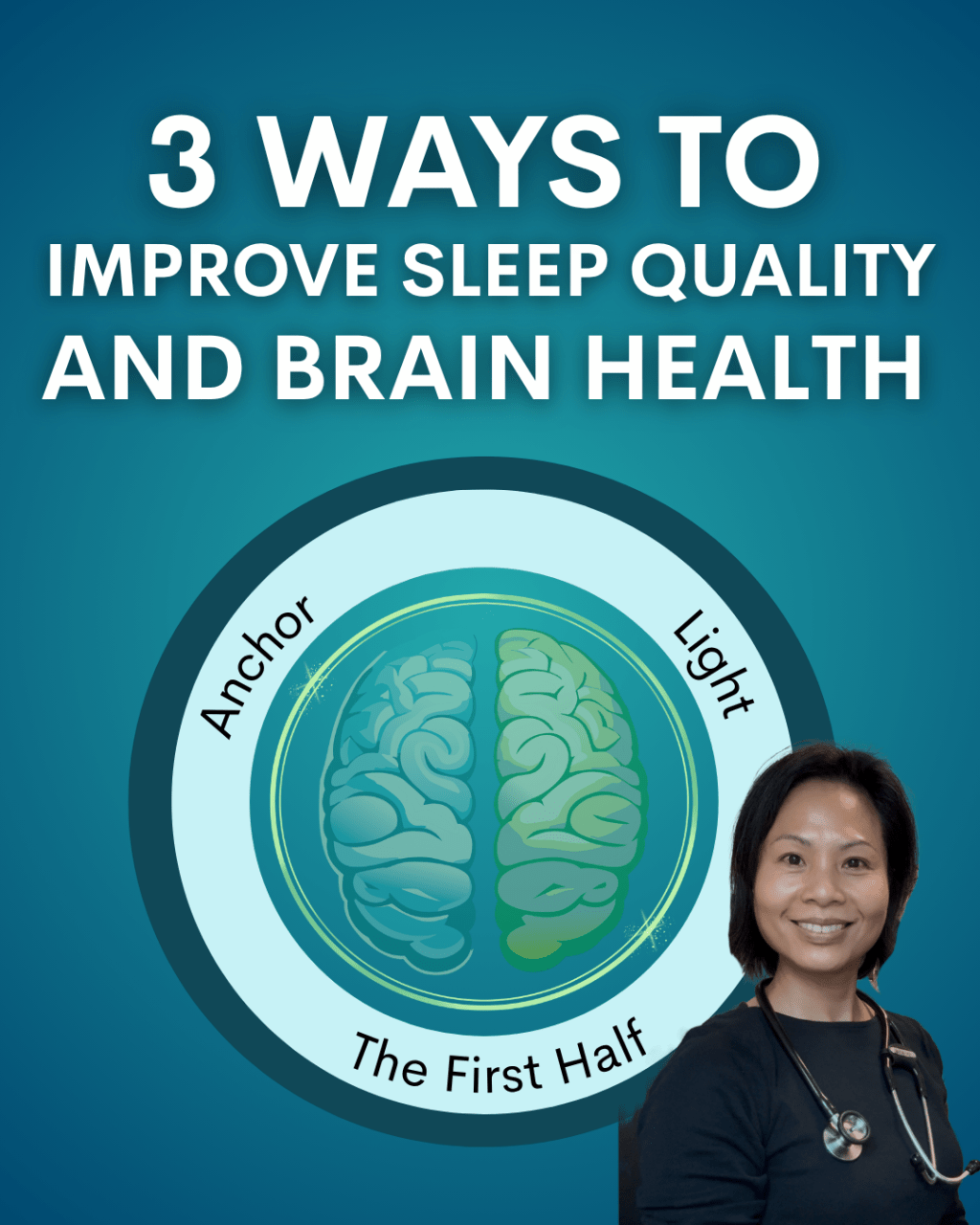
Here are 3 fixes to help what most people get wrong:
📍3 Ways to Improve Your Sleep Quality
[1] Anchor your wake time, not your bedtime
Pick one wake time and hold it, weekends included, within about 30 minutes.
You’re probably thinking, “Wait, you want me to wake early on a weekend?!”
I know it’s a big shift in thinking, particularly if you’re sleep-deprived during the workweek, but hear me out.
Your body clock takes its instruction from when you wake and see light, not from when you decide to go to bed.
By keeping the same wake time, you’ll support your inner body clock (circadian rhythm), which helps promote better-quality sleep.
Try this: set the same alarm on Saturday. If you are sleep-deprived, schedule a 20- to 30-minute early-afternoon nap instead of a lie-in. And yes, you heard me right: I said to nap. I sometimes prescribe naps to my patients!
[2] Get light into your eyes early
Aim for 10 to 20 minutes of outdoor light within an hour of waking.
Outdoor light, even under heavy clouds, is far brighter than anything indoors. This is the strongest signal your inner body clock receives.
I also use a bright light indoors for the winter period.
Try this: attach it to something you already do in the morning. The walk to the station, the first coffee taken outside, the dog.
[3] Protect the first half
Your deepest sleep occurs most in the first half of your night’s sleep.
And that is the part you want to protect as it’s part of your brain’s “overnight housekeeping” with clearing metabolic waste and embedding long-term memories.
The usual culprits that fragment deep sleep are at the end of a working day: a late heavy dinner, a nightcap, and scrolling on your phone in bed (I’ve done that!).
Try this: move one of these 3 common disrupters, e.g. dinner earlier (or lighter), less or no alcohol, or have your phone’s charging point away from your bed. Just one is enough for now as it’s a big shift 😊
📍Bonus tip if you are travelling
The same two levers do the work for jet lag and for the late nights of a Summer break: timed light and a shifted sleep schedule, adjusted for the direction of travel. Anchor the wake time to the zone (or the term-time schedule) you are moving into, get light at the right end of that new day, and the clock moves faster than it would if you simply waited it out.
📍The Brain Science*
Slow-wave activity is highest in the first sleep cycles and declines over the night. So the front of your night and the back of it are doing different jobs.
In deep non-REM sleep, human brain imaging shows large, slow pulses of cerebrospinal fluid washing in and out, locked to the brain’s slow electrical waves.
The clearance work itself has been shown most directly in mice, where the fluid-exchange space between brain cells widens during sleep and waste proteins are removed faster. So the cell-level clearance comes from animal work and the fluid dynamics from human work. Taken together, I think both are strong enough signals to protect your deep sleep.
Your body clock sets the timing of all this, and light is its main input. When people went camping without electric light, their internal clock shifted to align with sunrise and sunset within a week.
And regularity does the heavy lifting! In a large UK Biobank study using week-long activity monitors, the consistency of people’s sleep-wake timing predicted health outcomes more strongly than the number of hours they slept. That study is observational, so it shows association rather than causation. It still points somewhere useful.
How many hours is optimal? Expert consensus puts 7 to 9 hours as appropriate for most adults, with 6 to 10 reasonable depending on the person. There is no single correct number. There is a correct-for-you number, and a steady rhythm is how you find it.
📍Where this sits in the BRA(i)NS® Method
Sleep is a principle inside Building Brain Resilience, your physical foundations.
For those new to the Thursday Tips Tribe: the BRA(i)NS® Method has Purpose and Meaning as its container, with three pillars inside.
Building Brain Resilience covers your physical foundations.
Balancing the Autonomic Nervous System covers your stress and relaxation responses.
Optimisation pulls these together through mindset, habits and community.
All of it individualised to you, giving the (i).
Wind-down and a settled nervous system before bed sit in Balancing the ANS, which improves sleep. Holding the wake time on a Saturday is an Optimisation move, a habit made easy. And the (i) is the whole point here: your hours, your chronotype, your rhythm.
📍Question for you today
What time will you set your alarm for this Saturday? 😊
Wishing you a steadier rhythm this week,
Dr Sui Wong
PS – Many of you have been asking for more sleep tips, and based on the challenges I see among busy people and high achievers, I created the My Sleep Anchor Method® App, which gives you a personalised downloadable tracker and a companion troubleshooting chatbot built on my method and experience. [CLICK HERE TO LEARN MORE]

PPS – Thank you for your many messages of support about the exciting news I shared 2 days ago! If you didn’t see it, please check out my new public podcast, launching live on 1st October. 🥳 Catch the 3-minute teaser here:
Apple Podcasts: https://podcasts.apple.com/us/podcast/brain-health-fm-with-neurologist-dr-sui-wong/id6804728798
Spotify: https://open.spotify.com/show/0pPlHk1IQyEGQug8XkqXqX
Or search your podcast player for: Brain Health FM with neurologist Dr Sui Wong
More information here: www.BrainHealth.fm

*References:
- Dijk 2009 https://pubmed.ncbi.nlm.nih.gov/19998869/
- Fultz et al 2019 https://pubmed.ncbi.nlm.nih.gov/31672896/
- Xie et al 2013 https://pubmed.ncbi.nlm.nih.gov/31672896/
- Wright et al 2013 https://pubmed.ncbi.nlm.nih.gov/24136970/
- Windred et al 2024 https://pubmed.ncbi.nlm.nih.gov/37738616/
- Hirshkowitz et al 2015 https://pubmed.ncbi.nlm.nih.gov/29073412/
- Eastman et al 2009 https://pubmed.ncbi.nlm.nih.gov/20204161/
What are the best ways to improve sleep quality?
Sleep quality can be supported by keeping a consistent wake time, getting outdoor light soon after waking, and protecting the first half of the night. Sleep runs in cycles of roughly 90 minutes, with deep, slow-wave sleep weighted towards the first half of sleep.
How can you improve your sleep quality?
Three practical ways to support better sleep are:
- Anchor your wake time: Pick one wake time and keep it consistent, including weekends, within about 30 minutes.
- Get light into your eyes early: Aim for 10 to 20 minutes of outdoor light within an hour of waking to support your body clock.
- Protect the first half of your sleep: Deep, slow-wave sleep is weighted towards the first half of the night, so reduce common disruptors such as late heavy meals, alcohol and phone use in bed.
How to improve your sleep quality step-by-step
- Choose your wake time: Pick one wake time that you can maintain seven days a week.
- Keep it consistent: Aim to stay within about 30 minutes of that time, including weekends.
- Get outdoor light: Spend 10 to 20 minutes outside within an hour of waking.
- Protect your first sleep cycles: Look at what may be disrupting your early-night sleep.
- Change one thing: Try moving dinner earlier, reducing alcohol, or charging your phone away from your bed.
- If sleep-deprived, consider a short nap: Dr Sui suggests a 20 to 30 minute early-afternoon nap rather than a weekend lie-in.
Frequently Asked Questions About Sleep Quality
Why is a consistent wake time important for sleep?
A consistent wake time helps support your inner body clock, or circadian rhythm. Your body clock takes an important signal from when you wake and see light, which helps set up better quality sleep.
How much outdoor light should you get after waking?
Dr Sui recommends aiming for 10 to 20 minutes of outdoor light within an hour of waking. Outdoor light, even under heavy clouds, is much brighter than indoor light and provides a strong signal to your body clock.
Why is the first half of the night important?
Deep, slow-wave sleep is weighted towards the first half of the night. This is an important part of the brain’s “overnight housekeeping”, including processes involving cerebrospinal fluid movement and memory.
How many hours of sleep do adults need?
Expert consensus cited in the blog puts 7 to 9 hours as appropriate for most adults, with 6 to 10 hours being reasonable depending on the individual. There is no single correct number for everyone.
Can the same sleep habits help with jet lag?
The blog explains that timed light and a shifted sleep schedule can help with jet lag. The wake time and light exposure should be adjusted according to the direction of travel and the new time zone.
What should you avoid before sleep?
Common disruptors mentioned in the blog include a late heavy dinner, alcohol and scrolling on your phone in bed. The suggestion is to change just one of these habits to start.
What is the BRA(i)NS® Method’s approach to sleep?
Sleep is part of Building Brain Resilience, which covers physical foundations. Sleep also connects with Balancing the Autonomic Nervous System through winding down and settling the nervous system before bed, while keeping a consistent wake time can support Optimisation through habit.
What is the main takeaway for better sleep?
Start with your wake time. Keep it consistent, get outdoor light early, and protect the first half of your night. The exact sleep rhythm should still be individualised to you, including your sleep needs and chronotype.
My mission:
To inspire a movement for better brain health.
Because better brain health supports better wellbeing. And better wellbeing creates a ripple effect that benefits individuals, families, communities, and beyond. Making the world a better place for all. And it all starts with you as the individual.
I am a practising medical doctor (MBBS MD FRCP MA FHEA DipIBLM) working as a Neurologist and Neuro-Ophthalmologist, and am an active neuroscience researcher. My research is inspired by questions arising from my busy clinical practice, and I am grateful that both have been recognised with awards.
I am also an Author and Speaker, creating public-facing health content in my spare time.
Learn more:
drsuiwongmd.com
>> Join the Brain Health Movement: Share this email with someone who will enjoy my content. See link to socials below
>> Follow me on:
INSTAGRAM: drsuiwong.neurologist | LINKED IN: linkedin.com/in/dr-sui-wong-neurologist | YouTube: http://www.YouTube.com/@DrSuiWong
If you received this as a forwarded link, please sign up to the [TT] newsletter via bit.ly/drwongbrainhealth
Thank you for your support!
Books: available where all good books are sold, in print, eBook and audiobook formats. LEARN MORE: Mindfulness for Brain Health , Break Free From Migraines Naturally, Sleep Better to Thrive, Quit Ultra-Processed Foods Now, Sweet Spot for Brain Health, Magnesium: Restore & Revitalize Your Brain & Body
NEW BOOK COMING SOON!
To be on the priority notification list and receive bonuses during the promotional period, sign up here: brainsbooklaunch.com
Sleep Anchor Method®
Audioguide Series with Dr Sui Wong [learn more]
AI tool trained on Dr Sui Wong’s Sleep Anchor Method® to create a personalised, downloadable tracker, and a companion Chatbot for troubleshooting & questions [learn more]
Other Resources:
Brain Health Podcast with Dr Sui Wong, link: brainhealth.fm
The BRA(i)NS® Clarity Community, [click here for free access]
Read my past Thursday Tips posts on drsuiwongmd.blog
If you received this as a forwarded email, please sign up for the [TT] newsletter via drwongbrainhealth.com
Apply for my next intake of the Peak Performance Brain Lab (PPBL) Mentorship: request by email
(C) 2024-2026 Dr Sui H. Wong MD FRCP


Leave a Reply