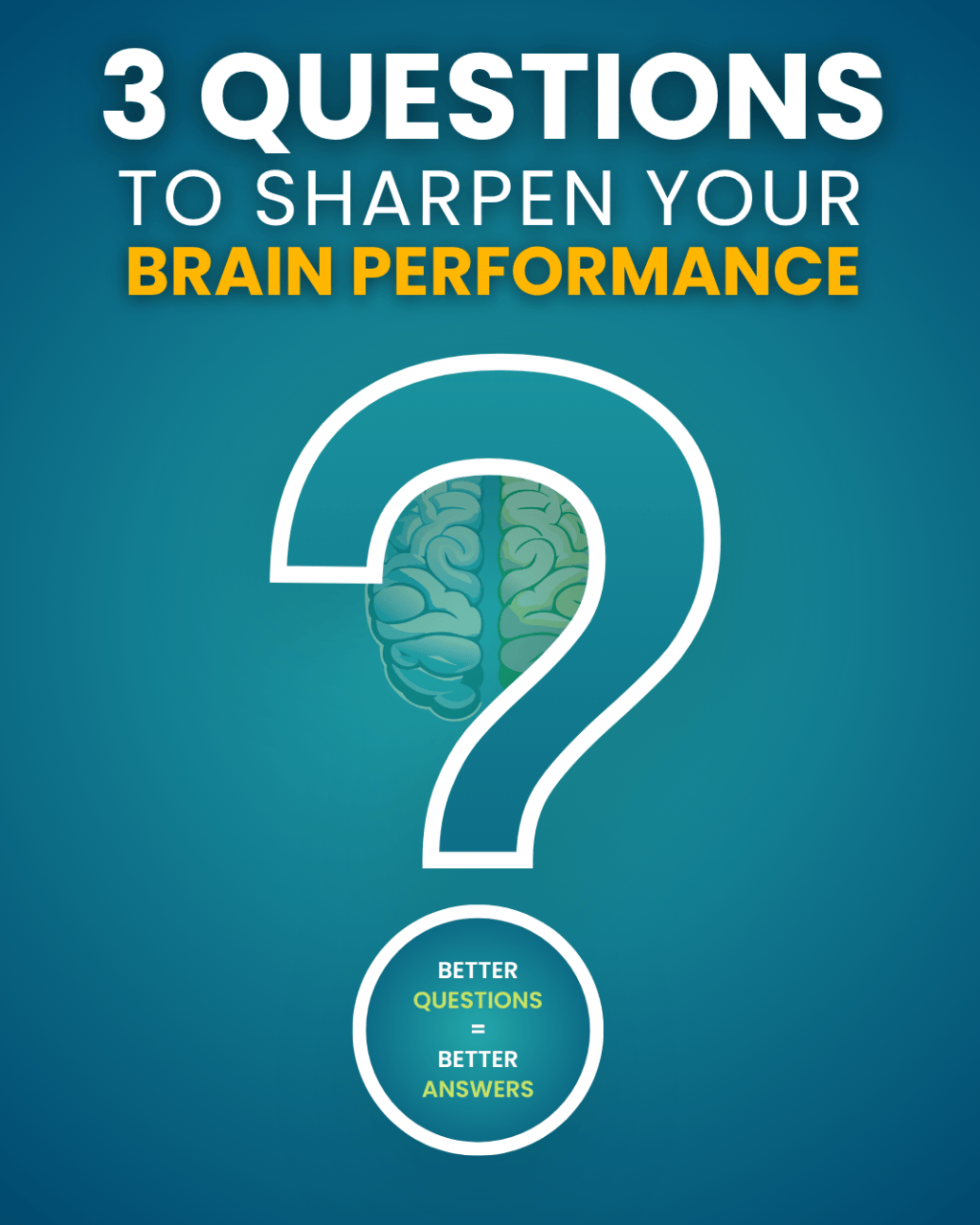
🌟[TT] Questions 🧠
Have you heard this before: the quality of your questions determines the quality of your answers?
I first heard some version of this decades ago, and it’s stayed with me every time I’m learning something new.
You may remember one of my past [TT] called I/O, on inputs and outputs: the inputs that shape your brain included nutrients, self-talk, and information. Today’s Thursday Tips are about a different kind of input: the questions you ask yourself.
A question is an input too. A poor one narrows what your brain looks for. A good one opens it up.
If you’re a high achiever intending to improve some aspects of your brain performance and wonder why it is not sticking yet, here are 3 questions I’d ask you to consider:
📍3 Questions to Sharpen Your Brain Performance
[1] What can I learn from this?
When you are learning something new and it feels clumsy, the reflex question is “why am I so bad at this?” That question has one answer, and it is not a useful one.
If your working life has been built on being the quickest in the room, that clumsiness stings more than it should. It gets read as a verdict on your brain, rather than what it usually is: the ordinary feel of a skill you have not built yet.
“What can I learn from this?” treats the stumble as information instead. It’s not failure, it’s data.
Try this: the next time something goes badly this week, write one line before you move on. What did that just tell me?
[2] What could make this easier?
“Why can’t I stick to this?” tends to fish for evidence of your own inadequacy and finds it easily.
“What would make this easier?” looks for a solution, not a verdict.
Try this: pick one habit you’ve been struggling with. Ask “what would make this 10% easier?” instead.
[3] What would I say to a friend going through this?
Judges recuse themselves from cases too close to home, because being too close can affect judgment.
Your brain works the same way. Give a little distance, and the fog lifts.
Try this: picture a good friend ringing you with your exact problem. What would you say to them? Now say it back to yourself, in those words.
📍The Brain Science Behind It*
You may have heard that better questions redirect your brain’s reticular activating system, the filter that decides what sensory information reaches your conscious attention. It’s a popular idea in self-help writing, but the reticular activating system is an arousal system: it sets how awake and alert you are, not what gets through. The filtering job belongs to a different brain structure with a confusingly similar name, the thalamic reticular complex. The effects below are real; they just work through another route.
Change the words you use for self-talk, and the effect is measurable. Across seven studies of social stress, people who reflected using their own name or “you,” instead of “I,” felt less rattled. They rated the same stressor as more of a challenge and less of a threat, and outside observers rated their performance as better.
Self-compassion works a similar trick on motivation. Across four experiments, people who met their own mistakes with compassion, rather than a harsher self-esteem lens, tried harder afterwards. They spent longer studying after failing a test, and reported more motivation to put things right.
On perspective, this is sometimes called Solomon’s Paradox. We’re wiser about other people’s problems than our own. Prompting people to step back from their own dilemma, rather than stay immersed in it, closed that gap. Their reasoning became as sound as when advising someone else.
The same problem looks fuzzy up close and clear from a step back.
📍Where this sits in the BRA(i)NS® Method
Questions sit within the BRA(i)NS® Pillar of Optimisation, under the principles of Mindset and Habits. How you frame a question to yourself is a habit like any other, and one of the more overlooked mindset tools you have.
A quick summary for those new to the Thursday Tips Tribe (welcome!), the BRA(i)NS® Method has Purpose and Meaning as its container, with three pillars inside:
- Building Brain Resilience covers your physical foundations.
- Balancing the Autonomic Nervous System covers your stress and relaxation responses.
- Optimisation pulls these together through mindset, habits and community.
- All this is individualised to you, giving the (i) in BRA(i)NS®.
So today’s questions sit mainly in Optimisation, but they touch ANS too, since a kinder question settles the stress response much as a slower breath does. And the (i) fits, because the right question, and the right way to ask it, lands differently for each of you.
📍Question for you today
Which of the three questions above is the most helpful swap for this week?
Hit reply, I’d love to hear which one lands.
Wishing you better questions and the answers that follow,
Dr Sui Wong
PS: Thank you for your supportive messages since I announced the launch of my public podcast! I have a section called “quick fire questions” at the end, where I answer questions submitted by listeners. If you have questions from my [TT] or anything else brain performance-related that you’d like me to cover in my podcast please let me know here: www.BrainHealth.fm
*References:
- Kross et al (2014) https://pubmed.ncbi.nlm.nih.gov/24467424/
- Breines & Chen (2012) https://pubmed.ncbi.nlm.nih.gov/22645164/
- Grossmann & Kross (2014) https://pubmed.ncbi.nlm.nih.gov/24916084/
- Crick (1984) https://pubmed.ncbi.nlm.nih.gov/6589612/

What questions can improve brain performance?
Questions can influence how you interpret challenges, approach habits and respond to mistakes. Asking “What can I learn from this?”, “What could make this easier?” and “What would I say to a friend?” can encourage learning, problem-solving and a more compassionate perspective.
How can asking better questions improve your mindset?
The questions you ask yourself can change what you focus on and how you respond to difficult situations.
- Ask what you can learn: This turns a setback into information rather than treating it as a verdict on your ability.
- Ask what could make things easier: This shifts attention from self-criticism towards finding a practical solution.
- Ask what you would say to a friend: This creates distance from your own problem and can help you respond with more perspective.
What are the 3 questions to ask yourself?
| Question | What it can help with | BRA(i)NS® principle |
|---|---|---|
| What can I learn from this? | Learning from mistakes | Mindset |
| What could make this easier? | Making habits more achievable | Habits |
| What would I say to a friend going through this? | Gaining perspective | Mindset |
How can you use these questions in everyday life?
- Notice the difficult moment: Pay attention when something goes wrong or a habit feels difficult.
- Change the question: Replace self-critical questions with one of the three questions above.
- Write down your answer: Even one sentence can help you turn the situation into useful information.
- Take action: Use the answer to make one small change.
- Repeat it: Asking better questions can become a habit in itself.
FAQ
Can asking questions improve brain performance?
Better questions can influence how you approach learning, habits, mistakes and stressful situations. The blog focuses on questions as a form of input that can shape self-talk, problem-solving and perspective.
What is a good question to ask when something goes wrong?
Ask, “What can I learn from this?” This reframes the setback as information and gives you something useful to take forward.
What question can help make a difficult habit easier?
Ask, “What could make this easier?” Instead of looking for evidence that you cannot stick to something, the question directs your attention towards a practical solution.
What can you ask yourself when you are being too hard on yourself?
Ask, “What would I say to a friend going through this?” Imagining how you would respond to someone you care about can create some distance and help you approach your own situation more fairly.
What is Solomon’s Paradox?
Solomon’s Paradox describes the tendency to reason more wisely about other people’s problems than our own. Taking a step back from your own dilemma can help create the same kind of perspective you might have when advising a friend.
Is positive self-talk good for brain health?
The blog’s research section points to evidence that changing the way you refer to yourself during stressful situations can affect how you experience and respond to stress. Self-compassion research also suggests that responding to mistakes with compassion can support motivation.
How does self-talk affect performance?
Research discussed in the blog found that people who used their own name or “you” rather than “I” when reflecting on social stress felt less rattled, viewed the stressor more as a challenge than a threat, and were rated as performing better by outside observers.
Where do questions fit within the BRA(i)NS® Method?
Questions sit mainly within Optimisation, particularly Mindset and Habits. The way you frame questions is a mindset practice, while repeatedly using helpful questions can turn them into a habit. The approach is also individualised, giving the “(i)” in BRA(i)NS®.
Summary
The questions you ask yourself can shape how you respond to challenges, mistakes and habits. In this Thursday Tips, Dr Sui Wong shares three questions to help sharpen brain performance: What can I learn from this? What could make this easier? And what would I say to a friend going through this?
My mission:
To inspire a movement for better brain health.
Because better brain health supports better wellbeing. And better wellbeing creates a ripple effect that benefits individuals, families, communities, and beyond. Making the world a better place for all. And it all starts with you as the individual.
I am a practising medical doctor (MBBS MD FRCP MA FHEA DipIBLM) working as a Neurologist and Neuro-Ophthalmologist, and am an active neuroscience researcher. My research is inspired by questions arising from my busy clinical practice, and I am grateful that both have been recognised with awards.
I am also an Author and Speaker, creating public-facing health content in my spare time.
Learn more:
drsuiwongmd.com
>> Join the Brain Health Movement: Share this email with someone who will enjoy my content. See link to socials below
>> Follow me on:
INSTAGRAM: drsuiwong.neurologist | LINKED IN: linkedin.com/in/dr-sui-wong-neurologist | YouTube: http://www.YouTube.com/@DrSuiWong
If you received this as a forwarded link, please sign up to the [TT] newsletter via bit.ly/drwongbrainhealth
Thank you for your support!
Books: available where all good books are sold, in print, eBook and audiobook formats. LEARN MORE: Mindfulness for Brain Health , Break Free From Migraines Naturally, Sleep Better to Thrive, Quit Ultra-Processed Foods Now, Sweet Spot for Brain Health, Magnesium: Restore & Revitalize Your Brain & Body
NEW BOOK COMING SOON!
To be on the priority notification list and receive bonuses during the promotional period, sign up here: brainsbooklaunch.com
Sleep Anchor Method®
Audioguide Series with Dr Sui Wong [learn more]
AI tool trained on Dr Sui Wong’s Sleep Anchor Method® to create a personalised, downloadable tracker, and a companion Chatbot for troubleshooting & questions [learn more]
Other Resources:
Brain Health Podcast with Dr Sui Wong, link: brainhealth.fm
The BRA(i)NS® Clarity Community, [click here for free access]
Read my past Thursday Tips posts on drsuiwongmd.blog
If you received this as a forwarded email, please sign up for the [TT] newsletter via drwongbrainhealth.com
Apply for my next intake of the Peak Performance Brain Lab (PPBL) Mentorship: request by email
(C) 2024-2026 Dr Sui H. Wong MD FRCP


Leave a Reply