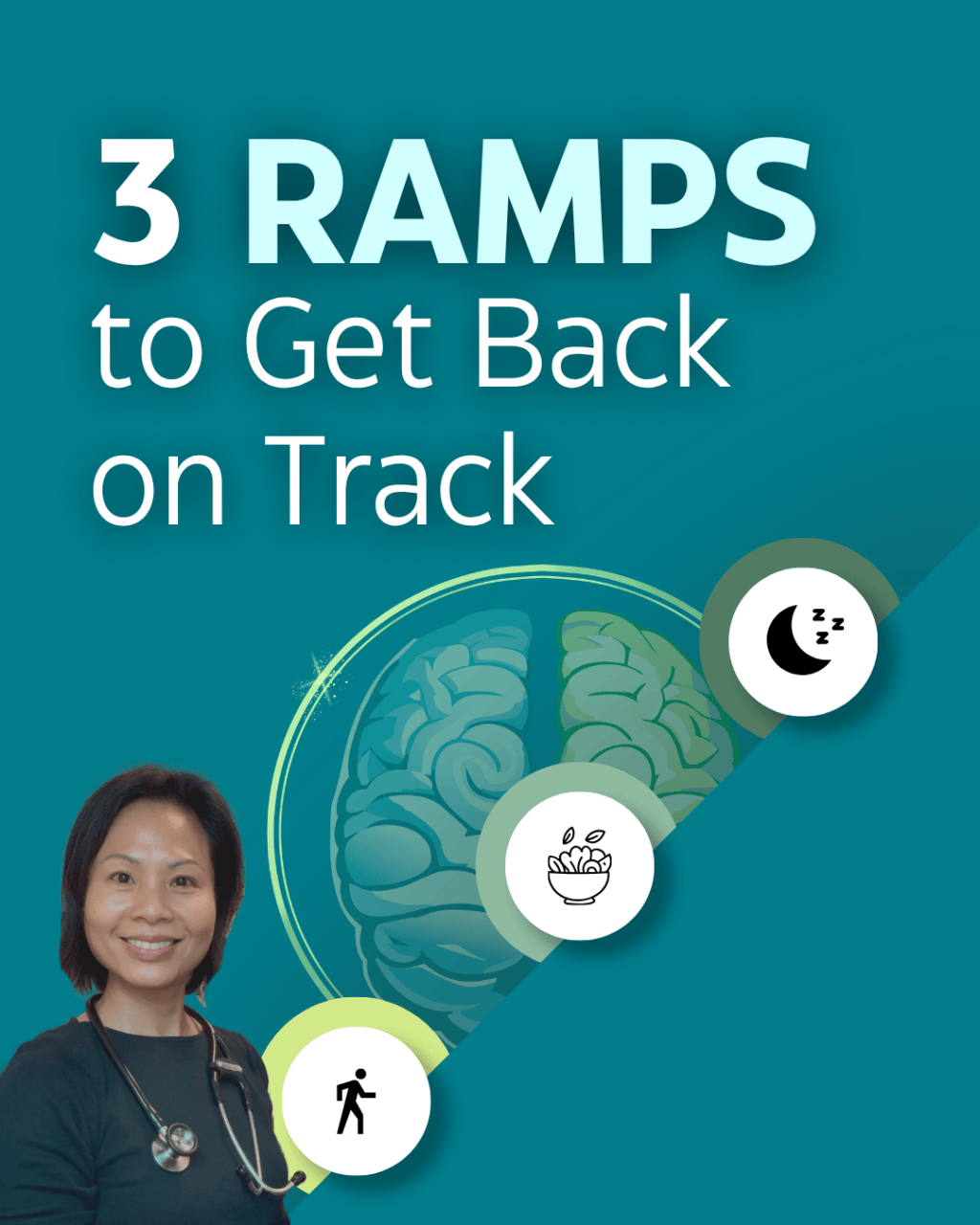
🌟[TT] Ramp 🧠
Thank you for your encouraging words and feedback on the launch of my podcast, Brain Health FM, last week!
As I settle back into my daily routine, the idea of a ramp has been particularly front and centre for me this week.
It’s taking me a while to adjust my inner body clock back to the UK. On the way back from the USA, I think my body clock got lost over the Atlantic, maybe misdirected to Iceland 🤣
This jet lag has affected my morning mindful movement practice. My physical fitness routine has also taken a hit from all the travel, compounded by sleep deprivation that has reduced my strength and endurance.
So the concept of a ramp has been helpful as I get back to my sleep schedule and fitness routines.
Consider a ramp when you’re returning to your best, whether after an illness, travel, or a change in routine.
Your ramp can be as long or as short as you wish. Think of it as the build-up back to where you used to be, or to where you want to get to.
Very often I see high achievers take an “all or nothing” approach, where not completing something as intended is taken as failure. With Q4 under way and year-end pressure building, that pattern tends to get louder.
If this is you, here’s what I’d suggest instead.
📍 Three ramps back to your edge
[1] Physical activity: keep the slot, shrink the session
Does a 45-minute exercise session feel out of reach? Block the time in your diary and cut the content by half or more.
The appointment is the habit, and the exercise volume can climb back week by week.
Try this: start with a 10-minute brisk walk in your usual exercise slot. That counts as a full win. As it gets easier, add five minutes each time.
[2] Nutrition: one meal at a time
Perhaps your nutrition has slipped, and you’re relying more on convenience foods, and you want to get back on track.
Rather than an overnight overhaul that leaves you feeling like you’ve failed when you miss the mark, start with one less-processed lunch.
Try this: swap one convenience lunch this week for one built from whole foods: leftovers from last night’s dinner, or a bowl of beans, grains, leafy greens and olive oil. Next week, make it two.
[3] Sleep: five minutes counts
Let’s say you’re working to improve your sleep and want to introduce a 20- or 30-minute evening wind-down routine.
Use the ramp concept: start with five minutes of your wind-down routine and build from there.
Try this: read a printed book for five minutes instead of scrolling on your phone before bed. As it becomes routine, extend your reading, or add a few minutes of breathwork.
📍 The Brain Science*
Why a ramp works better than a cliff edge:
Missing a day doesn’t reset the clock. In a study following 96 people building a new daily eating, drinking or exercise habit over 12 weeks, missing a single opportunity did not materially affect how the habit formed. Time to automaticity ranged from 18 to 254 days, with a median of 66. That spread is like the (i) in BRA(i)NS®, individualised, in action.
How you speak to yourself after a slip matters. In a series of experiments, people prompted to respond to failure with self-compassion studied longer for a difficult test after an initial failure and reported greater motivation to change a personal weakness than those given a self-esteem prompt or no intervention. Being kind to yourself isn’t letting yourself off the hook. It appears to fuel the next step.
Small doses are not wasted doses. A meta-analysis of 79 studies found that a single exercise session provides a small but consistent lift in cognitive performance: during exercise, immediately after, and after a delay. I think this is a helpful point for your ramp: even a short session counts.
What’s on your plate matters for your brain. In a Brazilian study following over 10,000 adults for around eight years, those who got more of their daily energy from ultra-processed foods showed faster decline in overall cognition and executive function than those who ate the least. That’s an observational study, so it’s association not proof, but I see a less-processed lunch as a small step in a helpful direction.
📍 Where this sits in the BRA(i)NS® Method
For those new to the Thursday Tips Tribe, the BRA(i)NS® Method has Purpose and Meaning as its container, with three pillars:
- Building Brain Resilience: your physical foundations
- Balancing the Autonomic Nervous System: your stress and relaxation responses
- Optimisation: pulls these together through mindset, habits and community
All individualised to you, giving the (i).
The ramp itself is Optimisation: the habits and mindset that let everything else do its work. What you ramp up this week sits in Building Brain Resilience: movement, nutrition and sleep. And the length of your ramp is your (i). Eighteen days or 254, it’s yours.
📍 Question for you this week
What’s one thing you’d like to get back to, and what’s the first rung on your ramp?
Wishing you a steady ramp-up in your brain performance,
Dr Sui Wong
PS – Jet lag is a sleep-timing problem first. If your body clock is still somewhere over the Atlantic, the Sleep Anchor Method® app walks you through resetting it: [LEARN MORE]
PPS – New Brain Health FM episodes land every Tuesday. If this edition helped, share an episode with someone on their own ramp back: [LISTEN HERE]
*References:
- Lally et al (2010) https://onlinelibrary.wiley.com/doi/10.1002/ejsp.674
- Breines & Chen (2012) https://pubmed.ncbi.nlm.nih.gov/22645164/
- Chang et al (2012) https://pubmed.ncbi.nlm.nih.gov/22480735/
- Gomes Gonçalves et al (2023) https://pubmed.ncbi.nlm.nih.gov/36469335/
Summary
What is the “ramp” approach to building healthy habits?
The ramp approach means gradually rebuilding a habit rather than expecting yourself to return to your previous level immediately. You keep the habit slot, start with a manageable amount, and increase it over time. For example, you might begin with a 10-minute walk instead of a 45-minute workout, one less-processed meal instead of changing your entire diet, or five minutes of wind-down time instead of a 30-minute evening routine.
FAQ
What does it mean to use a “ramp” for your habits?
A ramp means gradually building back towards your previous routine or a new goal rather than expecting an immediate return to full capacity.
What should I do if I’ve fallen out of my exercise routine?
Keep your usual exercise time and reduce the amount of exercise. Starting with a 10-minute brisk walk can be a manageable first step.
Does missing a day mean I’ve failed?
No. The research referenced in this article found that missing a single opportunity did not materially affect habit formation.
How long does it take to build a habit?
The study referenced in this article found a range of 18 to 254 days for behaviours to become automatic, with a median of 66 days.
Can being kind to yourself help with motivation?
The research discussed here suggests that self-compassion after a failure can support motivation and persistence.
What is the BRA(i)NS® Method?
The BRA(i)NS® Method uses Purpose and Meaning as its container, with three pillars: Building Brain Resilience, Balancing the Autonomic Nervous System and Optimisation, all individualised to you.
What is the first step of the ramp?
Choose one thing you want to get back to and make the first step small enough that you can realistically do it.
Key Takeaways
The Ramp Approach
- Keep the habit slot: If you normally exercise for 45 minutes, keep the appointment but reduce the session.
- Start small: Ten minutes of movement or five minutes of wind-down time still counts.
- Build gradually: Increase the amount as the habit becomes easier.
- Don’t treat a missed day as failure: One slip doesn’t erase the progress you’ve already made.
- Make it individual: Your ramp can take 18 days, 66 days, 254 days or something entirely different.
My mission:
To inspire a movement for better brain health.
Because better brain health supports better wellbeing. And better wellbeing creates a ripple effect that benefits individuals, families, communities, and beyond. Making the world a better place for all. And it all starts with you as the individual.
I am a practising medical doctor (MBBS MD FRCP MA FHEA DipIBLM) working as a Neurologist and Neuro-Ophthalmologist, and am an active neuroscience researcher. My research is inspired by questions arising from my busy clinical practice, and I am grateful that both have been recognised with awards.
I am also an Author and Speaker, creating public-facing health content in my spare time.
Learn more:
drsuiwongmd.com
>> Join the Brain Health Movement: Share this email with someone who will enjoy my content. See link to socials below
>> Follow me on:
INSTAGRAM: drsuiwong.neurologist | LINKED IN: linkedin.com/in/dr-sui-wong-neurologist | YouTube: http://www.YouTube.com/@DrSuiWong
If you received this as a forwarded link, please sign up to the [TT] newsletter via bit.ly/drwongbrainhealth
Thank you for your support!
Books: available where all good books are sold, in print, eBook and audiobook formats. LEARN MORE: Mindfulness for Brain Health , Break Free From Migraines Naturally, Sleep Better to Thrive, Quit Ultra-Processed Foods Now, Sweet Spot for Brain Health, Magnesium: Restore & Revitalize Your Brain & Body
NEW BOOK COMING SOON!
To be on the priority notification list and receive bonuses during the promotional period, sign up here: brainsbooklaunch.com
Sleep Anchor Method®
Audioguide Series with Dr Sui Wong [learn more]
AI tool trained on Dr Sui Wong’s Sleep Anchor Method® to create a personalised, downloadable tracker, and a companion Chatbot for troubleshooting & questions [learn more]
Other Resources:
Brain Health Podcast with Dr Sui Wong, link: brainhealth.fm
The BRA(i)NS® Clarity Community, [click here for free access]
Read my past Thursday Tips posts on drsuiwongmd.blog
If you received this as a forwarded email, please sign up for the [TT] newsletter via drwongbrainhealth.com
Apply for my next intake of the Peak Performance Brain Lab (PPBL) Mentorship: request by email
(C) 2024-2026 Dr Sui H. Wong MD FRCP


Leave a Reply