🌟[TT] Prep 🧠
Following on from last week’s Thursday Tips [TT] about a ramp for your brain performance goals (my ramp has been a long one!), I’ve been thinking about another word: “prep”.
Getting prepared for deadlines or events isn’t new. We’ve all been through school exams!
As I gently restart some NHS clinics after a year out to focus on delivering my mindfulness research and writing my book about the BRA(i)NS Method, I must admit to suffering from a bit of re-entry burn! 🤣
This readjustment has brought the idea of preparation to the fore.
I bet you don’t think about what we do every day as prep, setting us up to get more or less out of our brains’ performance.
Do you live a busy life, juggling work and family while trying to stay on top of your game?
And do you wonder, “How in the world do I find space for brain-healthy habits?” If that’s you, here are 3 ideas to consider.
How can you prepare for better brain health and performance?
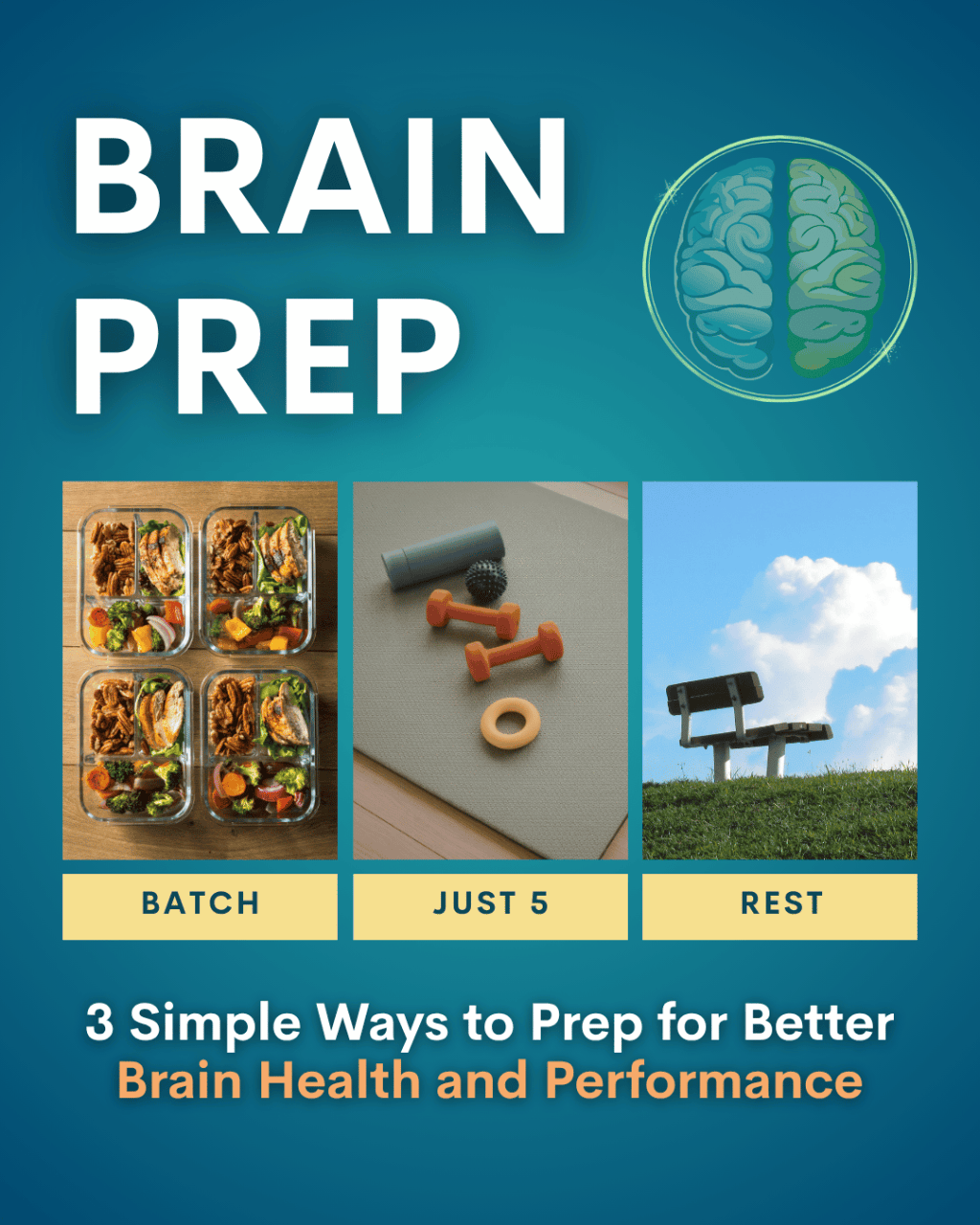
Three practical habits can help you prepare for better brain performance: batch cooking to make nutritious meals easier, adding five minutes of movement to an existing daily routine, and scheduling proper rest. These small actions can reduce daily decision-making, encourage regular movement and give your brain time to recover and consolidate learning. The best approach is individualised to your needs and routine.
📍 3 ways to prep for brain performance
[1] Batching
Some time ago, I found that cooking more at one meal, planning to save leftovers for lunch or freeze them for another day, made life much easier. It took a decision off my plate at 7pm, when my brain was already spent from the day. No last-minute scramble for groceries, and no reaching for a ready meal because I felt too tired to cook.
I particularly like batch cooking rice. Cooling cooked rice turns some of its starch into resistant starch, which is digested more slowly and feeds your gut bacteria. Cool it quickly and reheat until steaming hot, only once.
Try this: next time you cook a meal, double it – for another meal, pre-cooked!
[2] Just 5
Just 5 minutes of walking after a meal. Just 5 push-ups in the morning. Just 5 slow stretches in the evening.
Tied to a time of day or something you already do, “just 5” becomes a movement break that happens without a debate.
Try this: pick one daily anchor (the kettle, the end of lunch, brushing your teeth) and attach your 5 to it.
[3] Rest
Rest from work. Rest from screens. Rest from worrying.
Rest is prep too: it’s when your brain does some of its most useful work.
Try this: look at your diary this week, have you set aside time for a proper rest?
📍 Where this sits in the BRA(i)NS® Method
For those new to the Thursday Tips Tribe, welcome!
The BRA(i)NS® Method is my systems-based approach to building your brain health ecosystem, for consistent energy, focus and performance.
Purpose and Meaning is the container that holds it, infusing everything inside.
The three pillars inside are:
- Building Brain Resilience: your physical foundations
- Balancing the Autonomic Nervous System: your stress and relaxation responses
- Optimisation: pulls these together through mindset, habits and community
All of it is individualised to you, giving the (i) in BRA(i)NS®.
How does today’s [TT] relate to the BRA(i)NS® Method? Prep is an Optimisation principle: the habits that set everything else up to work. This week’s prep touches Building Brain Resilience (nutrition, movement) and Balancing the Autonomic Nervous System (rest), held together by Optimisation. Your (i) is which prep fits your week: the batch, the 5, or the rest.
📍 The Brain Science*
Cooled rice, gentler glucose.
In a small randomised study of 15 healthy adults, rice cooled in the fridge for 24 hours then reheated had more than double the resistant starch of fresh rice, and a lower blood glucose response. Freezing seems to work similarly, though so far only in lab studies.
Gut effects are modest.
In a trial of 50 adults, one resistant-starch-richer potato side dish a day shifted gut bacteria towards butyrate producers (butyrate is a short-chain fatty acid that gut bacteria make when they ferment fibre). But butyrate levels didn’t change. So I think of this as a helpful nudge, not a gut makeover!
Rice needs a little care.
Uncooked rice can carry Bacillus cereus spores that survive cooking. The UK’s Food Standards Agency advises cooling leftovers within an hour, keeping them in the fridge no more than a day, and reheating only once, until steaming hot.
Small breaks, sharper thinking.
In older adults sitting through an 8-hour day, adding 3-minute walking breaks every 30 minutes after a morning walk improved working memory compared with uninterrupted sitting.
Rest is when the brain consolidates.
In a skill-learning study, most early gains happened in the short rests between practice, not during the practice itself.
📍 Question for you this week
Which of these 3 prep tips will you try this week?
Wishing you good prep for your brain performance,
Dr Sui Wong
PS – Have you listened to my new podcast, Brain Health FM yet? New episodes land every Tuesday. Last week, I talked about why the holiday glow fades so fast, and how to make it last! It’s also relevant to Tip [3] above about rest. Listen on your podcast player; links here: https://www.buzzsprout.com/2640550/episodes/19908038
Or on YouTube: https://youtu.be/w-2p5_GsRUY?si=ZiBRX-JitjtquJMN
*References:
- Sonia et al (2015) https://pubmed.ncbi.nlm.nih.gov/26693746/
- Siminiuc & Vîrlan (2026) https://pubmed.ncbi.nlm.nih.gov/42121416/
- DeMartino et al (2022) https://pubmed.ncbi.nlm.nih.gov/35277080/
- UK FSA Home Food Fact Checker (updated Aug 2026) https://www.gov.uk/government/publications/home-food-fact-checker/home-food-fact-checker#rice
- Wheeler et al (2020) https://pubmed.ncbi.nlm.nih.gov/31036563/
- Bönstrup et al (2019) https://pubmed.ncbi.nlm.nih.gov/30930043/

Three Ways to Prep for Brain Performance
- Batch your cooking
Make extra at one meal so another meal is already prepared.
- Try “Just 5”
Attach five minutes of movement to something you already do each day.
- Schedule rest
Check your diary and deliberately make room for proper rest.
FAQ
What does prep mean for brain health?
Prep means making choices in advance that support brain health and performance. This can include preparing meals, attaching short movement breaks to daily routines and protecting time for rest.
How does batch cooking help you eat more healthily?
Batch cooking makes meals available when time and energy are limited. Cooking extra portions can reduce last-minute decisions and make it easier to choose a meal you’ve already prepared.
Does cooling cooked rice increase resistant starch?
The small randomised study described in this article found that rice refrigerated for 24 hours and reheated contained more than twice the resistant starch of freshly cooked rice and produced a lower blood glucose response. The finding comes from a small study of 15 healthy adults, so it should be interpreted in that context.
Is five minutes of exercise enough?
Five minutes is a manageable starting point for building consistency. The article also discusses research in which brief walking breaks improved working memory in older adults who had been sitting for extended periods. The effect of any specific routine will depend on the individual and context.
Why does rest matter for brain performance?
Rest gives the brain opportunities to recover and consolidate learning. Research discussed in this article found that much of the early improvement in a newly practised skill occurred during short rest periods between practice sessions.
How can I build healthy habits into a busy schedule?
Attach a small action to an existing routine. For example, do five minutes of movement after lunch, prepare extra food while cooking dinner or schedule rest in your diary. Start with an action that fits your current circumstances.
How does prep relate to the BRA(i)NS® Method?
Prep is an Optimisation principle within the BRA(i)NS® Method. It supports Building Brain Resilience through nutrition and movement, and Balancing the Autonomic Nervous System through rest. The approach is individualised to the person’s needs and circumstances.
My mission:
To inspire a movement for better brain health.
Because better brain health supports better wellbeing. And better wellbeing creates a ripple effect that benefits individuals, families, communities, and beyond. Making the world a better place for all. And it all starts with you as the individual.
I am a practising medical doctor (MBBS MD FRCP MA FHEA DipIBLM) working as a Neurologist and Neuro-Ophthalmologist, and am an active neuroscience researcher. My research is inspired by questions arising from my busy clinical practice, and I am grateful that both have been recognised with awards.
I am also an Author and Speaker, creating public-facing health content in my spare time.
Learn more:
drsuiwongmd.com
>> Join the Brain Health Movement: Share this email with someone who will enjoy my content. See link to socials below
>> Follow me on:
INSTAGRAM: drsuiwong.neurologist | LINKED IN: linkedin.com/in/dr-sui-wong-neurologist | YouTube: http://www.YouTube.com/@DrSuiWong
If you received this as a forwarded link, please sign up to the [TT] newsletter via bit.ly/drwongbrainhealth
Thank you for your support!
Books: available where all good books are sold, in print, eBook and audiobook formats. LEARN MORE: Mindfulness for Brain Health , Break Free From Migraines Naturally, Sleep Better to Thrive, Quit Ultra-Processed Foods Now, Sweet Spot for Brain Health, Magnesium: Restore & Revitalize Your Brain & Body
NEW BOOK COMING SOON!
To be on the priority notification list and receive bonuses during the promotional period, sign up here: brainsbooklaunch.com
Sleep Anchor Method®
Audioguide Series with Dr Sui Wong [learn more]
AI tool trained on Dr Sui Wong’s Sleep Anchor Method® to create a personalised, downloadable tracker, and a companion Chatbot for troubleshooting & questions [learn more]
Other Resources:
Brain Health Podcast with Dr Sui Wong, link: brainhealth.fm
The BRA(i)NS® Clarity Community, [click here for free access]
Read my past Thursday Tips posts on drsuiwongmd.blog
If you received this as a forwarded email, please sign up for the [TT] newsletter via drwongbrainhealth.com
Apply for my next intake of the Peak Performance Brain Lab (PPBL) Mentorship: request by email
(C) 2024-2026 Dr Sui H. Wong MD FRCP


Leave a Reply