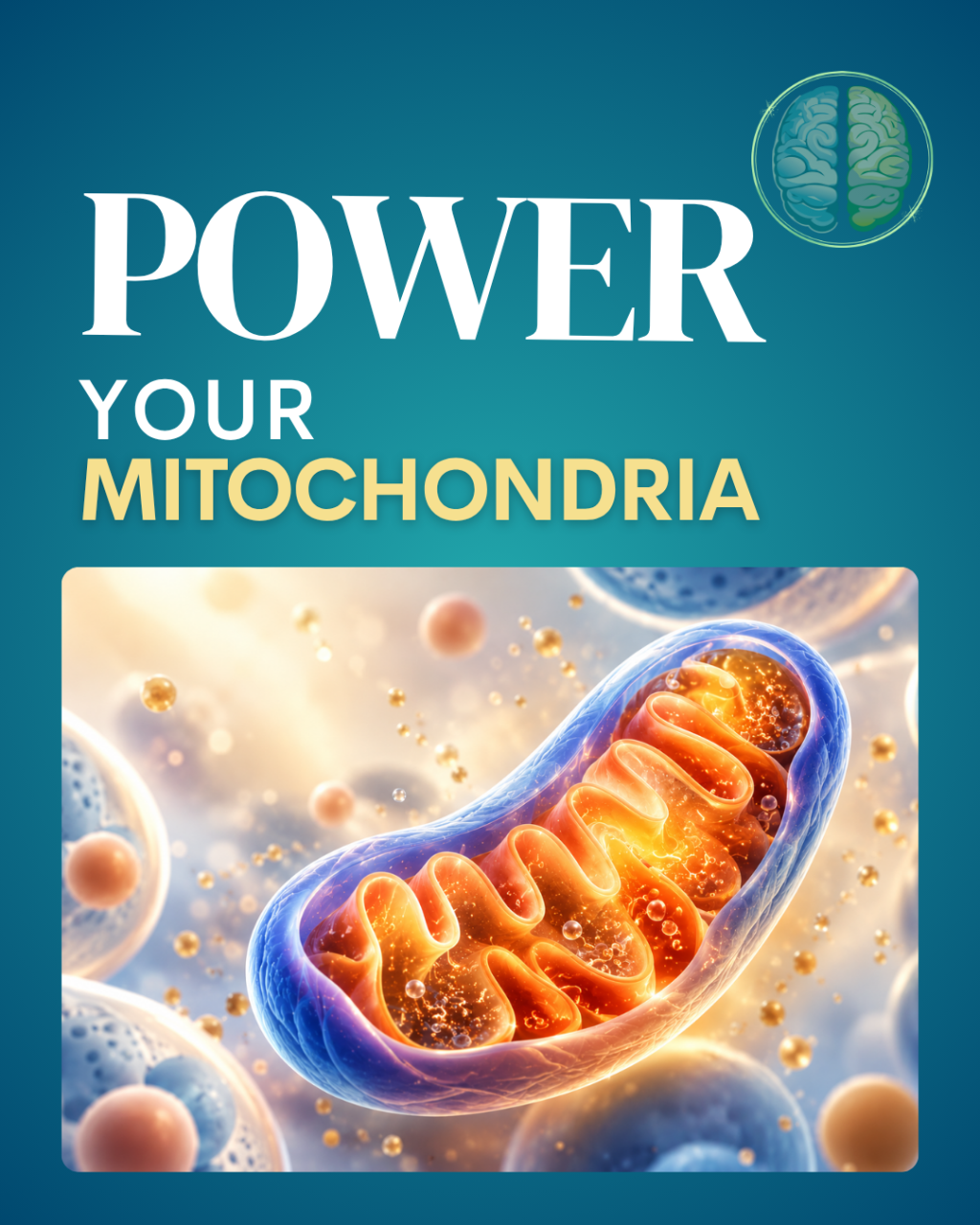
🌟[TT] Power 🧠
How can you support mitochondrial health for better brain performance?
Three practical approaches are to nourish your body with a varied, wholefoods-based diet, protect your cells by eating a colourful range of fruit and vegetables, and replenish through consistent sleep and recovery habits. Mitochondria produce ATP, the energy currency used by cells, and play important roles in brain circuit function. These habits support the physical foundations of brain health, although the specific benefits for mitochondrial function in humans are not yet fully established.
After last week’s [TT], how did your brain prep for performance go this past week?
This week, the word “power” came to mind, as I’m coming back to my weightlifting in the gym (almost hitting personal bests again!).
This made me think about where we generate power in our brain and body.
Yes, it comes from how we nourish ourselves, e.g. what we eat, how we hydrate.
And yes, there is also the repair element to this, e.g. how we rest and recover.
We can zoom out to the bigger picture and look at the system (you know me, I like to think about systems: hence the BRA(i)NS® Method, of course! 🙂).
Sometimes it’s also helpful to zoom in. Right in. To the microscopic level, even…
That takes us to… our humble and hardworking mitochondria!
Did you know mitochondria were once free-living bacteria? Long ago, one was taken in by an ancestral cell, and the partnership stuck. Every animal, plant and fungus, including us, descends from that merger. Today, mitochondria make most of the energy currency (called ATP, or adenosine triphosphate for those interested in the name) that powers our cells.
From the cells, organs are built.
From these energy molecules, messages are transmitted in our brains.
The health of our mitochondria is linked to our brain health.
If you are a high achiever, pushing and struggling through brain fog on some days, and have difficulty with focus, these are 3 tips I would share with you to support the microscopic powerhouses inside your cells: the mitochondria (singular: mitochondrion).
📍3 tips that power your mitochondria
[1] Nourish
Are you having enough micronutrients (vitamins and minerals) in your diet? For example, magnesium is important for mitochondrial function, and B vitamins help your cells turn food into energy. A wholefoods-based, varied diet helps, e.g. magnesium from dark leafy greens and pumpkin seeds, and wholegrains, seeds and nuts for a variety of micronutrients.
Try this: add a handful of pumpkin seeds or a side of dark leafy greens to three meals this week.
[2] Protect
When mitochondria produce energy currency (ATP), they also make by-products called free radicals. These are a natural part of the energy-production process, like the exhaust from a factory chimney.
If there is too much, or it is not cleared, it can contribute to damage or inflammation. Some scientists have linked this to ageing, though that theory is now debated. What can you do? Eat fresh fruits and vegetables for antioxidants that help clear free radicals.
Try this: aim for a colourful plate of fruit and vegetables at one meal a day.
[3] Replenish
An interesting fact about mitochondria is that they can divide and fuse. In other words, they can go from one to many and many to one. It’s a natural part of their turnover.
You can support this by protecting your rest (ah, that little golden nugget called sleep again! I seem to bring it into a lot of my recent posts).
Try this: pick a consistent wind-down time for three nights this week, and protect it like a meeting.
📍 Where this sits in the BRA(i)NS® Method
For those new to the Thursday Tips Tribe, welcome!
The BRA(i)NS® Method is my systems-based approach to building your brain health ecosystem, for consistent energy, focus and performance.
Purpose and Meaning is the container that holds it, infusing everything inside.
The three pillars of the BRA(i)NS® Method are:
= Building Brain Resilience: your physical foundations
= Balancing the Autonomic Nervous System: your stress and relaxation responses
= Optimisation: pulls these together through mindset, habits and community
All of it is individualised to you, giving the (i) in BRA(i)NS®.
How does today’s [TT] relate to the BRA(i)NS® Method? Mitochondrial health is a Building Brain Resilience principle: your physical foundations, right down to the cells. This week’s [TT] touches Building Brain Resilience (nutrition and nutrients, sleep) and Balancing the Autonomic Nervous System (how stress and recovery reshape your powerhouses), held together by Optimisation, the habits that keep them supplied. Your (i) is spotting which of the three tips is your weak link right now.
📍The Brain Science Behind It
A major review published this summer in Nature Reviews Neuroscience brings together the evidence on how mitochondria shape how we think and behave. The authors describe two modes.
The first is a baseline mode. Over weeks and months, your mitochondria help maintain the structure of your brain circuits: how nerve cells branch, and how many stable connections they keep. This sets how ready a circuit is to switch on when you need it.
The second is an on-demand mode. When a circuit fires, mitochondria near the active connections supply local energy and help manage calcium signals, supporting learning in the moment.
Think of it as your training block versus the session itself. The weeks of lifting build the capacity. The session is when you draw on it.
Sleep may be part of the reset. In fruit flies, sleep loss fragmented mitochondria in the brain’s sleep-control neurons, and recovery sleep reversed it.
Stress reshapes them too. In rodent studies, some mitochondrial changes after a short burst of stress settle back towards baseline within a day, while chronic stress mostly points to dampened mitochondrial function. The spike is not the problem. The lack of recovery is.
How I view this: most of this evidence comes from animal studies, and in humans the links are mainly associations so far. So I think of these tips as sensible foundations with a plausible mechanism behind them, rather than proven mitochondrial upgrades.
📍Question for you this week
Nourish, protect or replenish: which is your weak link right now, and what is one small change you will try this week?
Do let me know, I love hearing from you, and your message comes straight to my inbox.
Wishing you power for your brain performance,
Dr Sui Wong
PS. Did you know I wrote a short book on magnesium? Magnesium: Restore and Revitalize Your Brain and Body covers how it affects your brain and body, and how to get it from food. Check it out here [Learn More]
PPS. If this [TT] was useful, you’d find Season 1 Episode 2 of Brain Health FM of interest, as I talk about being Wired, Tired, Slow or Flow: the bigger picture view of maintaining your brain energy, focus and performance [Link for podcast players, or YouTube]
*References: Roger et al 2017; Sandi et al 2026; Pilchova et al 2017; Kennedy 2016; Gladyshev 2014, Sarnataro et al 2025.

*References: Roger et al 2017; Sandi et al 2026; Pilchova et al 2017; Kennedy 2016; Gladyshev 2014, Sarnataro et al 2025.
3 Ways to Support Your Mitochondria
| Nourish | Protect | Replenish |
| Include varied, nutrient-rich foods such as dark leafy greens, pumpkin seeds, nuts and wholegrains. | Add colourful fruit and vegetables to your meals to provide antioxidants. | Choose a consistent wind-down time and protect your sleep and recovery. |
FAQ
What are mitochondria?
Mitochondria are structures inside cells that produce most of the ATP used as cellular energy. They also have roles in processes such as calcium signalling and the maintenance of brain circuits.
Why are mitochondria important for brain health?
Brain cells need energy to function and communicate. Mitochondria supply energy locally around active connections and help regulate calcium signals involved in brain activity. Research also links mitochondrial function with the maintenance of brain circuits over time.
What foods support mitochondrial health?
A varied, wholefoods-based diet can provide nutrients involved in cellular energy production. Examples include dark leafy greens and pumpkin seeds for magnesium, and wholegrains, seeds and nuts for a range of micronutrients.
Do antioxidants help protect mitochondria?
Antioxidants help manage free radicals, which are natural by-products of cellular energy production. Eating a variety of colourful fruit and vegetables is one way to obtain dietary antioxidants. However, this does not guarantee a specific improvement in mitochondrial function.
Can poor sleep affect mitochondria?
The article describes fruit-fly research in which sleep loss fragmented mitochondria in neurons involved in sleep control, while recovery sleep reversed those changes. These findings offer a possible mechanism, but they do not establish the same effect in humans.
Can stress affect mitochondrial function?
Animal studies suggest that acute stress can produce mitochondrial changes that may settle towards baseline, while chronic stress has been associated with reduced mitochondrial function. More research is needed to establish how these findings translate to humans.
What is the relationship between magnesium and mitochondria?
Magnesium is important for normal cellular function, including processes involved in energy metabolism. It is found in foods such as pumpkin seeds and dark leafy greens. The article recommends food-based sources as part of a varied diet.
How does mitochondrial health fit into the BRA(i)NS® Method?
Mitochondrial health falls under Building Brain Resilience, the physical foundations of the BRA(i)NS® Method. Nutrition and sleep are relevant to these foundations, while stress and recovery relate to Balancing the Autonomic Nervous System. Optimisation brings the pillars together through habits and individualised choices.
My mission:
To inspire a movement for better brain health.
Because better brain health supports better wellbeing. And better wellbeing creates a ripple effect that benefits individuals, families, communities, and beyond. Making the world a better place for all. And it all starts with you as the individual.
I am a practising medical doctor (MBBS MD FRCP MA FHEA DipIBLM) working as a Neurologist and Neuro-Ophthalmologist, and am an active neuroscience researcher. My research is inspired by questions arising from my busy clinical practice, and I am grateful that both have been recognised with awards.
I am also an Author and Speaker, creating public-facing health content in my spare time.
Learn more:
drsuiwongmd.com
>> Join the Brain Health Movement: Share this email with someone who will enjoy my content. See link to socials below
>> Follow me on:
INSTAGRAM: drsuiwong.neurologist | LINKED IN: linkedin.com/in/dr-sui-wong-neurologist | YouTube: http://www.YouTube.com/@DrSuiWong
If you received this as a forwarded link, please sign up to the [TT] newsletter via bit.ly/drwongbrainhealth
Thank you for your support!
Books: available where all good books are sold, in print, eBook and audiobook formats. LEARN MORE: Mindfulness for Brain Health , Break Free From Migraines Naturally, Sleep Better to Thrive, Quit Ultra-Processed Foods Now, Sweet Spot for Brain Health, Magnesium: Restore & Revitalize Your Brain & Body
NEW BOOK COMING SOON!
To be on the priority notification list and receive bonuses during the promotional period, sign up here: brainsbooklaunch.com
Sleep Anchor Method®
Audioguide Series with Dr Sui Wong [learn more]
AI tool trained on Dr Sui Wong’s Sleep Anchor Method® to create a personalised, downloadable tracker, and a companion Chatbot for troubleshooting & questions [learn more]
Other Resources:
Brain Health Podcast with Dr Sui Wong, link: brainhealth.fm
The BRA(i)NS® Clarity Community, [click here for free access]
Read my past Thursday Tips posts on drsuiwongmd.blog
If you received this as a forwarded email, please sign up for the [TT] newsletter via drwongbrainhealth.com
Apply for my next intake of the Peak Performance Brain Lab (PPBL) Mentorship: request by email
(C) 2024-2026 Dr Sui H. Wong MD FRCP


Leave a Reply