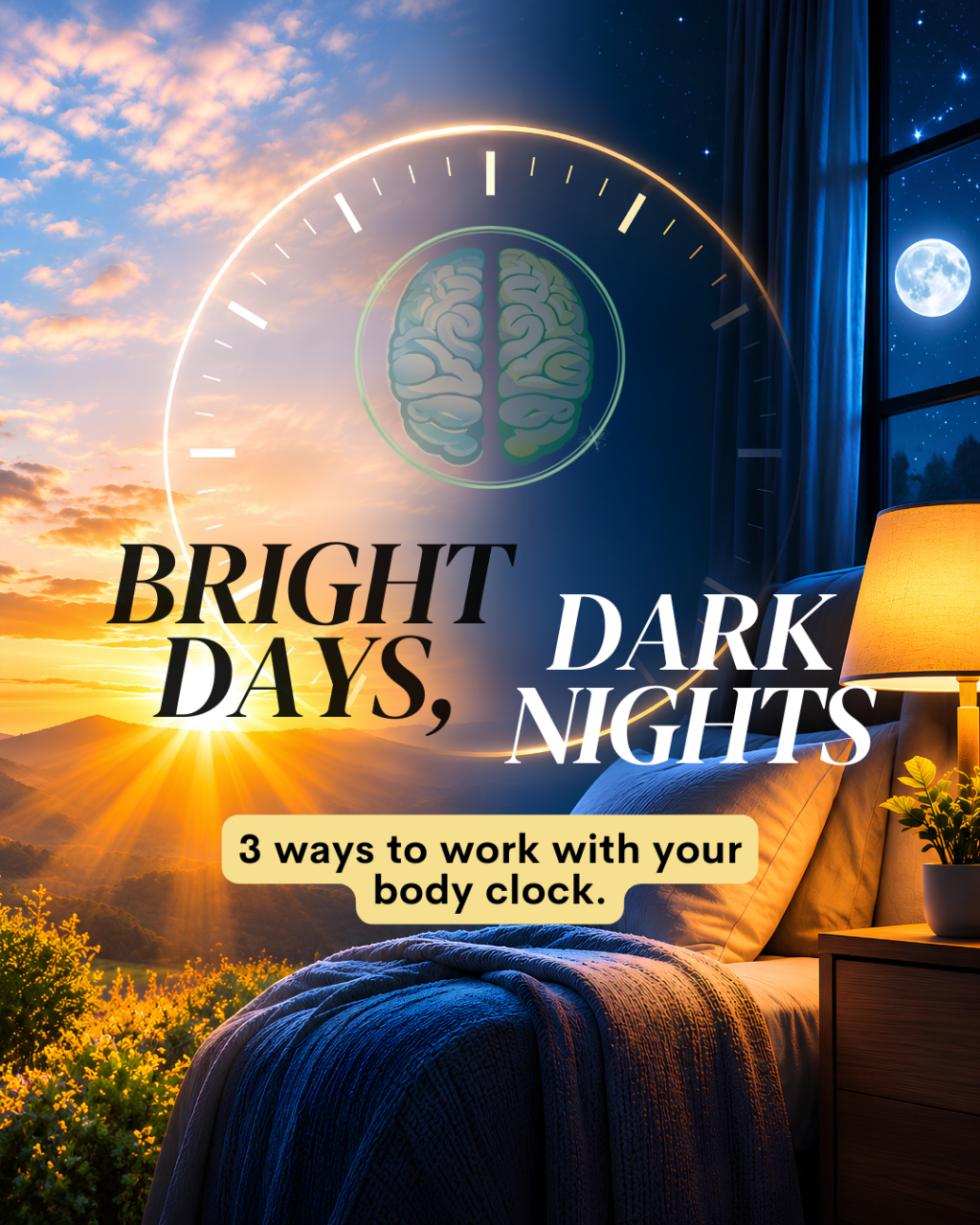
🌟[TT] Light 🧠
I hope you had an opportunity to choose your Time Travel after last week’s [TT] ☺️
It’s now November, doesn’t time just fly?
This time of the year, I often hear people talk about feeling tired.
Perhaps it’s the clock change compounded by the dark mornings (in the Northern Hemisphere), the viruses that circulate this season, or the final stretch to year-end before the excitement of the festivities starts.
This is also when high achievers working towards their Q4 targets can feel a dip. If this is you, here are 3 tips about light that might surprise you!
How does light exposure affect brain health and sleep?
Light helps regulate the body’s internal clock, known as the circadian rhythm. Specialised cells in the retina detect light and send signals to the brain’s body clock, influencing sleep timing, melatonin production and alertness. Getting bright light early in the day, reducing bright overhead lighting in the evening and keeping the bedroom dark overnight are three practical ways to support a healthy light-dark rhythm.
📍3 tips to work with light this November
[1] Get bright light early
Morning light is the main signal that sets your body clock, and that clock shapes when you feel alert and when you feel sleepy.
Indoor lighting is far dimmer than daylight, even on a grey day. So outside beats the office, every time. If you can’t get outdoors, a bright light, like the SAD 10,000 lux lamps, can be helpful (though evidence is for those with Seasonal Affective Disorders, see science section below)
Try this: within an hour of waking, take your first coffee or call outside, or walk the first 10 minutes of your commute.
[2] Go dim, low and warm after dark
Light reaching your eyes in the evening tells your brain it’s still daytime and holds back melatonin, your “night is here” hormone. Overhead ceiling lights may be worse offenders.
Try this: from about three hours before bed, switch off the ceiling lights and use one or two low, warm lamps instead.
[3] Make your bedroom properly dark
Your brain keeps reading light even while you sleep. A dark bedroom supports deeper rest and a sharper brain the next day.
Try this: tonight, cover the standby lights, close the gap in the curtains, or try an eye mask.
📍 Where this sits in the BRA(i)NS® Method
For those new to the Thursday Tips Tribe, welcome!
The BRA(i)NS® Method is my systems-based approach to building your brain health ecosystem for consistent energy, focus and performance.
Purpose and Meaning is the container that holds it, infusing everything inside.
The three pillars inside it are:
| Building Brain Resilience: your physical foundations
| Balancing the Autonomic Nervous System: your stress and relaxation responses
| Optimisation: pulls these together through mindset, habits and community
All of it is individualised to you, giving the (i) in BRA(i)NS®. It’s the lens through which everything is viewed.
How does today’s [TT] relate to the BRA(i)NS® Method?
Light is a Building Brain Resilience principle: it anchors the body clock that your sleep and daytime energy run on. This week’s [TT] touches Building Brain Resilience (sleep and circadian rhythm in tips 1 and 2) and Balancing the Autonomic Nervous System (night-time heart rate and HRV in tip 3), held together by Optimisation (small changes to your surroundings that become habits).
Your (i) is your own sensitivity to light: the same evening lamp can affect you very differently from the person sitting next to you.
📍The Brain Science Behind It*
Your eyes have a second job beyond seeing. Specialised retinal ganglion cells containing melanopsin detect light and signal directly to your body clock at the base of your brain, in an area called the suprachiasmatic nucleus in the hypothalamus (first shown in animal studies).
In 2022, international experts recommended plenty of daylight by day, dim light in the three hours before bed, and a bedroom as dark as possible overnight. Most of us get too little light by day and too much by night.
Brighter light raised how alert people felt in most studies, but not all. I suspect the bigger dividend comes through using light to help your body clock, rather than an instant jolt from the light itself.
In the evening, ordinary room light before bed delayed the release of melatonin, the sleepiness hormone, in 99% of people, and shortened it.
📍Question for you this week
Which light change will you try first: morning, evening, or night?
Do let me know, I love hearing from you, and your message comes straight to my inbox.
Wishing you brighter days and darker nights,
Dr Sui Wong
PS. If your sleep needs more support this winter, listen to this episode of the Brain Health FM podcast (hit top 10% global ranking recently!). Season 1 Episode 9 talks about sleep and your circadian rhythm [listen on your podcast player or YouTube]

PPS: This is educational content, not medical advice. If tiredness or low mood is new or persistent, please speak with your doctor. Do the same before using a light box, especially if you have an eye condition or bipolar disorder.
*References:
Berson et al 2002, Brown et al 2022, Souman et al 2018, Gooley et al 2011
FAQ
How does light affect the body’s internal clock?
Light is detected by specialised retinal ganglion cells containing a pigment called melanopsin. These cells send signals to the suprachiasmatic nucleus in the hypothalamus, which helps regulate the body’s internal clock.
Does evening light affect melatonin?
Yes. Light reaching the eyes in the evening can delay melatonin onset and shorten the period during which melatonin is produced. Even relatively dim light may affect some people.
Can wearing an eye mask improve sleep?
A study discussed in this article found that wearing an eye mask for a week improved episodic encoding and next-day alertness in adults aged 18 to 35. The findings are interesting, although the study population was younger than many midlife readers.
What is melanopic lux?
Melanopic lux is a measure of light based on how strongly it stimulates the melanopsin-containing cells in the retina. It differs from standard lux, which measures light according to the sensitivity of human daytime vision.
Dr Sui Wong | www.drsuiwongmd.com
I am a practising medical doctor (MBBS MD FRCP MA FHEA DipIBLM) working as a Neurologist and Neuro-Ophthalmologist, and am an active neuroscience researcher. My research is inspired by questions arising from my busy clinical practice, and I am grateful that both have been recognised with awards.
I am also an Author and Speaker, creating public-facing health content in my spare time. Why? Because of my mission:
My mission: To inspire a movement for better brain health.
Because better brain health supports better wellbeing. And better wellbeing creates a ripple effect that benefits individuals, families, communities, and beyond. Making the world a better place for all. And it all starts with you as the individual.
Learn more: drsuiwongmd.com
>> Join the Brain Health Movement: Share this blog with someone who will enjoy my content. See link to socials below
>> Follow me on:
INSTAGRAM: drsuiwong.neurologist | LINKED IN: linkedin.com/in/dr-sui-wong-neurologist | YouTube: http://www.YouTube.com/@DrSuiWong
Books: available where all good books are sold, in print, eBook and audiobook formats. LEARN MORE: Mindfulness for Brain Health , Break Free From Migraines Naturally, Sleep Better to Thrive, Quit Ultra-Processed Foods Now, Sweet Spot for Brain Health, Magnesium: Restore & Revitalize Your Brain & Body
NEW BOOK COMING SOON!
To be on the priority notification list and receive bonuses during the promotional period, sign up here: brainsbooklaunch.com
Other Resources:
Sleep Anchor Method® – Create your personalised sleep plan [learn more]
The BRA(i)NS® Clarity Community, [click here for free access]
If you received this as a forwarded email, please sign up for the [TT] newsletter via drwongbrainhealth.com
Apply for my next intake of the Peak Performance Brain Lab (PPBL) Mentorship: build your brain health ecosystem for sustained energy, focus and performance with Dr Sui Wong. Join the waitlist [here]
(C) 2024-2026 Dr Sui H. Wong MD FRCP
BRA(i)NS® and Sleep Anchor Method® are registered trademarks of Dr Sui Wong


Leave a Reply