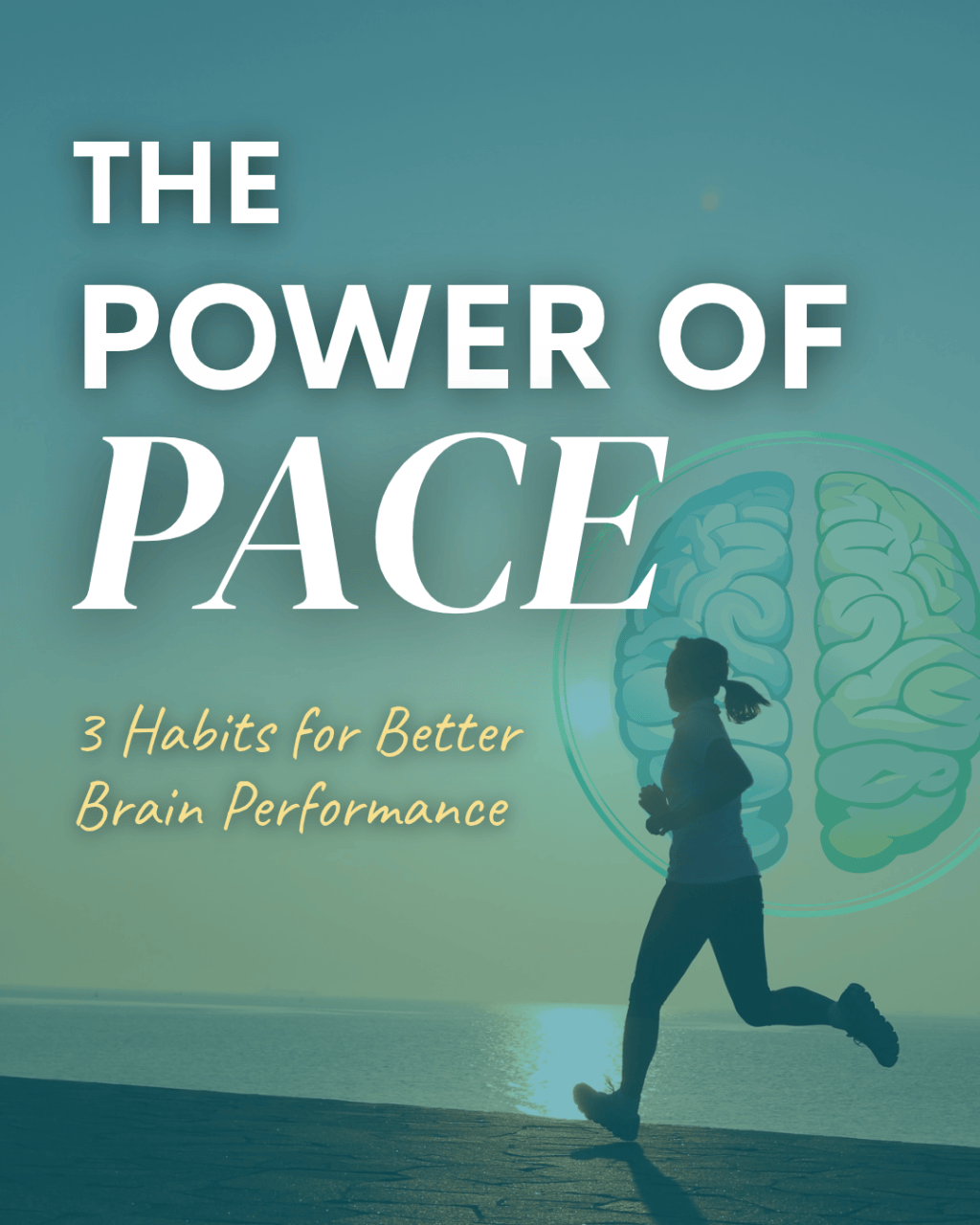
🌟[TT] Pace 🧠
After last week’s [TT], how are you getting on with morning light?
I’ve just recorded the Season 1 Finale of Brain Health FM, and it inspired today’s [TT].
In it, I told the story of how I started running, and how that turned into signing up for a marathon challenge! 🤣 I know, I was young back then!
I took up running when I got to university, thinking it’d be a portable form of fitness.
Alas! The first time I tried, I was shocked to realise I couldn’t run more than a block (200m) before I had to stop, too breathless to carry on.
Turns out, I was just running at the wrong pace.
What followed was a series of experiments, including getting one of the early heart rate monitors (Gen X runners, remember those Polar heart rate monitor chest straps?). Following a programme that had me training according to my heart rate, it really forced me to slow down to a pace so slow… that someone brisk walking could overtake me!
But that helped me build my endurance and get through that marathon challenge in 1999.
Wow, I just realised that’s 27.5 years ago.
If you’re a high achiever working in stops and starts, or in a boom and bust cycle (a surge of energy, then feeling flat or burnt out), do you think about your pace?
As the saying goes, “slow and steady wins the race.” Or I prefer to paraphrase this into a rhyme: a steady pace wins the race! 🤣
Here are three pace-related ideas for your brain performance.
How can you maintain steady energy and focus throughout the workday?
Three practical habits can help support energy and brain performance throughout the day. Choose meals and snacks containing fibre, complex carbohydrates and protein to provide steady nutritional fuel. Take short movement breaks throughout your workday, such as walking or doing a few squats every 45 minutes. Finally, use simple breathwork, such as a 90-second slow-breathing practice, between meetings or before stressful situations. The aim is to find a sustainable pace that balances effort, movement and recovery.
📍 3 tips to find your pace
[1] Fuel
Here’s another race-inspired analogy: how we fuel ourselves. In that first (and only!) marathon in 1999, I “hit the wall” in the final mile and felt confused and agitated. It wasn’t just water I needed: I needed some of those sugary drinks offered at the fuelling stations, too.
The desk version of hitting the wall is the mid-afternoon slump, right when the big meeting lands. Quick sugar is for race day. For a work day, steady energy from foods with fibre and complex carbohydrates is a great place to start.
Try this: look at your meals and snacks this week. Do they have fibre, complex carbs and protein? My go-to snacks are roasted chickpeas and mixed nuts!
[2] Move
Do you take movement and screen breaks every 45 minutes?
Sitting at your desk for 8 hours straight is rather bad for your blood sugar balance. I talk more about this in this week’s Brain Health FM, Season 1 Episode 11, on how walking breaks helped balance blood sugar, particularly after meals. [LISTEN HERE] And in one study, regular walking breaks also supported sharper working memory.
Try this: set a 45-minute timer on your computer to prompt you to stand up, or schedule breaks into your work calendar. Three minutes is enough: a walk to the kettle or a few squats. Bonus if you can fit in 8 movement breaks a day!
[3] Breathe
When you run (or do any form of exercise), your breath rate is a handy gauge of how hard you’re working. When training for that marathon, I eventually used my breath to guide my pace.
Do you bring breathwork into your work day?
Try this: the 90-second breathwork practice I shared in Brain Health FM, Season 1 Episode 4 [🎧LISTEN HERE]. Use it between meetings or just before a high-stakes moment, to balance your nervous system’s stress response through a hefty work day.
📍 Where this sits in the BRA(i)NS® Method
For those new to the Thursday Tips Tribe, welcome!
The BRA(i)NS® Method is my systems-based approach to building your brain health ecosystem, for consistent energy, focus and performance.
Purpose and Meaning is the container that holds it, infusing everything inside.
The three pillars inside are:
| Building Brain Resilience: physical foundations
| Balancing the Autonomic Nervous System: stress and relaxation responses
| Optimisation: mindset, habits and community
The (i) in BRA(i)NS®? Everything is individualised, seen through the lens of you and your life.
How does today’s [TT] relate to the BRA(i)NS® Method?
Pace is an Optimisation principle: the habits that set the rhythm of effort and recovery across your day. This week’s [TT] touches Building Brain Resilience (nutrition, physical activity) and Balancing the Autonomic Nervous System (breathwork), held together by Optimisation (the timers and routines that keep your pace steady). Your (i) is finding the pace that fits your day: the snack, the timer, or the 90 seconds of breath.
📍 The Brain Science Behind It*
Steady fuel. This is something I observed in my clinical practice. The research data is more modest: a meta-analysis of 15 studies in adults compared breakfasts with a lower or higher glycaemic load (roughly, how much a meal raises your blood sugar). There was no difference in thinking for the first two hours. After that, memory was slightly better following the lower-load breakfast, though the effect was small and only just reached significance. So I see fibre, complex carbs and protein as sensible steady fuel, rather than a proven focus upgrade.
Little and often. In a small trial, 18 young men with overweight or obesity sat for 8.5 hours. Breaking that up with 3 minutes of walking or squats every 45 minutes lowered their post-meal blood sugar rise compared with sitting straight through. It also beat a single 30-minute walk with the same total activity. That study measured glucose, not focus. For a brain link: in 67 older adults, a morning walk plus 3-minute walking breaks every 30 minutes improved working memory compared with sitting all day.
Breath as a gauge. Unlike heart rate, breathing rate closely tracks how hard exercise feels, making it a strong marker of effort (according to a perspective article reviewing the evidence). And a meta-analysis of 223 studies found that slow breathing raises heart rate variability, a marker of the rest-and-digest (parasympathetic) branch of your nervous system, both during the practice and straight after a single session. 90 seconds is my practical starting point rather than a tested dose.
📍 Question for you this week
What pacing tip suits you best for your work week?
Do let me know, I love hearing from you, and your message comes straight to my inbox.
Wishing you a steady pace for your brain performance,
Dr Sui Wong
PS. Question! I’m thinking of experimenting with a new format for Thursday Tips. I’d love to answer a crowdsourced question from you. Do let me know what you think, and send me any questions you’d like me to cover!

* References:
Gaylor et al (2022), Gao et al (2024), Wheeler et al (2020), Nicolò et al (2017), Laborde et al (2022)
3 Ways to Find Your Pace
1. Fuel
Choose meals and snacks with fibre, complex carbohydrates and protein to support steady energy.
2. Move
Take a three-minute movement break every 45 minutes. Walk to the kettle or do a few squats.
3. Breathe
Use a 90-second breathing practice between meetings or before a high-pressure situation.
FAQ
How can I maintain energy throughout the workday?
Choose balanced meals and snacks containing fibre, complex carbohydrates and protein. Take regular movement breaks and use short breathing practices to help manage stress throughout the day.
What foods help support steady energy?
Foods containing fibre, complex carbohydrates and protein are useful options. Examples include roasted chickpeas, mixed nuts, wholegrains and other nutrient-rich foods.
How often should you take movement breaks at work?
The article suggests taking a short movement break every 45 minutes. A three-minute walk or a few squats can be a practical way to interrupt prolonged sitting.
Can walking breaks improve working memory?
A study involving 67 older adults found that a morning walk combined with three-minute walking breaks every 30 minutes improved working memory compared with sitting throughout the day.
How does breathing help you pace exercise?
Breathing rate closely tracks how hard exercise feels, making it a useful indicator of effort. Paying attention to your breathing can help you recognise when you may be pushing too hard.
Dr Sui Wong | www.drsuiwongmd.com
I am a practising medical doctor (MBBS MD FRCP MA FHEA DipIBLM) working as a Neurologist and Neuro-Ophthalmologist, and am an active neuroscience researcher. My research is inspired by questions arising from my busy clinical practice, and I am grateful that both have been recognised with awards.
I am also an Author and Speaker, creating public-facing health content in my spare time. Why? Because of my mission:
My mission: To inspire a movement for better brain health.
Because better brain health supports better wellbeing. And better wellbeing creates a ripple effect that benefits individuals, families, communities, and beyond. Making the world a better place for all. And it all starts with you as the individual.
Learn more: drsuiwongmd.com
>> Join the Brain Health Movement: Share this blog with someone who will enjoy my content. See link to socials below
>> Follow me on:
INSTAGRAM: drsuiwong.neurologist | LINKED IN: linkedin.com/in/dr-sui-wong-neurologist | YouTube: http://www.YouTube.com/@DrSuiWong
Books: available where all good books are sold, in print, eBook and audiobook formats. LEARN MORE: Mindfulness for Brain Health , Break Free From Migraines Naturally, Sleep Better to Thrive, Quit Ultra-Processed Foods Now, Sweet Spot for Brain Health, Magnesium: Restore & Revitalize Your Brain & Body
NEW BOOK COMING SOON!
To be on the priority notification list and receive bonuses during the promotional period, sign up here: brainsbooklaunch.com
Other Resources:
Sleep Anchor Method® – Create your personalised sleep plan [learn more]
The BRA(i)NS® Clarity Community, [click here for free access]
If you received this as a forwarded email, please sign up for the [TT] newsletter via drwongbrainhealth.com
Apply for my next intake of the Peak Performance Brain Lab (PPBL) Mentorship: build your brain health ecosystem for sustained energy, focus and performance with Dr Sui Wong. Join the waitlist [here]
(C) 2024-2026 Dr Sui H. Wong MD FRCP
BRA(i)NS® and Sleep Anchor Method® are registered trademarks of Dr Sui Wong


Leave a Reply