🌟[TT] Constraints 🧠
How can constraints improve focus and productivity?
Constraints can help improve focus and productivity by reducing the number of decisions competing for your attention and giving your workday more structure. Three practical examples are setting a clear finish time, choosing a maximum of three priorities each day, and protecting at least one daily habit that supports brain health. These boundaries can help you manage your time, focus on important tasks and make room for recovery.
After last week’s [TT], have you noticed any difference in your day-to-day pace?
Thank you to Laura, who replied to my request for topics to cover! I’m here to share practical tips and food for thought that actually move the needle 😊 so please reply to last week’s question, which you may have missed since it was tucked into the PS. Here it is again
I’d love to experiment with a new format for Thursday Tips: answering a crowd-sourced question from you. Do let me know what you think, and send me any questions you’d like me to cover!
This question feeds nicely into this week’s [TT] on constraints!
Question for you: are constraints helpful or unhelpful?
Let me propose that constraints are one of the most underused tools for improving our focus, our productivity and, ironically, our creativity!
When I started the [TT] newsletters on 29 February 2024, I didn’t really know how to do this. Thankfully I had a coach at the time (shout out to Dr Jo Watkins!) who looked at my first few editions before I sent them out, as part of my confidence building.
Fast forward a few months, and I started to add constraints to the format, e.g. 3 tips.
It was this constraint that allowed me to hone my weekly [TT]s further. It would seem from the replies I get (thank you! I love getting them!) that this format has been helpful.
The constraint of a structure helped me be more creative.
More recently, I’ve started coaching my 17-year-old nephew on how to focus, as he struggled to stay consistent with his exam revision. Part of that is putting some constraints on when he plans to do his work, so that it’s time-limited.
If you’re a high achiever with a never-ending list of tasks, here are 3 ways I’d suggest you use constraints for your brain performance.
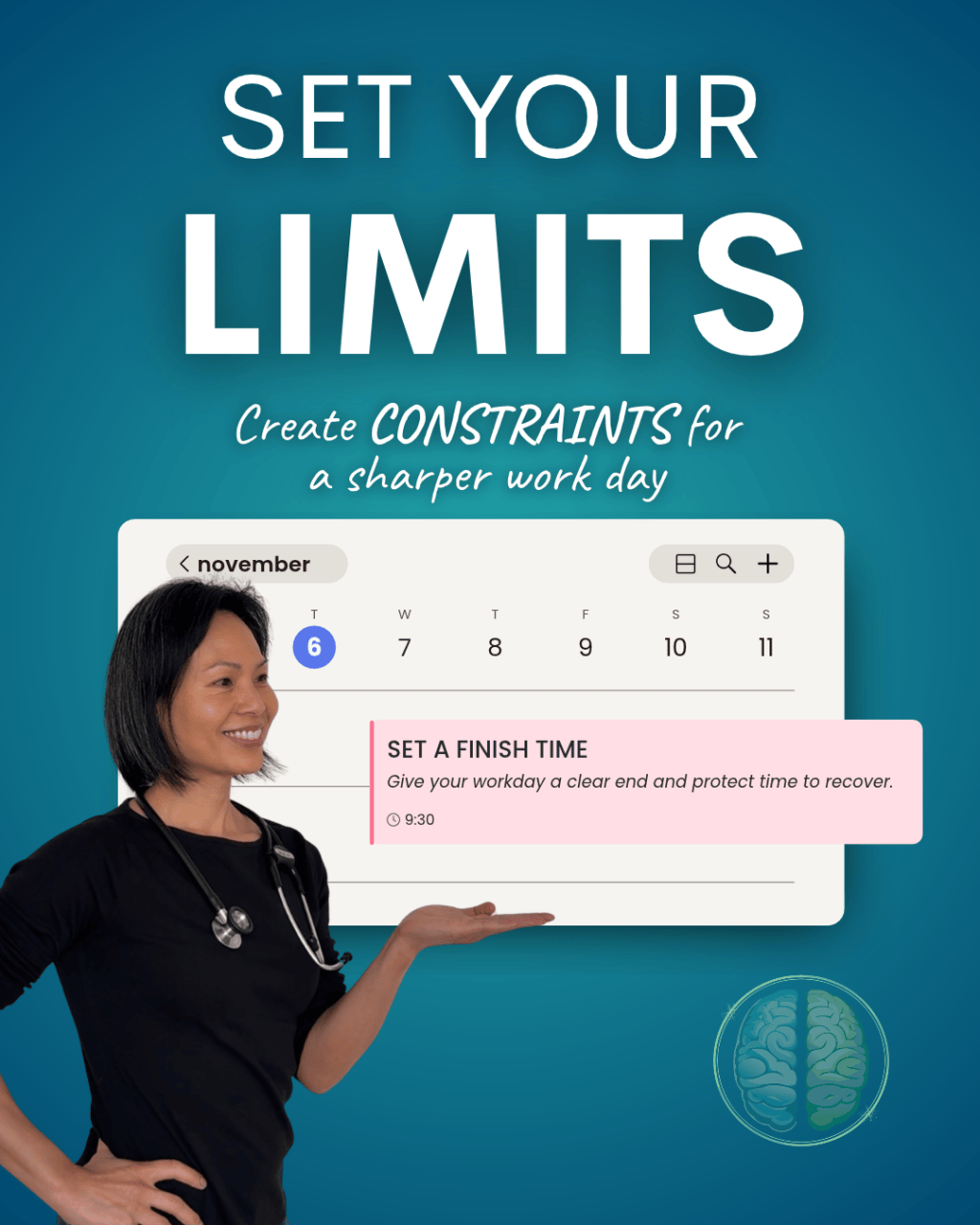
📍 3 constraints for a sharper work day
[1] Limit the time you work
When the list never ends, the default is to keep going until it’s done. But it’s never done, so the day simply stretches into the evening. A finish time is a constraint that protects today’s output and gives tomorrow’s brain a chance to recover.
Try this: set a finish time for your work day this week, and put it in your calendar like a meeting. Within the day, give focused tasks a time box: 45 minutes on one task, then take a short movement break (like what we talked about in last week’s [TT] 🙂).
[2] Limit to 3 things (max) that day
Your to-do list might hold 30 items. Your working memory, the mental desk where you hold things while you work on them, holds far fewer at once. Choosing 3 things turns an endless list into a focused day.
Try this: the evening before, or first thing in the morning, write down the 3 things that would make today a good day’s work. Start the first one before you open your inbox.
[3] At least 1 thing for your brain
A constraint can be a floor as well as a ceiling. On your busiest days, the things that look after your brain are the first to go, which is exactly when you need your brain at its best.
Try this: choose one non-negotiable for your brain each day, small enough to survive your busiest day. A 10-minute walk, the 90-second breathwork practice from Brain Health FM Season 1 Episode 4 [LISTEN HERE or watch here for YouTube video], or lights out on time.
📍 Where this sits in the BRA(i)NS® Method
For those new to the Thursday Tips Tribe, welcome!
The BRA(i)NS® Method is my systems-based approach to building your brain health ecosystem, for consistent energy, focus and performance.
Purpose and Meaning is the container that holds it, infusing everything inside.
The three pillars inside are:
| Building Brain Resilience: physical foundations
| Balancing the Autonomic Nervous System: stress and relaxation responses
| Optimisation: mindset, habits and community
The (i) in BRA(i)NS®? Everything is individualised, seen through the lens of you and your life.
How does today’s [TT] relate to the BRA(i)NS® Method?
Constraints are an Optimisation principle: the habits and structures that decide where your time and energy go. This week’s [TT] touches on Balancing the Autonomic Nervous System (a finish time that lets you switch off) and Building Brain Resilience (your daily minimum, whether that’s movement or sleep), held together by Optimisation (the time box and the 3-thing list). Your (i) is choosing the constraints that fit your life: your finish time, your 3 things, your minimum.
📍 The Brain Science Behind It*
Why 3? Your working memory has a limited capacity. A landmark review put it at around four chunks of information at once, under lab conditions. The exact number is still debated, and a to-do list isn’t a memory test. So 3 is my practical number, with a little room left for the unexpected, rather than a tested dose.
Constraints and creativity. A review pulling together research across psychology, management and other fields suggests an inverted U: a moderate level of constraint tends to go with more creativity and innovation than either very few or very many constraints. It’s a review rather than a single trial, and much of the evidence comes from workplaces and teams. But that matches my experience with the [TT] format: the right amount of structure gave me something to be creative within, and the same goes for how I structure my day 🙂
📍 Question for you this week
Which constraint will you try this week: a finish time, 3 things, or your daily minimum?
Do let me know, I love hearing from you, and your message comes straight to my inbox.
Wishing you the right constraints for your brain performance,
Dr Sui Wong
PS. I love sharing content that makes a real difference to your brain health. What matters most, at the end of the day, is taking action. How can I help you take action?
PPS. Know someone with a never-ending to-do list? Forward this to them, and they can sign up for Thursday Tips here: https://drwongbrainhealth.com
* References: Cowan (2001), Acar et al (2019)
3 Constraints for a Sharper Workday
1. Limit your working time
Set a finish time and use focused time blocks for individual tasks.
2. Limit your daily priorities
Choose three important things that would make the day feel productive.
3. Protect one thing for your brain
Make one small brain-health habit non-negotiable, even on busy days.
FAQ
How many tasks should I prioritise each day?
A practical starting point is three important tasks. This gives you a manageable focus while leaving some room for unexpected demands.
Why is working memory important for productivity?
Working memory allows you to temporarily hold and work with information. It has limited capacity, so keeping too many tasks and details in mind at once can make it harder to stay focused.
How can I protect my brain health during a busy workday?
Choose one small daily habit that you can maintain even when work gets busy. This could be a 10-minute walk, a short breathing practice or getting to bed on time.
Dr Sui Wong | www.drsuiwongmd.com
I am a practising medical doctor (MBBS MD FRCP MA FHEA DipIBLM) working as a Neurologist and Neuro-Ophthalmologist, and am an active neuroscience researcher. My research is inspired by questions arising from my busy clinical practice, and I am grateful that both have been recognised with awards.
I am also an Author and Speaker, creating public-facing health content in my spare time. Why? Because of my mission:
My mission: To inspire a movement for better brain health.
Because better brain health supports better wellbeing. And better wellbeing creates a ripple effect that benefits individuals, families, communities, and beyond. Making the world a better place for all. And it all starts with you as the individual.
Learn more: drsuiwongmd.com
>> Join the Brain Health Movement: Share this blog with someone who will enjoy my content. See link to socials below
>> Follow me on:
INSTAGRAM: drsuiwong.neurologist | LINKED IN: linkedin.com/in/dr-sui-wong-neurologist | YouTube: http://www.YouTube.com/@DrSuiWong
Books: available where all good books are sold, in print, eBook and audiobook formats. LEARN MORE: Mindfulness for Brain Health , Break Free From Migraines Naturally, Sleep Better to Thrive, Quit Ultra-Processed Foods Now, Sweet Spot for Brain Health, Magnesium: Restore & Revitalize Your Brain & Body
NEW BOOK COMING SOON!
To be on the priority notification list and receive bonuses during the promotional period, sign up here: brainsbooklaunch.com
Other Resources:
Sleep Anchor Method® – Create your personalised sleep plan [learn more]
The BRA(i)NS® Clarity Community, [click here for free access]
If you received this as a forwarded email, please sign up for the [TT] newsletter via drwongbrainhealth.com
Apply for my next intake of the Peak Performance Brain Lab (PPBL) Mentorship: build your brain health ecosystem for sustained energy, focus and performance with Dr Sui Wong. Join the waitlist [here]
(C) 2024-2026 Dr Sui H. Wong MD FRCP
BRA(i)NS® and Sleep Anchor Method® are registered trademarks of Dr Sui Wong


Leave a Reply