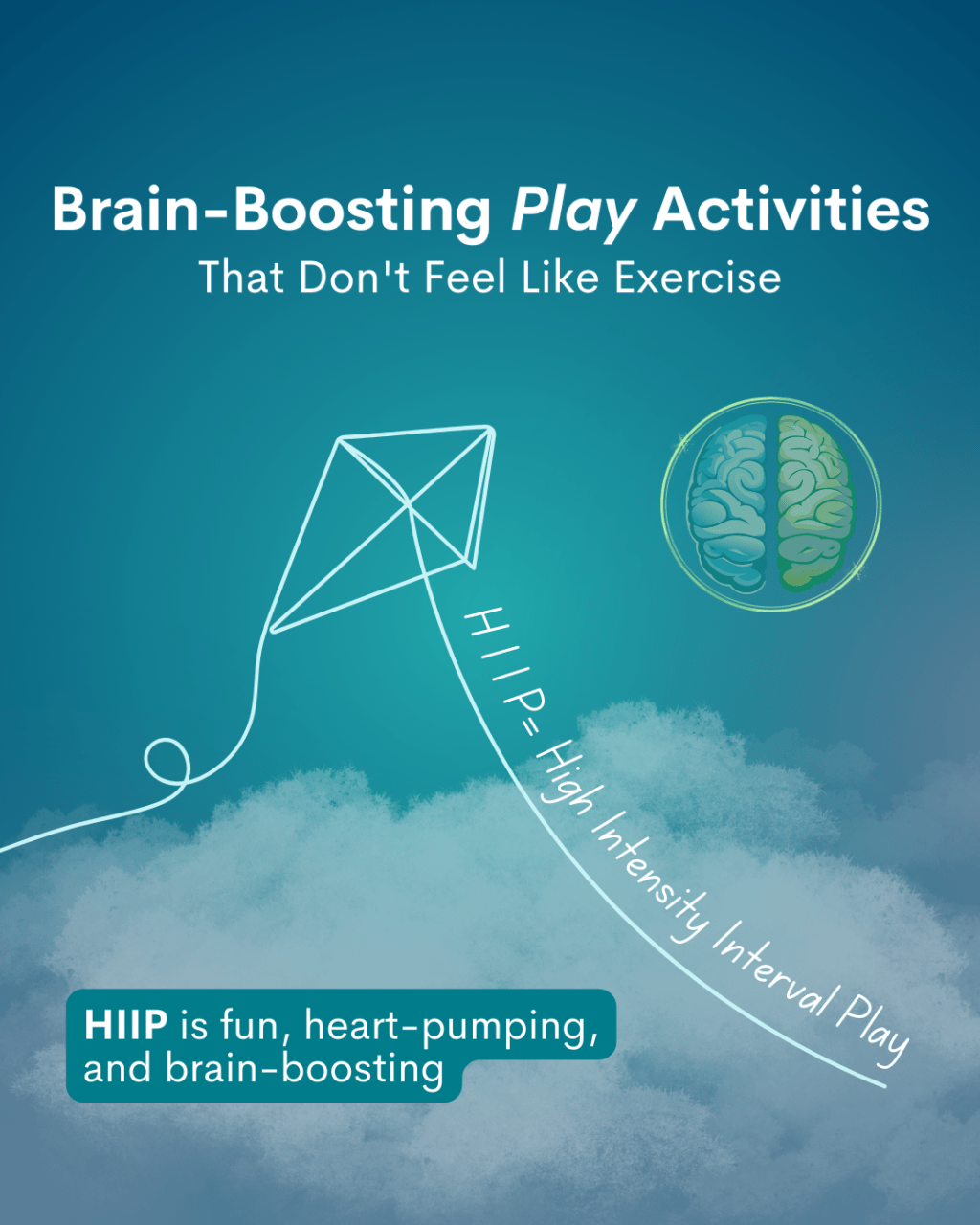
Recently, I decided to introduce my nieces to kite flying!
When I was growing up in Malaysia, my father used to take us kite flying on weekends.
My memory was of fun-filled times (and sometimes trying to dodge the lightning when a tropical storm unexpectedly descends!).
I was convinced that decades later I could still remember how to do it…and YES! I remembered how to fly a kite!! My late father would have been proud ☺️
It was great fun. Lots of laughter. I impressed my little nieces – reinforcing the fact that their aunty is really cool 😆
And bonus: I only realised afterwards, that it’s such a great high intensity interval workout too!
Running to get the kite airborne, quick sprints when the wind changes, and those big arm swings to keep the kite soaring – were all great for whole body physical fitness!
📍How High Intensity Interval Play: Benefits Your Brain
You’ve heard of “high intensity interval training” or “HIIT”.
But how about High Intensity Interval Play? HIIP? I just came up with that as I write this, but surely, I can’t be the first person to do so – I’m not that HIIP 🤣
Activities that don’t feel like “exercise” can deliver impressive brain health benefits while creating joy.
Research shows that intermittent bursts of activity—like the natural intervals that occur during play—can be particularly beneficial for brain health and longevity.
A fascinating study published in the British Journal of Sports Medicine* found that racket sports players had a 47% lower risk of all-cause mortality compared to sedentary individuals.
Here’s the mortality risk reduction based on activity type, compared to sedentary individuals:
Racket sports (including badminton, tennis, and squash): 47% reduction
Swimming: 28% reduction
Aerobics: 27% reduction
Cycling: 15% reduction
What makes racket sports special? They naturally incorporate intervals of high and low intensity, similar to many childhood games and activities like kite flying!
These playful intervals boost BDNF (Brain-Derived Neurotrophic Factor), often called “fertilizer for the brain,” supporting neuroplasticity and cognitive health.
Interval-based play also promotes vascular health and the delivery of oxygen and nutrients to your neurons while efficiently removing waste products.
These activities release endorphins that improve mood and reduce stress hormones like cortisol that can damage brain cells over time.
Play-based movement also strengthens the connections between your cerebellum (movement control center) and prefrontal cortex (decision-making area), improving executive function.
📍3 Brain-Boosting Play Activities That Don’t Feel Like Exercise
Here are three playful ways to get those beneficial intervals without feeling like you’re “working out”:
🌟1️⃣ Rediscover Childhood Games
Activities like tag, hopscotch, or flying kites naturally create interval patterns as you alternate between sprints and recovery.
The unpredictable nature of these games creates a different cognitive challenge than structured exercise, engaging your brain’s coordination and spatial awareness networks.
Try organizing a family game of tag or capture the flag, and notice how quickly your heart rate rises and falls, creating fun and natural intervals!
🌟2️⃣ Play Catch with a Twist
Grab a ball and play catch with friends or family, but with variations that create natural intervals.
The quick bursts of movement as you reach, jump, or run for the ball naturally create interval patterns that benefit your cardiovascular system.
This also builds hand-eye coordination, strengthening neural pathways between your visual cortex and motor regions!
🌟3️⃣ Hiking with Curiosity
The varied terrain of hills and valleys on a hiking trail can create the perfect interval training as your heart rate rises during climbs and recovers on descents.
Let curiosity guide you—pause to examine interesting plants, take photos of beautiful views, or search for wildlife. These natural pauses create the recovery periods that make interval training so effective.
Hiking in natural settings also reduces activity in brain regions associated with rumination while activating sensory processing areas—providing both physical benefits and a mental refresh!
📍Question for you today
Which of these three activities might you try this weekend, or what childhood game would you like to rediscover?
Wishing you playful HIPP moments!
Dr Sui Wong
*Reference: Oja P, Kelly P, Pedisic Z, et al. Associations of specific types of sports and exercise with all-cause and cardiovascular-disease mortality: a cohort study of 80,306 British adults. British Journal of Sports Medicine. 2017;51(10):812-817. doi:10.1136/bjsports-2016-096822
Dr Sui Wong
Spread the love! ❤️ Share this post with someone who will enjoy my Thursday Tips [TT].
If you received this as a forwarded link, please sign up to the [TT] newsletter via bit.ly/drwongbrainhealth
INSTAGRAM: drsuiwong.neurologist | LINKED IN: linkedin.com/in/dr-sui-wong-neurologist
My mission here is to share good quality, actionable information that empowers people to improve their brain health and wellbeing.
Thank you for your support!
 Dr Sui Wong Empowering Your Brain Health
Leave a comment