🌟[TT] Sips 🧠
Last week, we talked about “being ready is a decision”. Today, let’s talk about fluids!
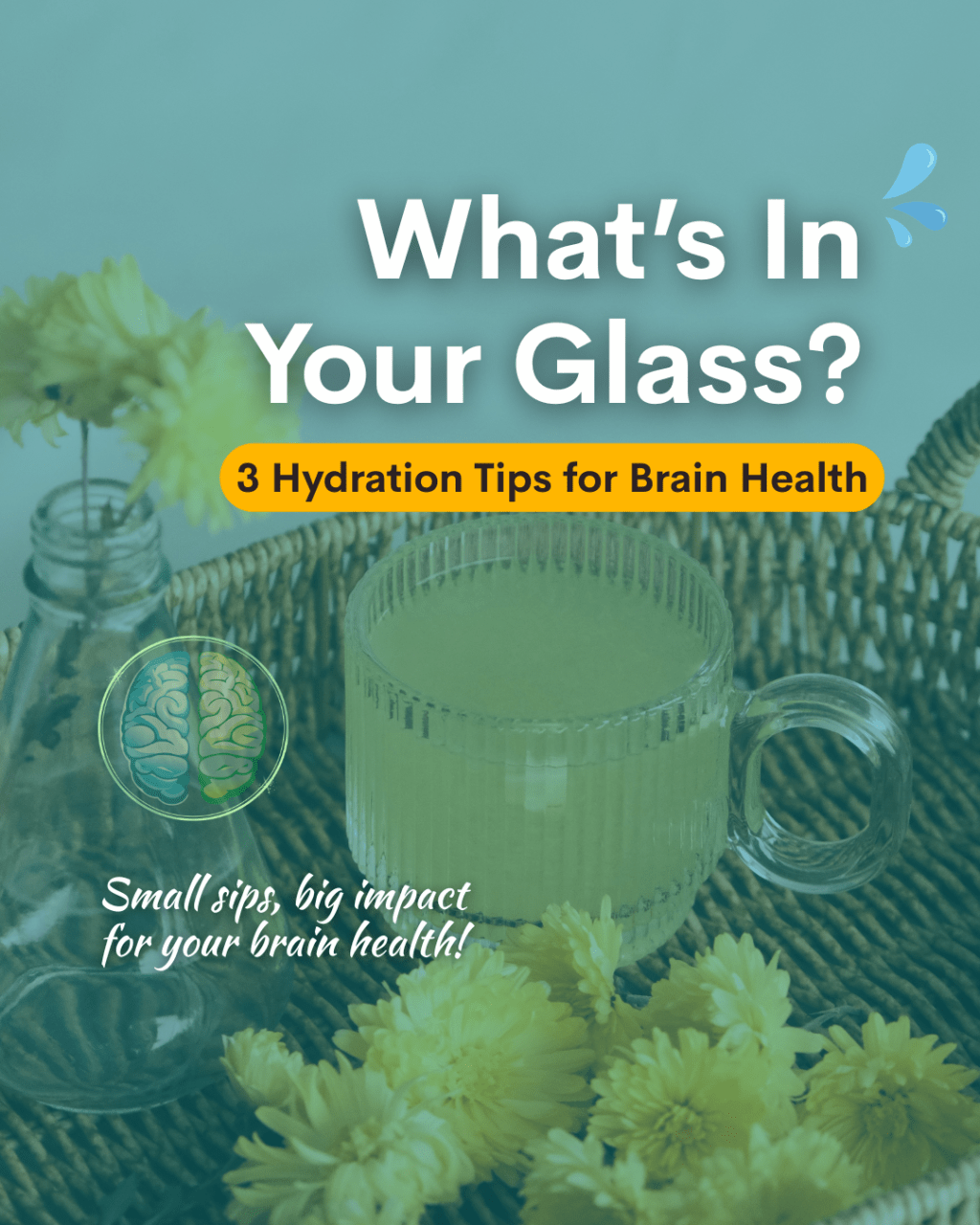
I recently got some dried chrysanthemum flowers and have been experimenting with a flask of chrysanthemum tea, alternating with my glass of filtered water.
And this got me thinking about how we hydrate.
What do you reach for?
Hydration is one of those quiet foundations for your brain: both easily overlooked, and easy to improve!
So my chrysanthemum flowers (finished now) inspired today’s Thursday Tips.
📍3 Ways to Hydrate for Your Brain
[1] Sip steadily, do not gulp
(BRA(i)NS® Method Pillar: Building Brain Resilience. Plus Optimisation, through habits)
Do you hydrate with sips throughout the day, or down a big glass at one go?
Steady sips keep your hydration levels topped up better than a big gulp at one go (though hydrate in whichever way is better than not!).
Think of watering a plant. A slow trickle soaks in, compared to a flood that runs off the surface.
I also love my glass water bottle, because visually seeing it at my desk reminds me to sip it. Also, doesn’t water taste better in glass than in plastic?! Strange but true for me 😀
[2] Match your drink to the time of day
(BRA(i)NS® Method Pillar: Building Brain Resilience, through sleep)
Caffeine in the afternoon lingers longer than most people think. So I lean towards caffeine-free options as the day winds down.
Chamomile, chrysanthemum, echinacea, red dates or goji berries. Those are the types of non-caffeinated teas I have at my desk.
Remember to ease off the volume an hour to two before bed, and hydrate during the day instead. Just so that you are not topping up the day’s dehydration in the evening, leading to a full bladder waking you in the night.
Side note: I learned this the hard way before I became aware of my daytime patterns when swamped during a busy clinical shift!
[3] Flavour it naturally
(BRA(i)NS® Method Pillar: Building Brain Resilience, under Nutrition and Nutrients)
Plain water can feel boring, and boring is why many people drift to sugary or artificially sweetened drinks instead.
Try this instead: a slice of orange or lemon, a few cucumber ribbons, mint leaves, or a couple of crushed berries. Not all at once of course!
Pick one of these to add to your water bottle, and see how that works for you.
📍The Brain Science Behind It
Your brain is quick to notice when water runs low.
Thirst is actually a late signal, not an early one. By the time you feel it, your brain has already been dehydrated.
A meta-analysis of 33 studies found that dehydration nudges down attention, executive function and motor coordination, with the clearest effects once fluid loss passes about 2% of body weight.*
So topping up steadily, before thirst arrives, keeps your focus on a more even keel.
📍Where this sits in the BRA(i)NS® Method
Hydration sits within the BRA(i)NS® Pillar of Building Brain Resilience, under the BRA(i)NS® principle of Nutrition and Nutrients. It is part of what you consume, and a quiet foundation for the rest.
A quick summary for those new to the Thursday Tips Tribe (welcome!) – the BRA(i)NS® Method has Purpose and Meaning as its container, with three pillars inside:
Building Brain Resilience covers your physical foundations.
Balancing the Autonomic Nervous System covers your stress and relaxation responses.
Optimisation pulls these together through mindset, habits and community.
All this is individualised to you, giving the (i) in BRA(i)NS®.
So hydration feeds your physical foundations, supporting your sleep and your metabolic health (and more, but let’s keep [TT] bitesized!). The visible bottle and the steady sips are an Optimisation move, a habit made easy. And the (i) for individualisation fits too. How much you need shifts with your body, your climate and how active you are. There is no single number for everyone.
📍Question for you today
What is in your glass right now? And is there one small swap you would make this week?
I love it when people reply. It comes straight to my inbox and I will message you back.
Wishing you steady sips and a clear head,
Dr Sui Wong
PS – that young millennial I mentioned last week? Turns out I got it wrong. He is actually Gen Z! Ah, so many things I learn from the younger generation. And not just how to play FIFA from my nephew. Lots of joy there, too!
*Reference:
Wittbrodt & Millard-Stafford 2018 https://pubmed.ncbi.nlm.nih.gov/29933347/
📌 Summary
Hydration is one of the quiet foundations of brain health, yet it is often overlooked. Small habits like sipping steadily throughout the day, choosing caffeine-free drinks in the evening, and naturally flavouring water can support attention, executive function, sleep, and metabolic health. Research shows that even mild dehydration can reduce focus and coordination, making regular hydration an important part of building brain resilience. Through the BRA(i)NS® Method, hydration becomes not just about water intake, but about creating sustainable, personalised habits that support long-term brain health.
❓ FAQ (SEO-Optimised)
- Why is hydration important for brain health?
Your brain is highly sensitive to dehydration. Even mild fluid loss can affect attention, executive function, mood, and coordination. - Is sipping water throughout the day better than drinking large amounts at once?
Steady sipping may help maintain more consistent hydration levels throughout the day compared to occasional large gulps. - Can caffeine affect sleep and brain health?
Yes. Caffeine can stay in the system for longer than many people realise, which is why caffeine-free options are often better later in the day.
Books: available where all good books are sold, in print, eBook and audiobook formats. LEARN MORE: Mindfulness for Brain Health , Break Free From Migraines Naturally, Sleep Better to Thrive, Quit Ultra-Processed Foods Now, Sweet Spot for Brain Health, Magnesium: Restore & Revitalize Your Brain & Body
My mission:
To inspire a movement for better brain health.
Because better brain health supports better wellbeing. And better wellbeing creates a ripple effect that benefits individuals, families, communities, and beyond.
Making the world a better place for all.
I am a practising medical doctor (MBBS MD FRCP MA FHEA DipIBLM) working as a Neurologist and Neuro-Ophthalmologist, and am an active neuroscience researcher. My research is inspired by questions arising from my busy clinical practice, and I am grateful that both have been recognised with awards.
I am also an Author and Speaker, creating public-facing health content in my spare time.
Learn more:
drsuiwongmd.com
Join me on my mission?
>> Spread the love! ❤️ Share this email with someone who will enjoy my Thursday Tips [TT] newsletter.
>> Follow me on:
INSTAGRAM: drsuiwong.neurologist | LINKED IN: linkedin.com/in/dr-sui-wong-neurologist | YouTube: http://www.YouTube.com/@DrSuiWong
If you received this as a forwarded link, please sign up to the [TT] newsletter via bit.ly/drwongbrainhealth
Thank you for your support!
(C) 2024-2026 Dr Sui H. Wong MD FRCP


Leave a Reply