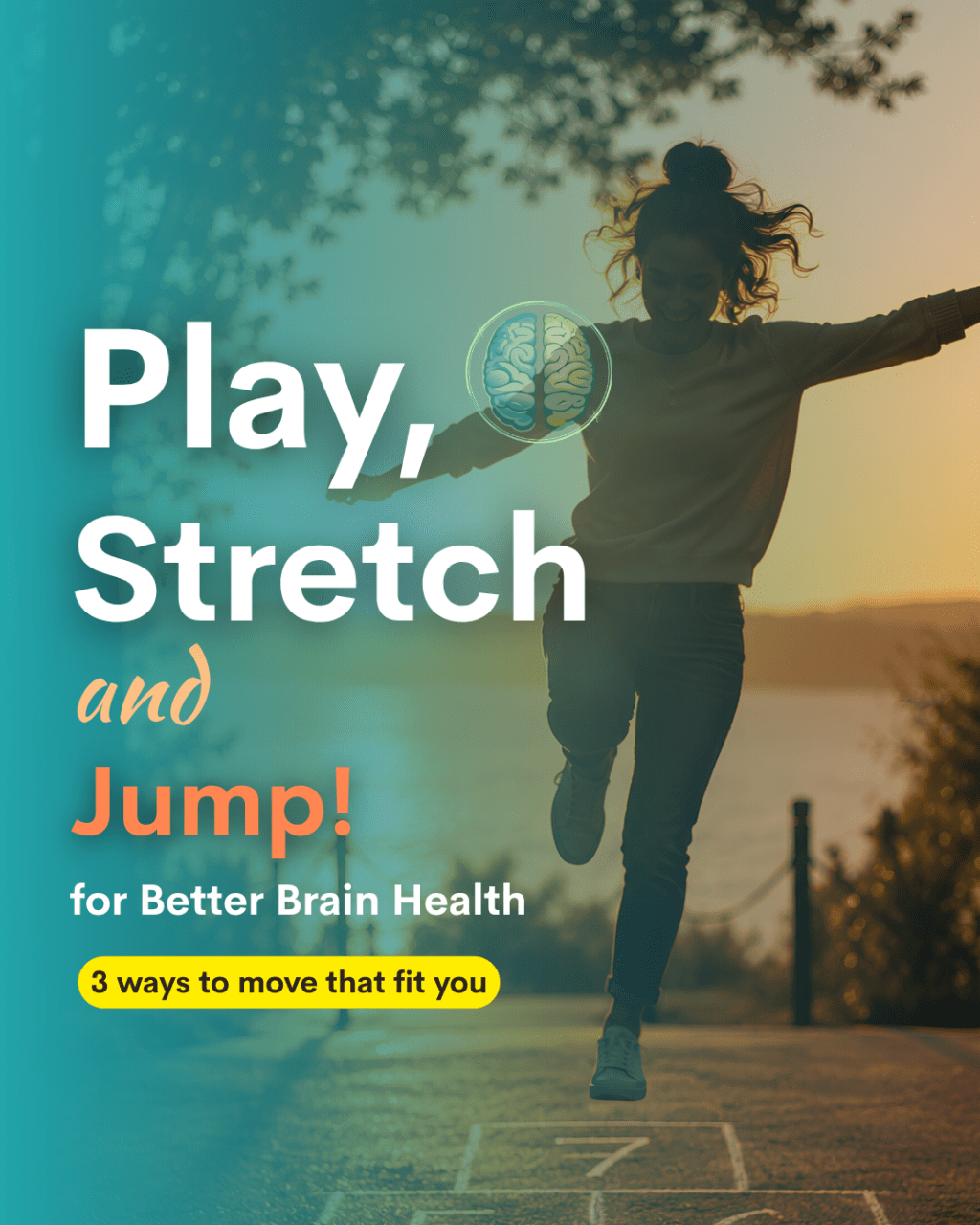
🌟[TT] Hopscotch 🧠
A while back I wrote to you about high intensity interval training (HIIT), and how they can be good for your brain. (If you want to read that post, just reply and I’ll send you the link.)
But you know what? I don’t really do them, because I think I’m too “lazy”! I do like the idea of HIITs, but I need a bit of motivation…
And I found a “hack”! 🤣🪁
Let me share more…
A couple of weeks ago, I was playing tag with my two nieces.
They decided to do it as a race between me and each of them in turn, which inadvertently meant lots of HIIT reps for me. And best of all, lots of laughter!
So, today’s Thursday Tips newsletter is inspired by my two cute nieces.
And no, don’t worry, today’s [TT] is not about doing HIIT! 🤣 It’s about how to adapt evidence from physical activity to be individualised to you.
📍 Three ways to move that fit you, for your brain health
[1] Play, don’t train
As I write this newsletter, I find myself thinking about a study I quoted in a Thursday Tips in November 2025. Hotel housekeepers who were told that their work counted as exercise benefiting their health showed improvements in blood pressure and weight, compared with a group who weren’t told that, though neither group changed what they actually did.*
So let’s extrapolate from that (admittedly non-replicated) study. What if you viewed playing with your kids as physical activity? Like the story I shared above.
Or you could deliberately choose a form of physical activity that is actually playing! Like racket sports.
Try this: pick one thing this week, first think of something that involves physical activity, and next think of how you can make it fun or play! You can start it as something more gentle (e.g. make up a speedy game of tidying up after dinner) rather than playing tag. Be creative and have fun with this! ☺️
[2] Stretch after eating, and again before bed
This one is for those of you who prefer to start gentler, or who have a physical limitation.
Do some stretching after eating and again before bed.
This is also a lovely one to bring in some mindful moment awareness of your gentle breath and the sensation of stretching.
Doing this helps in a few ways. It may improve your blood sugar (well, in studies of people with type 2 diabetes). And in my experience as a yoga and mindfulness teacher, it’s a gentle wind down that helps sleep.
Try this: a 5 minute leg stretches after dinner, and again as you get ready for bed.
[3] Jump!
This one is for those with the physical ability to do this; you might have to prepare your body if you’re usually sedentary (by choice or not), or if you’re in midlife. I’ve put this down as tip number 3 today, as it was a surprise to me.
Did you know that jumping is a great way to build bone strength? Bone strength matters because in older age, a fall that breaks a bone carries a high risk of poor outcomes.
Remember to warm up well first (particularly if you’re in midlife or are usually sedentary) to minimise the risk of Achilles tendon rupture. If unsure, please speak with a physio or sports specialist.
Do ten jumps with a short pause between each, landing softly with your knees bent.
Oh, and if you saw my social media post about standing on one leg as a measure of brain health, you can do single-leg jumps to aid your bone strength too!
Try this: do ten jumps today, and if that feels good, try jumping single-legged! Anyone up for a childhood game of hopscotch? ☺️
📍 The brain science behind it*
Racket sports? Not all activity is equal, at least not in the observational data. In a study of 80,000 British adults, racket sports, swimming and aerobics were each associated with lower all-cause mortality, while running and football were not. I read it as a nudge towards varied, whole-body movement rather than proof that one sport beats another.
Intensity is what your brain notices: A meta-analysis in healthy young adults found that high-intensity exercise produced an immediate rise in circulating brain-derived neurotrophic factor (BDNF), a protein involved in neuroplasticity, compared with rest or light activity. The limitation: it was measured in young adults, and blood BDNF is a peripheral marker, not a direct reading of what’s happening in your brain.
Stretching does something to blood sugar, indeed! A 2024 research paper pooling 13 studies across 731 people with type 2 diabetes or at raised risk of it found reductions in blood glucose and HbA1c (a marker of blood sugar control) after stretching interventions. I think this is a nice nudge to treat stretching as a useful addition on the days you can’t take a stroll after a meal, but not as a replacement for aerobic activity.
Jumping and bones? In premenopausal women aged 25 to 50, ten or twenty jumps twice daily for sixteen weeks improved hip bone mineral density compared with controls. In men aged 65 to 80, brief daily hopping on one leg over twelve months increased bone density in that leg compared with the other. Small studies but the signal is there.
📍 Where this sits in the BRA(i)NS® Method
Physical activity is a principle within Building Brain Resilience, and the bedtime version of tip two reaches across into Balancing the Autonomic Nervous System.
For those new to the Thursday Tips Tribe, a quick recap. The BRA(i)NS® Method has Purpose and Meaning as its container, with three pillars inside:
= Building Brain Resilience: your physical foundations.
= Balancing the Autonomic Nervous System: your stress and relaxation responses.
= Optimisation: mindset, habits and community.
All of it individualised to you, giving the (i) in BRA(i)NS®.
Movement sits in all three at once. The activity itself is Building Brain Resilience. A slow stretch with your attention on the breath is Balancing the Autonomic Nervous System. And choosing the version you’ll actually repeat, rather than the version that looks best on paper, is Optimisation. Which movement? That’s the individualisation (i) piece.
📍 Question for you today
Which of these 3 tips are you most inspired to do this week?
I’d love to hear from you. If you reply to this email, it comes straight to me, and I reply to all feedback from the Thursday Tips Tribe. Thank you for being here!
Wishing you fun, play and movement,
Dr Sui Wong
PS: Reminder again for the jumping tip number 3: please check with your doctor first if you have known osteoporosis, a previous fragility fracture, a joint replacement, significant knee or hip pain, or pelvic floor symptoms. High impact is not right for everyone, and there are lower-impact alternatives.
*References:
- Crum & Langer (2007) https://pubmed.ncbi.nlm.nih.gov/17425538/
- Oja et al (2017) https://pubmed.ncbi.nlm.nih.gov/27895075/
- Fernández-Rodríguez et al (2022), https://pubmed.ncbi.nlm.nih.gov/34481089/
- Thomas et al (2024) https://pubmed.ncbi.nlm.nih.gov/38334888/
- Tucker et al (2015) https://pubmed.ncbi.nlm.nih.gov/24460005/
- Allison et al (2013) https://pubmed.ncbi.nlm.nih.gov/23291565/
Single-leg standing test previously shared on social media:

📌 Summary
Movement doesn’t have to look like a tough workout to benefit your brain. Inspired by a playful afternoon chasing her nieces, Dr Sui Wong explores how enjoyable, sustainable movement can support brain health. From turning activity into play and adding gentle stretches to your day, to the surprising benefits of jumping for bone strength, these practical tips show how finding movement that fits your life is more important than following the perfect exercise plan.
❓ FAQ
Does exercise have to be intense to benefit brain health?
Not always. While higher-intensity exercise can increase brain-derived neurotrophic factor (BDNF), regular movement that you enjoy is more likely to become a lasting habit and support long-term brain health.
Can stretching improve health?
Stretching may help improve flexibility, support relaxation, and, in some people, contribute to better blood sugar regulation. It can also be a calming way to prepare for sleep.
Why is jumping good for healthy ageing?
Jumping places healthy stress on bones, which can help maintain bone density and reduce the risk of fractures as we age. It should be introduced gradually and may not be suitable for everyone.
My mission:
To inspire a movement for better brain health.
Because better brain health supports better wellbeing. And better wellbeing creates a ripple effect that benefits individuals, families, communities, and beyond. Making the world a better place for all. And it all starts with you as the individual.
I am a practising medical doctor (MBBS MD FRCP MA FHEA DipIBLM) working as a Neurologist and Neuro-Ophthalmologist, and am an active neuroscience researcher. My research is inspired by questions arising from my busy clinical practice, and I am grateful that both have been recognised with awards.
I am also an Author and Speaker, creating public-facing health content in my spare time.
Learn more:
drsuiwongmd.com
>> Join the Brain Health Movement: Share this email with someone who will enjoy my content. See link to socials below
>> Follow me on:
INSTAGRAM: drsuiwong.neurologist | LINKED IN: linkedin.com/in/dr-sui-wong-neurologist | YouTube: http://www.YouTube.com/@DrSuiWong
If you received this as a forwarded link, please sign up to the [TT] newsletter via bit.ly/drwongbrainhealth
Thank you for your support!
Books: available where all good books are sold, in print, eBook and audiobook formats. LEARN MORE: Mindfulness for Brain Health , Break Free From Migraines Naturally, Sleep Better to Thrive, Quit Ultra-Processed Foods Now, Sweet Spot for Brain Health, Magnesium: Restore & Revitalize Your Brain & Body
NEW BOOK COMING SOON!
To be on the priority notification list and receive bonuses during the promotional period, sign up here: brainsbooklaunch.com
Sleep Anchor Method®
Audioguide Series with Dr Sui Wong [learn more]
AI tool trained on Dr Sui Wong’s Sleep Anchor Method® to create a personalised, downloadable tracker, and a companion Chatbot for troubleshooting & questions [learn more]
Other Resources:
Brain Health Podcast with Dr Sui Wong, link: brainhealth.fm
The BRA(i)NS® Clarity Community, [click here for free access]
Read my past Thursday Tips posts on drsuiwongmd.blog
If you received this as a forwarded email, please sign up for the [TT] newsletter via drwongbrainhealth.com
Apply for my next intake of the Peak Performance Brain Lab (PPBL) Mentorship: request by email
(C) 2024-2026 Dr Sui H. Wong MD FRCP


Leave a Reply