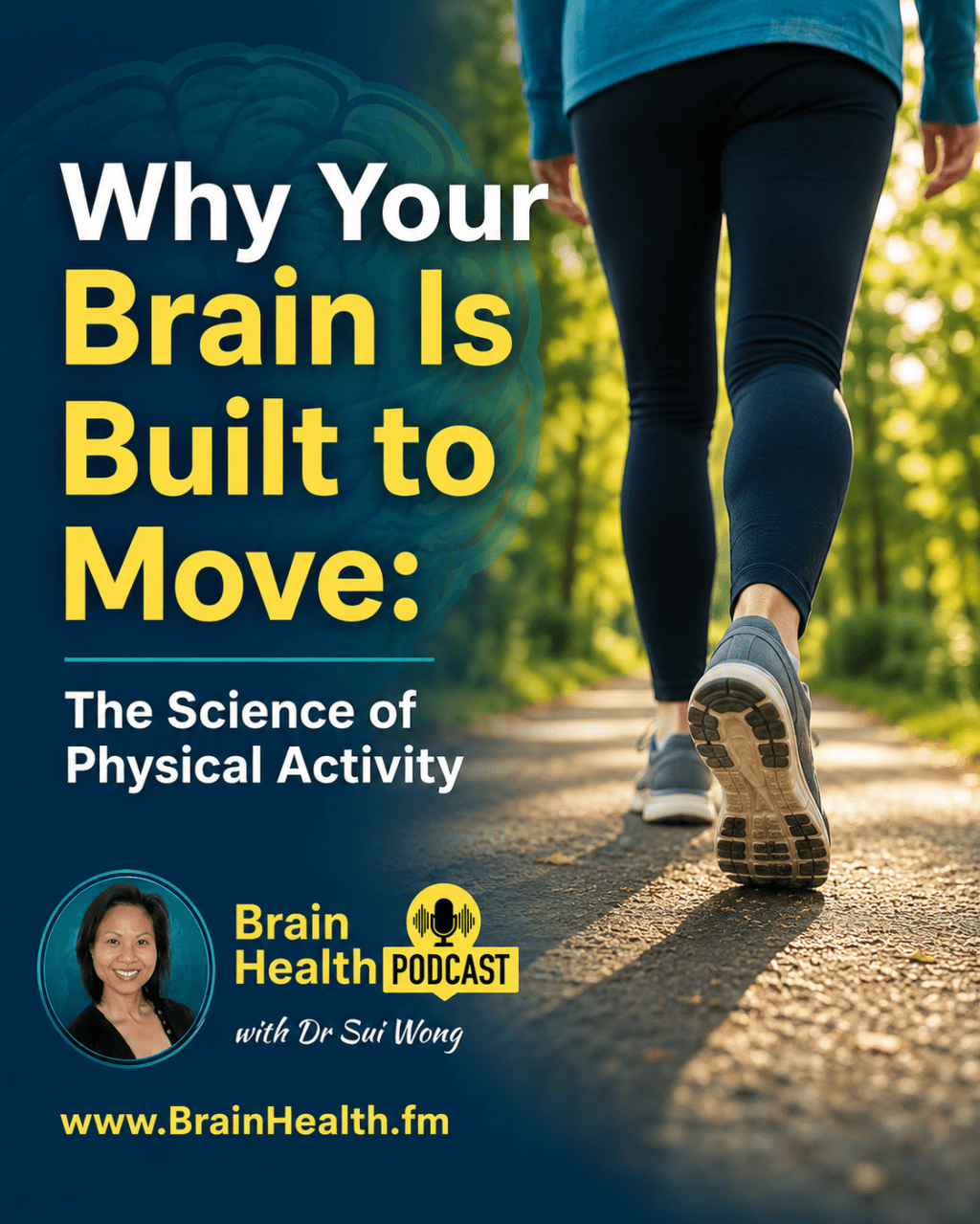
Movement isn’t a luxury for the brain. It’s how the brain stays sharp, plastic and protected.
Our brains evolved while we were on the move, walking, gathering, every single day. The sedentary, screen-bound life most of us lead now is, in evolutionary terms, very recent indeed. So your brain is, in a sense, expecting you to move. And it rewards you generously when you do.
Physical activity is one of the principles within the BR pillar, Building Brain Resilience, of my BRA(i)NS® Method. Here’s what each kind of movement is actually doing inside your head.
📍Every movement counts (start with your NEAT)
Before the structured exercise, look at your NEAT: non-exercise activity thermogenesis. These are the small, incidental movements scattered through your day.
It matters more than people realise. Sitting for long, unbroken stretches appears to harm the brain and body somewhat independently of how much formal exercise you do. Long uninterrupted sitting can reduce blood flow, dampen insulin sensitivity (your blood sugar regulation), and shift your metabolism in unhelpful ways.
The flip side is encouraging. Breaking up sitting with little movements, standing up, walking to fill your water glass, taking the stairs, acts as a series of small resets through the day. Every movement counts, and they compound.
📍The Five Types of Movement, and What Each Does for Your Brain
[1] Cardio, the heart-rate-raising kind
When you move briskly, blood flow to your brain increases, delivering more oxygen and nutrients.
Over time, regular cardio may promote the growth of new blood vessels through a signalling molecule called VEGF (vascular endothelial growth factor). It also boosts BDNF, brain-derived neurotrophic factor, sometimes nicknamed brain fertiliser, which helps your brain cells form new connections and supports your hippocampus, the brain’s memory hub.
A now-classic study found that older adults who walked regularly for a year increased the size of their hippocampus by about 2% in a region that normally shrinks slowly with age.*
Cardio may also support your brain’s waste-clearance system, the glymphatic system. One human study found that 12 weeks of regular cycling improved glymphatic flow.*
There’s a lovely twist here too. The lactate your muscles produce during exercise can be taken up by the brain like a premium fuel, not just metabolic waste, but something that may actively support your neurons.
Try: A brisk walk around your neighbourhood, a bike ride, or any activity that gently raises your heart rate can help support blood flow to the brain. The goal isn’t perfection, it’s finding a form of movement you can do consistently.
[2] Strength, Underrated but So Important
When your muscles work against resistance, they release signalling molecules called myokines. It’s worth thinking of muscle as a kind of endocrine organ, one that releases hormones. Some of these myokines may cross from the muscle into the brain and support BDNF and neuroplasticity.
Strength training also improves insulin sensitivity, which supports your metabolic health, and that protects your brain too.
Try: Consider adding simple strength exercises into your week, whether that’s resistance bands, bodyweight exercises, gardening, or carrying groceries. Small amounts of resistance training can have benefits beyond muscle health alone.
[3] Balance, Far More Than Fall Prevention
Balance engages your cerebellum and your proprioception circuit, the system that tells your body where it is in space and asks your brain to integrate sensory input rapidly. That’s excellent brain exercise in its own right. And protecting yourself from falls in later life protects your brain as well.
Try: Balance can be practised in simple ways throughout the day. Standing on one leg while brushing your teeth or choosing activities that challenge coordination can help keep these important brain-body pathways active.
[4] Flexibility, Gentle but Doing Double Duty
Gentle stretching may not sound like brain training, but it can nudge you towards your parasympathetic nervous system, your rest-and-digest mode, which is exactly why it tends to feel so calming.
A little tip: stretch to the point where you can feel the stretch, not to the point of pain. So stretching does double duty, caring for your body and your nervous system at once.
Try: Spend a few minutes stretching each day, aiming for the point where you can feel the stretch but not pain. Gentle stretching can support both physical comfort and nervous system regulation.
[5] Mindful Movement, Both Layers at the Same Time
This is where the BRA(i)NS Method principle of physical activity overlaps beautifully with the ANS pillar, Balancing the Autonomic Nervous System.
Move with awareness: a walk without headphones, a slow Tai Chi or yoga sequence, mindful walking. These combine the physical benefits of movement with the calming effects of present-moment attention. You get both layers at once.
Try: Take a walk without headphones, try a gentle yoga session, or explore Tai Chi. Moving with awareness allows you to benefit from both physical activity and present-moment attention at the same time.
📍What about how movement makes you feel?
This is the most immediate part of the story, and often the most motivating.
The moment you start moving, your brain releases dopamine, serotonin and noradrenaline, the same chemical messengers that many antidepressant medications act on. That’s why even a 10-minute brisk walk can lift your mood, sharpen your focus and ease a frustrating moment. It’s one of the most reliable resets we have when a day feels stuck.
Over time, regular movement also builds your stress resilience and your executive function, the part of the brain that helps you plan, decide and stay on task.
And there’s a longer-term picture. A large meta-analysis of long-term studies found that people who are regularly physically active have about an 18% lower risk of dementia compared with those who aren’t.* That’s a striking effect for something free and available to most of us.
Other research suggests walking can boost creative thinking by around 60%.* Which may be why so many thinkers, from philosophers to CEOs, have done their best thinking on foot.
A note on the science: many of the long-term dementia studies are observational, so they show strong associations rather than absolute proof. But the consistency across studies, populations and biological mechanisms is remarkable.
📍 It’s All Woven Together
This principle threads tightly into all the others. Movement supports your sleep, partly by helping reset your circadian rhythm and partly through that same glymphatic clearance. It works hand in hand with your blood sugar by pulling glucose into your muscles. It feeds your mood, your stress response and your mindfulness practice. Even your gut microbiome appears to benefit.
So when you move, you’re not looking after one thing, you’re recharging several systems at once.
📍 The Hopeful Part: Your Brain Stays Responsive at Any Age
The hippocampus study was in older adults; the glymphatic study was in healthy volunteers. These benefits aren’t reserved for the young or the already-fit.
You don’t need to do all five types at once, or hit any particular target. You begin where you are, and let consistency build. As I always say: movement creates motivation, not the other way around.
In my own clinical practice, I see this constantly. People who assumed movement meant the gym discover that walking to a friend’s house, taking the stairs at work, or 15 minutes of morning stretching is already changing how they feel, sleep and think. I see how simply increasing daily NEAT leads to a walking habit, which then becomes the lever that moves every other brain-healthy habit.
Every kind of movement, from the smallest NEAT through to cardio, strength, balance, flexibility and mindful movement, is doing real, measurable work for your brain.
So begin where you are, and let it build.
📍 Question for You Today
What kind of movement do you enjoy most?
Have you noticed a difference in your mood, focus, sleep, or energy levels when you move regularly?
I’d love to hear your thoughts in the comments below.
Wishing you a brain-healthy week ahead,
Dr Sui Wong
Prefer to Hear It in My Voice?
This is the written companion to Episode 19 of the Brain Health Podcast, Movement Isn’t a Luxury for the Brain, and offers a sneak peek of the content I’m recording for my Peak Performance Brain Lab mentorship. There are a few extra thoughts and reflections in the audio that didn’t make it onto the page.
Have a listen here: https://app.hiro.fm/products/68d764f5bc1a64002830b721/episodes/6a1fe503d21f14001c0dc0ff
Want consistent energy and focus? My free Thursday Tips are brain-performance tips delivered weekly. Sign up at drwongbrainhealth.com
This article is educational and not medical advice. If you have a health condition or any concerns, please speak with your own doctor before making significant changes to your activity levels.
References:
- Erickson KI, Voss MW, Prakash RS, et al. (2011). Exercise training increases size of hippocampus and improves memory. Proceedings of the National Academy of Sciences, 108(7), 3017–3022. DOI: 10.1073/pnas.1015950108 https://pubmed.ncbi.nlm.nih.gov/21282661/
- Yoon J-H, et al. (2025). Long-term physical exercise facilitates putative glymphatic and meningeal lymphatic vessel flow in humans. Nature Communications, 16, 3360. DOI: 10.1038/s41467-025-58726-1 https://pmc.ncbi.nlm.nih.gov/articles/PMC12221947/
- Blondell SJ, Hammersley-Mather R, Veerman JL. (2014). Does physical activity prevent cognitive decline and dementia? A systematic review and meta-analysis of longitudinal studies. BMC Public Health, 14, 510. DOI: 10.1186/1471-2458-14-510 (PMID: 24885250) https://pubmed.ncbi.nlm.nih.gov/24885250/
- Oppezzo M, Schwartz DL. (2014). Give your ideas some legs: The positive effect of walking on creative thinking. Journal of Experimental Psychology: Learning, Memory, and
Cognition, 40(4), 1142–1152. DOI: 10.1037/a0036577 https://pmc.ncbi.nlm.nih.gov/articles/PMC12764636/
📌 Summary
Movement isn’t just about physical fitness. It’s one of the most powerful ways to support brain health. Regular movement helps increase blood flow to the brain, supports memory and learning, improves mood, strengthens stress resilience, and may reduce the risk of cognitive decline. From the small movements that make up your daily NEAT to cardio, strength training, balance work, flexibility, and mindful movement, every type of movement offers unique benefits. The good news is that you don’t need to be an athlete to experience these effects. Small, consistent actions can make a meaningful difference to how you think, feel, and function every day.
❓ FAQ
What are default behaviours?
Default behaviours are the automatic actions, habits, or thought patterns we fall back on when we’re tired, stressed, or distracted.
Why does the brain rely on defaults?
Deliberate decision-making requires more energy. When resources are low, the brain often chooses familiar habits because they require less effort.
Can default habits be changed?
Yes. Repetition helps build new habits, making healthier choices easier and more automatic over time.
Why is self-compassion important when changing habits?
Research suggests that responding to setbacks with self-compassion can increase motivation and support future behaviour change.Q: What type of exercise is best for brain health?
There isn’t a single “best” type of exercise. Cardio, strength training, balance exercises, flexibility work, and mindful movement all support brain health in different ways. A combination of these movement types provides the broadest range of benefits.
Q: How much movement do I need to support my brain?
The most important thing is consistency. Even small amounts of movement throughout the day can be beneficial. Breaking up long periods of sitting, taking regular walks, and finding activities you enjoy are excellent places to start.
Q: Can movement really improve memory and thinking?
Research suggests that regular physical activity supports brain plasticity, memory, attention, and executive function. Movement increases blood flow to the brain and may help strengthen the connections between brain cells that support learning and cognitive performance.
Q: Is it too late to start if I’m older or haven’t exercised for years?
Not at all. The brain remains responsive to movement throughout life. Studies have shown benefits in older adults, and it’s never too late to start building healthier habits. Begin where you are and focus on making movement a regular part of your routine.
Q: Do I need a gym membership to improve brain health?
No. Walking, taking the stairs, gardening, stretching, yoga, Tai Chi, and other everyday activities can all contribute to better brain health. What matters most is moving regularly in ways that work for you.
Books: available where all good books are sold, in print, eBook and audiobook formats. LEARN MORE: Mindfulness for Brain Health , Break Free From Migraines Naturally, Sleep Better to Thrive, Quit Ultra-Processed Foods Now, Sweet Spot for Brain Health, Magnesium: Restore & Revitalize Your Brain & Body
My mission:
To inspire a movement for better brain health.
Because better brain health supports better wellbeing. And better wellbeing creates a ripple effect that benefits individuals, families, communities, and beyond.
Making the world a better place for all.
I am a practising medical doctor (MBBS MD FRCP MA FHEA DipIBLM) working as a Neurologist and Neuro-Ophthalmologist, and am an active neuroscience researcher. My research is inspired by questions arising from my busy clinical practice, and I am grateful that both have been recognised with awards.
I am also an Author and Speaker, creating public-facing health content in my spare time.
Learn more:
drsuiwongmd.com
>> Follow me on:
INSTAGRAM: drsuiwong.neurologist | LINKED IN: linkedin.com/in/dr-sui-wong-neurologist | YouTube: http://www.YouTube.com/@DrSuiWong
If you received this as a forwarded link, please sign up to the [TT] newsletter via bit.ly/drwongbrainhealth
Thank you for your support!
(C) 2024-2026 Dr Sui H. Wong MD FRCP


Leave a Reply